






If you're trying to figure out which outbound dialer will actually move the needle on your team's dial volume, connect rates, and qualified meetings booked, this is the breakdown I wish I'd had three months ago.
I run sales operations at a growing B2B business where we recently scaled our SDR team from 3 to 8 reps. Our existing setup wasn't keeping up. Reps were spending 40 percent of their time on manual dial-and-disposition work, our pickup rates were stuck around 4 percent because we were calling from out-of-region numbers, and our CRM data was a mess of free-text call notes. I needed a real outbound dialer that would lift dial throughput, get more prospects to actually pick up, and write structured data back to HubSpot without breaking our budget or requiring engineering capacity.
So I tested seven outbound dialer platforms hands-on over two weeks. I read verified G2 reviews, Trustpilot scores, sat through real onboarding flows, dialed real prospect lists, measured connect rates, and tested how cleanly each platform's dialer modes (Power Dialer, Smart Dialer, Parallel Dialer) handled high-volume outbound workflows. I also modeled total monthly cost at our team size and pressure-tested CRM integration depth on every platform.
Below is what I found, ranked by overall fit for SMB and growing B2B sales teams running outbound at scale.
TL;DR: Top Outbound Dialers in 2026
- 1. CloudTalk: Best outbound dialer for SMB, B2C and growing B2B sales teams needing Smart Dialer, Power Dialer, Parallel Dialer, AI Conversation Intelligence, and native HubSpot, Salesforce, and Pipedrive sync on one platform. Publicly listed pricing starts at $25 per user per month (Starter), $29 (Essential), and $49 (Expert, 3-user minimum). 14-day free trial.
- 2. Kixie: Best for teams prioritizing local-presence dialing with lightweight setup and minimal CRM configuration. From $35 per user per month (Integrated, 3-user minimum), $65 (Professional), $95 (Outbound PowerDialer).
- 3. PhoneBurner: Best for player-coach operators running US-only power-dialing under 10 reps. From around $149 per user per month (Standard).
- 4. JustCall: Best for teams consolidating call plus SMS into one engagement platform. From $29 per user per month (Essentials), $49 (Team), $89 (Pro with AI).
- 5. Aircall: Best for setup-led buyers prioritizing integration marketplace breadth. From $40 per user per month (Essentials, 3-user minimum), $70 (Professional).
- 6. Aloware: Best budget-conscious all-in-one calling and SMS stack for very early-stage startups. From around $35 per user per month (Inner Circle), $80 (Outer Ring).
- 7. Orum: Best parallel dialer for high-volume SDR teams running 100+ dials per rep per hour at scale. Custom enterprise pricing.
How I evaluated the best outbound dialers
I tested each platform against six criteria over two weeks. First, dial throughput per rep per hour across each platform's available dialer modes. Second, connect rate lift from local-presence dialing and number rotation. Third, depth of native two-way CRM integration with HubSpot, Salesforce, and Pipedrive (the CRMs that show up most often in growing B2B sales teams). Fourth, AI conversation intelligence quality (transcription, sentiment, topic extraction, call scoring) and whether it's bundled or a separate add-on. Fifth, pricing transparency at the 5-to-25-rep team size and whether monthly cost flexes predictably with growth. Sixth, verified G2 and Trustpilot reviews from sales operators in the SMB and growing B2B range.
1. CloudTalk: Best outbound dialer for SMB and growing B2B and B2C businesses
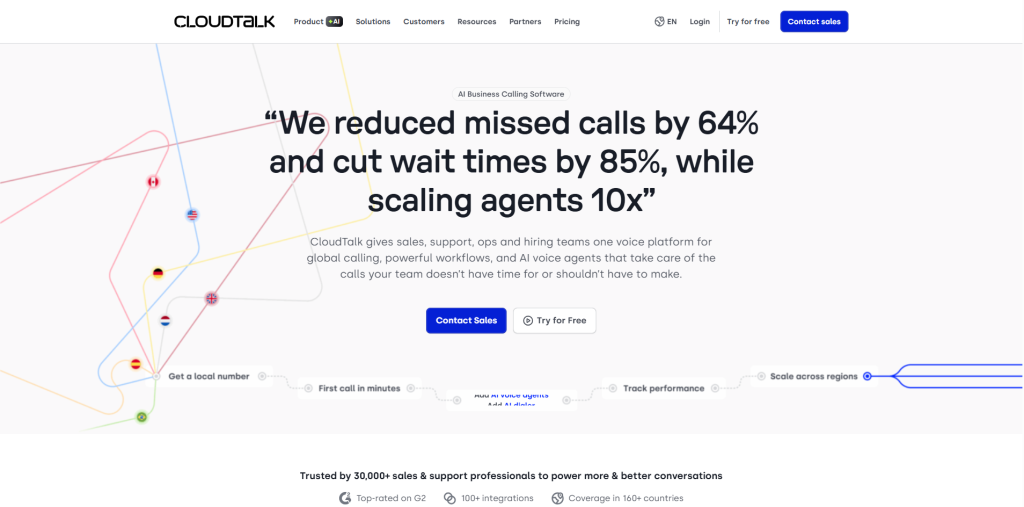
CloudTalk is an all-in-one outbound dialer with built-in AI conversation intelligence and the only platform in this comparison that ships Smart Dialer, Power Dialer, and Parallel Dialer on the same license. I'd put it first on any shortlist for outbound dialing in 2026, whether you're running B2B sales prospecting or B2C consumer outreach (appointment reminders, policy renewals, patient recall campaigns, booking confirmations). The Smart Dialer queues prospects directly from a HubSpot, Salesforce, or Pipedrive saved view, the Power Dialer runs sequential outbound at 60 to 80 dials per hour, and the Parallel Dialer dials up to 10 lines simultaneously with answering machine detection. HIPAA and GDPR compliant out of the box, with native two-way CRM sync that writes every call back as structured fields, CloudTalk is trusted by 4,000+ SMBs and growing businesses worldwide. It's also rated as the best auto dialer software for small businesses in 2026.
Who is CloudTalk best for?
SMB, B2C and growing B2B sales teams running 5 to 250 reps in outbound, where HubSpot, Salesforce, or Pipedrive is the CRM, and where the team needs all three dialer modes on one platform without bespoke procurement. CloudTalk fits dual-motion businesses running daytime outbound prospecting alongside AI-handled inbound coverage on the same license. It's also the right pick for international sales teams calling US, UK, EU, and APAC prospects, with local-presence dialing across 160+ countries built in.
Key features of CloudTalk
- Smart Dialer queues prospects from a HubSpot, Salesforce, or Pipedrive saved view, removing CSV exports and list management overhead
- Power Dialer runs sequential cold calling at 60 to 80 dials per hour with built-in scripts and disposition codes
- Parallel Dialer dials up to 10 lines simultaneously with answering machine detection (available as a $39 per user per month add-on)
- AI Conversation Intelligence ($9/user/month add-on) transcribes every call, scores sentiment, extracts named topics, and tracks talk-to-listen ratios as a coaching KPI
- Live Call Monitoring with listen, whisper, and barge modes for real-time SDR coaching at the Expert tier
- Native two-way sync with HubSpot, Salesforce, Pipedrive, Intercom, and Zendesk writes every call, disposition, recording, and AI summary back to the CRM as structured fields, not free-text notes
- Local-presence dialing across 160+ countries with automatic number rotation
- Workflow Automations trigger CRM updates, follow-up tasks, templated emails, and Slack alerts on every call outcome
Pros of CloudTalk
- All three dialer modes (Smart, Power, Parallel) on one platform, not three separate vendor contracts
- Native AI Conversation Intelligence at $9 per user per month instead of a $1,000-per-seat standalone tool
- Native two-way CRM sync with HubSpot, Salesforce, and Pipedrive removes webhook maintenance overhead
- Predictable per-seat pricing with clear add-on costs (Parallel Dialer, AI Conversation Intelligence)
- Local-presence dialing across 160+ countries lifts connect rates without manual rotation rules
- Deploys without engineering capacity through the visual call flow builder
- High G2 rating (4.4/5 based on 1,000+ verified reviews) reflecting strong SMB and growing B2B adoption
- Free 14-day trial without requiring a sales call
Cons of CloudTalk
- Parallel Dialer sits behind a $39 per user per month add-on rather than included in the base tier
- 3-user minimum on the Expert tier where Power Dialer is included
- Some regions require business address verification before local numbers can be issued, adding a few days to setup in those markets
For what industries does CloudTalk work best?
- Outbound sales teams. Small B2B sales teams use Smart Dialer and Power Dialer for high-volume prospecting with native HubSpot, Salesforce, and Pipedrive sync.
- Real estate. Small agencies route inbound buyer inquiries to AI Voice Agent for qualification, then run outbound prospecting on Power Dialer.
- Financial services and insurance. Small brokerages run lead qualification calls and policy renewal reminders on Smart Dialer with native CRM sync.
- SaaS and tech startups. Growing B2B SaaS startups run AI inbound coverage and outbound SDR prospecting on one license.
- Healthcare and dental practices. HIPAA-compliant outbound for appointment reminders, recall campaigns, and policy renewal calls.
- Travel and hospitality. Multilingual outbound across 60+ languages for booking confirmations and renewal campaigns.
What are the best use cases for CloudTalk?
- High-volume cold calling. Power Dialer runs 60 to 80 sequential dials per rep per hour with auto-progression and disposition logging.
- Queue-driven outbound prospecting. Smart Dialer queues prospects directly from CRM saved views, eliminating manual list management.
- Parallel dialing for SDR teams. Parallel Dialer dials up to 10 lines simultaneously with answering machine detection for high-volume SDR operations.
- AI-coached outbound. AI Conversation Intelligence transcribes and scores every call, surfacing coachable moments without a separate Gong contract.
- Local-presence dialing internationally. Automatic local-area-code matching across 160+ countries lifts pickup rates without rotation rules.
- Outbound + inbound on one license. Sales teams run outbound prospecting alongside AI-handled inbound coverage on the same platform.
CloudTalk pricing
- Starter ($25/user/month): core calling, click-to-call, voicemail, call flow builder, ring groups, business-hours routing, Automatic Call Distribution
- Essential ($29/user/month): Smart Dialer, unlimited US and Canada calling, IVR, skill-based routing, callback, VIP queues, 95+ CRM integrations, Open API access
- Expert ($49/user/month, 3-user minimum): Power Dialer, Salesforce Ecosystem integration, Live Call Monitoring, Wallboards, real-time analytics, unlimited call recording retention, 24/7 phone support
- Custom: contact sales for enterprise volumes, BYOC, dedicated infrastructure
Add-ons (priced separately, annual billing):
- AI Conversation Intelligence ($9/user/month): transcription, AI summaries, sentiment, topic extraction, call scoring
- Power Dialer ($15/user/month): included in Expert, available as add-on for Starter and Essential
- Parallel Dialer ($39/user/month): 10-line parallel dialing with voicemail detection
- AI Voice Agents (from $99/month for 200 minutes): 24/7 AI Receptionist
- Branded Caller ID (from $0.07 per call): business name display on outbound calls (US and UK)
2. Kixie: Best for teams prioritizing local-presence dialing with lightweight setup
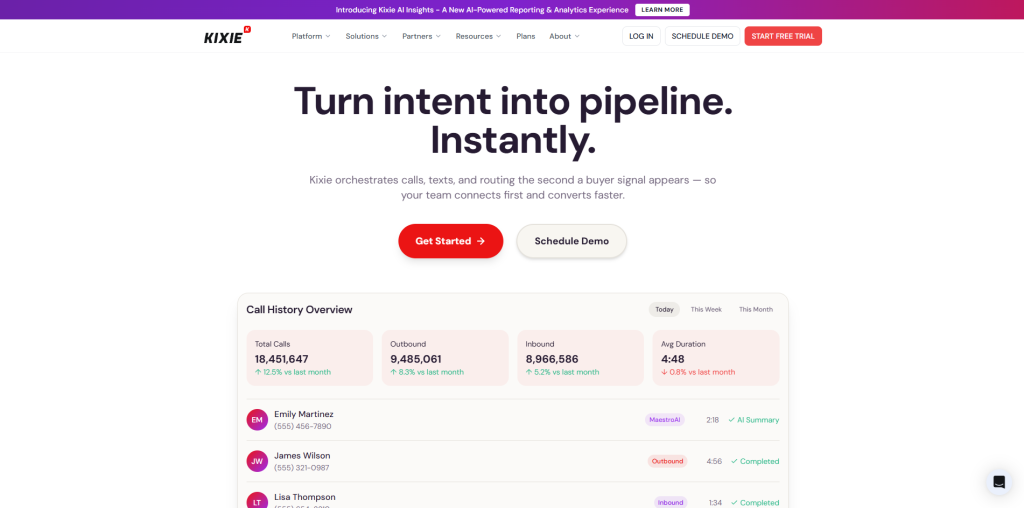
Kixie is a sales dialer designed around fast deployment and US local-presence outbound calling. When I tested it, setup from signup to first dial took about three hours. The product priority is keeping configuration light: number rotation across US local-area codes runs automatically, the dialer connects to common CRM tools through pre-configured connectors, and managers see basic rep activity inside the dialer interface without designing custom workflows.
Who is Kixie best for?
Teams that need a working local-presence dialer running quickly and don't want to invest implementation time in deep CRM workflow design. Best fit when the priority is pickup-rate lift through US area-code matching and the workflow prioritizes basic dial activity tracking over a structured coaching layer or AI-driven conversation intelligence.
Key features of Kixie
- PowerCall dialer with click-to-call, voicemail drop, disposition logging
- Local presence dialing with automatic US area-code matching per dial and number rotation
- Multi-line PowerDialer (up to 10 lines simultaneously) at the Outbound PowerDialer tier
- AI coaching with transcription, sentiment, and rep performance scoring on Professional and above
- SMS campaigns tied to workflow triggers
Pros of Kixie
- Fast setup, often live within hours
- Strong US local-presence number portfolio with automatic rotation
- Decent CRM integration depth for common CRM tools
- AI coaching bundled on Professional tier
Cons of Kixie
- 3-user minimum on every plan
- International local-presence coverage is significantly thinner than platforms with global number portfolios
- Multi-line PowerDialer locked to the highest tier ($95 per user per month)
- Teams scaling past 150 reps typically outgrow Kixie's lightweight architecture
Pricing plans of Kixie
- Integrated ($35/user/month, 3-user minimum): baseline dialer with pre-configured CRM connectors
- Professional ($65/user/month): Power Dialer, AI coaching, advanced features
- Outbound PowerDialer ($95/user/month): multi-line parallel dialing
- Enterprise: contact sales
3. SmartDialer (by Smartlead): Best AI Power Dialer for Teams Running Email Plus Calling in One Sequence
SmartDialer is the AI power dialer built inside Smartlead's outbound sequence engine. Unlike every other tool on this list, SmartDialer runs as a native step type inside the same Sequence Builder as cold email and LinkedIn steps.
A rep builds one sequence: Email, Wait 2 days, Call, Wait 1 day, Email. One engine drives all of it. When the call ends, the rep's post-call disposition branches the sequence forward automatically. No bridging between two tools, no manual CRM updates.
The Lead Context Panel surfaces the last 3 to 5 emails sent to each prospect during every live call, so reps stop switching tabs to the CRM mid-dial. SmartCoach listens during calls and surfaces real-time AI prompts when objection patterns are detected.
Parallel dialing, AI call summaries, voicemail drop, and Smart Prospect enrichment (which fills missing phone numbers before they hit the queue) are all included at flat pricing with no per-seat add-on.
Who Is SmartDialer Best For?
B2B SDR teams of 5 to 50 reps running coordinated email plus cold calling outbound from one platform. Best fit for agencies managing multiple client outbound programs and founder-led teams where flat pricing matters more than per-seat flexibility. Not the right fit for teams that need inbound IVR or full contact center infrastructure.
Key Features of SmartDialer
- Native PHONE_CALL step inside email sequences, not a separate workflow
- AI power dialer with parallel dialing, voicemail drop and detection, auto-dialing
- SmartCoach real-time AI coaching during live calls
- Lead Context Panel shows full email history during every call
- Unified Global Block List covers email and phone opt-outs in one record
- Smart Prospect enrichment fills missing phone numbers automatically
- Flat monthly pricing, no per-seat dialer fees
Pros of SmartDialer
- Only AI power dialer where calls run natively inside an email sequence engine
- Parallel dialing included at flat pricing, not gated behind an add-on tier
- Unified opt-out across email and phone removes manual compliance management
- SmartCoach real-time AI coaching scales to every rep simultaneously
Cons of SmartDialer
- No inbound IVR or contact center routing
- Salesforce integration is sync-based, not a native Lightning component
- Support response times have drawn criticism during peak periods
Pricing Plans of SmartDialer
- Basic: $32/month flat (entire team, not per seat)
- Pro: $78/month flat
- Unlimited Smart: $144/month
- Unlimited Prime: $315/month
All tiers include the AI power dialer, parallel dialing, SmartCoach, and voicemail drop. No add-on required. 14-day free trial, no credit card required.
4. PhoneBurner: Best for player-coach operators running US-only power-dialing under 10 reps
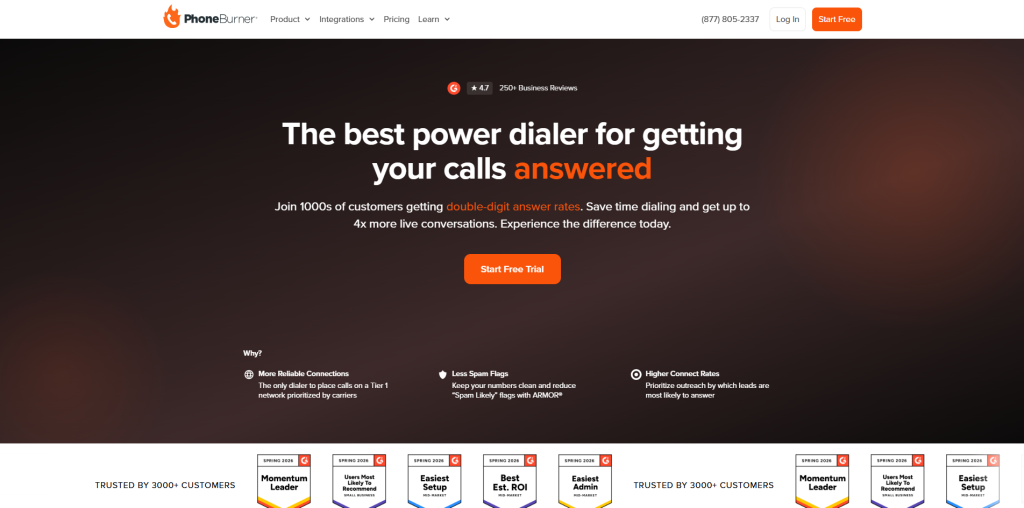
PhoneBurner is a single-line power dialer focused on raw US dial throughput. I tested it for a week with my smallest test team. The product priority is dial volume per rep-hour, not team management: sequential auto-dialing keeps the rep on the next prospect with no inter-call pause, one-click voicemail drop fires pre-recorded voicemails on detected answering machines, and disposition-driven workflows trigger automated email follow-ups the moment the call ends.
Who is PhoneBurner best for?
Player-coach operators running US-only outbound at small teams under 10 reps, where the manager is still dialing alongside the reps and needs basic live-call listening rather than a full sales-floor monitoring stack. Best fit for outbound-heavy operators in real estate, insurance, and financial services where the priority is raw US dial throughput per rep rather than coaching workflows or AI conversation intelligence.
Key features of PhoneBurner
- Sequential power dialing at 60 to 80 dials per hour with no inter-call pause
- One-click voicemail drop triggers pre-recorded voicemails automatically
- Disposition-driven workflows fire automated email sequences and CRM field updates
- Live call listening for spot coaching
- CRM integrations with native two-way sync for major CRMs
- Built-in email engine for templated sends from inside the dialer
Pros of PhoneBurner
- High dial throughput per rep with no inter-call pause
- One-click voicemail drop saves significant time per call
- Strong US-only customer base in real estate, insurance, and financial services
- Mature platform with stable feature set
Cons of PhoneBurner
- No live wallboard or multi-rep dashboard for larger teams
- Higher per-seat price than most competitors ($149+ entry)
- No native AI conversation intelligence or transcription
- US-only local-presence focus, no international coverage
Pricing plans of PhoneBurner
- Standard ($149/user/month): baseline dialer features
- Professional ($169/user/month): advanced workflow automation
- Premium ($199/user/month): dedicated customer success
- Annual contracts discount each tier by roughly 10 to 15 percent
5. JustCall: Best for teams consolidating call plus SMS into one engagement platform
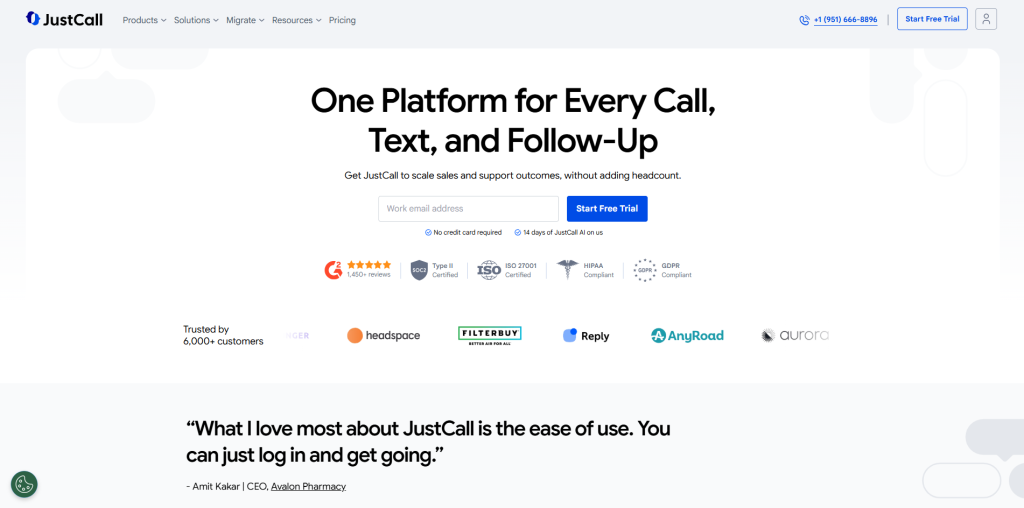
JustCall is a hybrid engagement platform combining cloud phone, SMS, and outbound sequences. The premise: modern outbound is multi-channel by default, so the dialer, the SMS engine, and the sequence builder orchestrate together rather than live in separate vendors. For teams running call workflows plus SMS follow-ups, JustCall consolidates two tools into one.
Who is JustCall best for?
Teams where SMS is a measurable channel alongside calls, where the alternative is buying both a phone system and a separate engagement platform, and where consolidation outweighs best-in-class depth on either channel.
Key features of JustCall
- Multi-step sequences combining call, SMS, and email touches with branching logic
- AI voice agent for autonomous outbound qualification calls on the Pro tier
- CRM integrations with native two-way sync for major CRMs
- Conversation intelligence (transcription, sentiment, call scoring) bundled on the Pro tier
- SMS engine for bulk SMS, 1-to-1 SMS, and templated messages tied to workflow triggers
Pros of JustCall
- Strong SMS engine bundled with the dialer
- Multi-channel sequences combine call + SMS + email in one workflow
- AI features bundled on Pro tier (not separate add-on)
- Solid CRM integration depth
Cons of JustCall
- AI features sit behind the Pro tier at $89 per user per month
- International calling rates stack quickly outside included regions
- UI density is higher than competing platforms, so onboarding takes longer
- Reporting depth lags purpose-built outbound analytics
Pricing plans of JustCall
- Essentials ($29/user/month): no Power Dialer
- Team ($49/user/month): Power Dialer, analytics
- Pro ($89/user/month): AI features, advanced integrations
- Business: contact sales
6. Aircall: Best for setup-led buyers prioritizing integration marketplace breadth
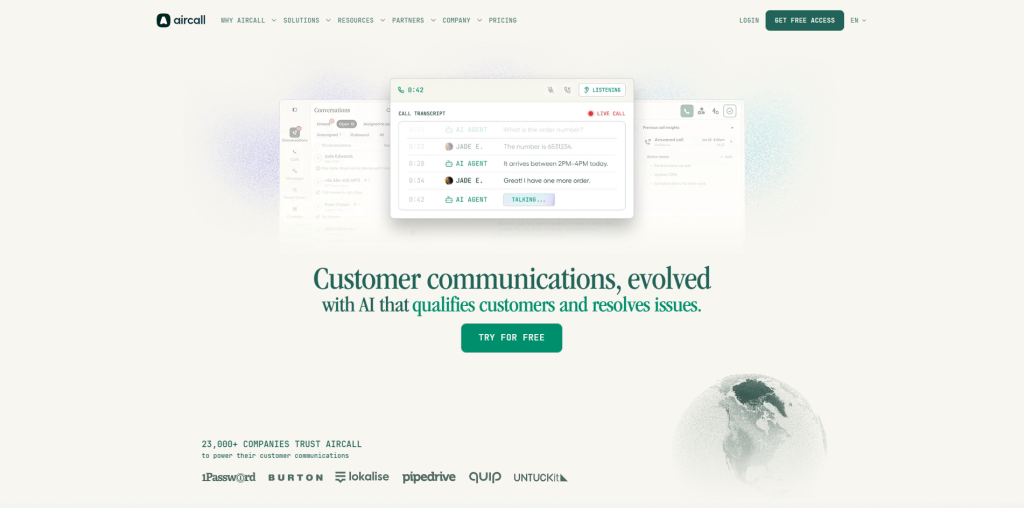
Aircall is a cloud phone system designed around setup simplicity and broad ecosystem connectivity. The product gets reps onto calls quickly through a visual call flow builder that handles IVR and routing without engineering involvement, a marketplace of 100+ pre-built connectors covering common business tools, and mobile and desktop apps with feature parity for distributed teams. Power Dialer is available from the Professional plan upward.
Who is Aircall best for?
Teams where setup speed and ecosystem breadth matter more than advanced dialer depth or international coverage, and where the immediate priority is connecting the phone system to a wide range of existing business tools rather than building deep outbound-specific workflows. Best fit when the team values time-to-value and marketplace flexibility over parallel dialing, AI conversation intelligence depth, or global local-presence portfolios.
Key features of Aircall
- Integration marketplace with 100+ pre-built connectors covering common business tools
- Visual call flow builder for IVR menus, business-hours routing, ring groups
- Power Dialer for sequential outbound dialing on the Professional plan upward
- Aircall AI add-on for transcription, sentiment, talk-to-listen ratio (separate $20 to $30 per user per month)
- Local-presence dialing available in select US, UK, and EU regions with number rotation
- Mobile and desktop apps with feature parity for distributed teams
Pros of Aircall
- Fast setup via visual call flow builder
- Broad integration marketplace (100+ connectors)
- Strong mobile and desktop app feature parity
- Cloud-phone-first foundation that scales beyond dialer use cases
Cons of Aircall
- 3-user minimum on every plan
- Power Dialer locked to Professional plan at $70 per user per month
- AI features not bundled, $20 to $30 per user per month add-on
- No native Parallel Dialer
- International local-presence coverage is significantly thinner than platforms with global number portfolios
Pricing plans of Aircall
- Essentials ($40/user/month, 3-user minimum): no Power Dialer
- Professional ($70/user/month): Power Dialer, analytics, advanced features
- Aircall AI add-on: $20 to $30 per user per month
- Custom: contact sales for enterprise volumes
7. Aloware: Best budget-conscious all-in-one calling and SMS stack
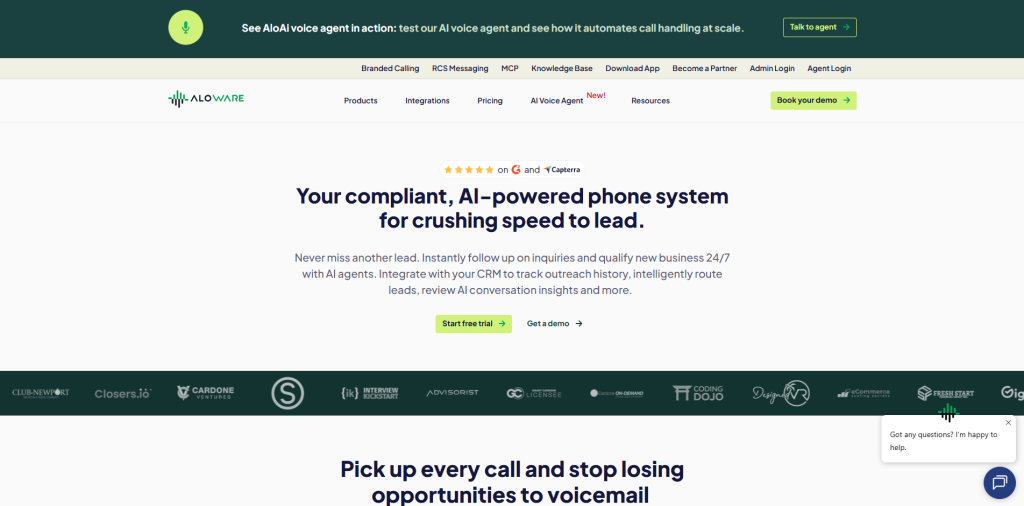
Aloware is an all-in-one calling and SMS platform positioned as a budget-friendly alternative for small US-focused operations, with overlapping features at lower per-seat pricing. The product targets very early-stage teams where total cost of ownership matters more than best-in-class depth on any single feature, and where the workflow combines outbound calls, SMS, and basic CRM logging into a single platform.
Who is Aloware best for?
Very early-stage startups (5 to 30 people) where total cost of ownership matters more than feature depth, and where the workflow combines outbound calls, SMS, and basic CRM logging. Best fit when the founder is optimizing the dialing stack for monthly burn rate rather than for advanced AI features or international coverage.
Key features of Aloware
- US local-presence dialing across all area codes
- SMS engine for bulk SMS, 1-to-1 SMS, and templated messages
- Basic AI features (transcription and call scoring)
- CRM integrations for major CRMs
- Power Dialer for sequential outbound
Pros of Aloware
- Low entry pricing compared to broader call center platforms
- US local-presence dialing across all area codes
- Decent CRM integration depth for the price
- Power Dialer included in lower tier
Cons of Aloware
- International coverage narrower than platforms with global number portfolios
- Reporting and dashboarding depth lags purpose-built outbound analytics
- Smaller customer base means a smaller third-party integration ecosystem
- AI features lighter than dedicated conversation intelligence platforms
Pricing plans of Aloware
- Inner Circle (around $35/user/month): baseline dialer plus SMS
- Outer Ring (around $80/user/month): AI features, advanced integrations
- Trailblazer: custom pricing
- All publicly listed pricing as of evaluation date. Verify current pricing on Aloware's website before signing.
8. Orum: Best parallel dialer for high-volume SDR teams at scale
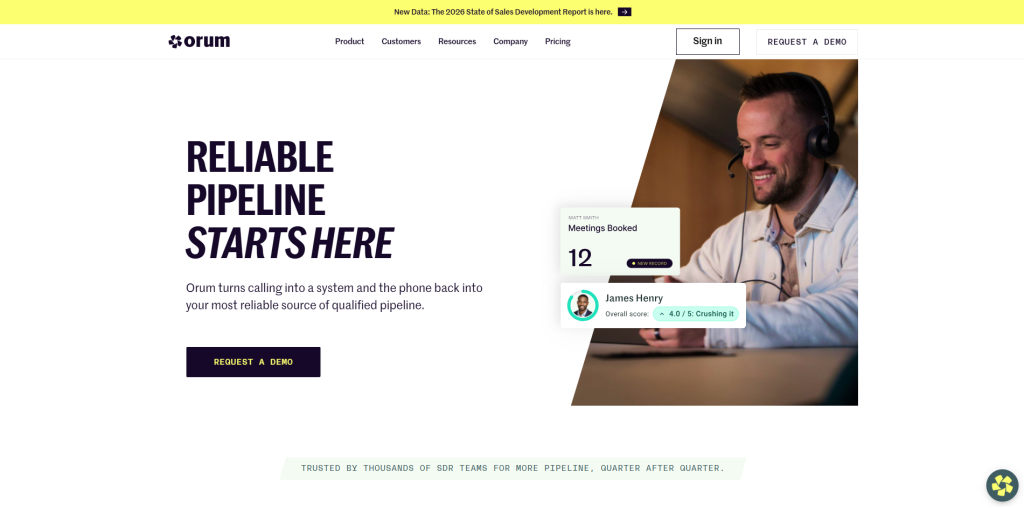
Orum is a parallel dialer purpose-built for high-volume SDR teams that need to maximize dial-to-conversation ratio at scale. The product runs autonomous parallel outbound dialing across multiple lines per rep, filters out voicemails and disconnects automatically with AI-driven detection, and connects the rep to a live human voice when one answers. For SDR teams running 100+ dials per rep per hour, the workflow is fundamentally different from sequential power-dialing.
Who is Orum best for?
High-volume SDR teams running 100+ dials per rep per hour at scale, where the bottleneck is voicemail and disconnect filtering, and where the operating model justifies enterprise pricing. Best fit when the team has a dedicated SDR function, structured outbound playbooks, and the budget for premium parallel dialing infrastructure.
Key features of Orum
- Autonomous parallel dialing across multiple lines per rep
- AI-driven voicemail and disconnect detection to filter out non-conversations
- Live transfer to rep the moment a human voice answers
- Salesforce native integration
- Sales engagement platform integration (Outreach, Salesloft)
- Real-time analytics for SDR team management
Pros of Orum
- Highest dial-to-conversation ratio in this comparison
- Native AI-driven voicemail and disconnect detection
- Strong integration with sales engagement platforms (Outreach, Salesloft)
- Built specifically for high-volume SDR operations
Cons of Orum
- Enterprise-only custom pricing, typically the highest per-seat cost in this comparison
- Implementation timelines run weeks, not days
- Overbuilt for SMB teams under 5 SDRs
- Less flexibility on CRM integration outside the SDR sales engagement workflow
Pricing plans of Orum
- Custom only: Orum does not publish per-seat pricing. Typical per-seat pricing runs at the higher end of this comparison.
- Enterprise tiers: higher pricing for advanced AI features and SDR analytics
How to choose the right outbound dialer for your team
Picking the right outbound dialer depends less on the marketing demo and more on operational fit. The first thing I'd check is whether the platform handles all three dialer modes (Smart Dialer, Power Dialer, Parallel Dialer) on one license, because buying separate tools for each mode quickly fragments the workflow and burns the budget. The second is how the platform integrates with the CRM. Native two-way sync with HubSpot, Salesforce, or Pipedrive determines whether outbound activity becomes structured pipeline data or stays trapped in free-text call logs that nobody reads after the call. The third is whether AI conversation intelligence is bundled or an add-on. A $9 per user per month add-on for transcription, sentiment, and topic extraction makes coaching workflows accessible at SMB scale, while a separate $1,000-per-seat Gong contract usually isn't. The fourth is pricing transparency at the team's scale. Per-seat pricing with clear add-on costs lets finance forecast monthly outbound costs reliably, while per-minute or per-conversation pricing creates volatility that breaks the budget on a busy quarter.
If your team is an SMB or growing B2B sales operation needing all three dialer modes plus AI plus multi-CRM workflows on one license, CloudTalk is the strongest fit. If your priority is local-presence dialing with the fastest possible deployment, Kixie deploys in hours. If you're a player-coach operator running US-only outbound under 10 reps, PhoneBurner serves that exact profile. If you need call plus SMS in one engagement workflow, JustCall consolidates the two. If you're a setup-led buyer prioritizing integration marketplace breadth, Aircall covers that lane. If you're optimizing for monthly burn rate at very early-stage scale, Aloware is the budget-conscious all-in-one. If you're running a dedicated SDR team at 100+ dials per rep per hour and parallel dialing is the unlock, Orum is purpose-built for that motion.
Conclusion:
After two weeks of hands-on testing, my answer to the opening question is straightforward. For SMB and growing B2B sales teams needing all three dialer modes (Smart, Power, Parallel) plus AI Conversation Intelligence plus native HubSpot, Salesforce, or Pipedrive sync on one license, CloudTalk is the best outbound dialer in 2026. It's the only platform in this comparison that delivers all of those capabilities under predictable per-seat pricing without bespoke procurement.
Kixie is the fast-deployment local-presence pick. PhoneBurner is the player-coach US-only dial-throughput choice. JustCall consolidates call plus SMS in one engagement platform. Aircall is the integration marketplace pick. Aloware is the budget-conscious all-in-one. Orum is the high-volume SDR parallel dialer for teams at scale.
The right call depends on team size, geographic scope, CRM standardization, and budget predictability. Run a free trial wherever one is offered, dial real prospects for a week with the real team, and let the metrics that actually matter (dials per rep per hour, connect rate, qualified meetings booked, cost per booked meeting, CRM data hygiene) make the buying decision.
If CloudTalk fits the profile, the 14-day free trial gets a working Smart Dialer, Power Dialer, AI Conversation Intelligence, and native CRM workflows live without booking a sales call.
Frequently asked questions
Q1. What is the best outbound dialer in 2026?
For SMB and growing B2B sales teams in 2026, CloudTalk is the strongest outbound dialer because it ships Smart Dialer, Power Dialer, and Parallel Dialer on one license, with native AI Conversation Intelligence and two-way sync with HubSpot, Salesforce, and Pipedrive.
Q2. What is the best outbound dialer for small businesses?
For small businesses running outbound sales, CloudTalk fits the profile most cleanly because it scales from 5 to 250 people on the same architecture, prices predictably at $25 to $49 per user per month, and integrates natively with HubSpot, Salesforce, and Pipedrive.
Q3. What's the difference between Power Dialer, Smart Dialer, and Parallel Dialer?
A Power Dialer runs sequential outbound at 60 to 80 dials per rep per hour with auto-progression and no inter-call pause. A Smart Dialer queues prospects directly from a CRM saved view, removing manual list management. A Parallel Dialer dials multiple lines simultaneously (typically up to 10) with AI-driven voicemail and disconnect detection.
Q4. How much does an outbound dialer cost for a small business?
Outbound dialer pricing varies widely. CloudTalk starts at $25 per user per month (Starter), $29 (Essential), or $49 (Expert with Power Dialer included). Kixie starts at $35 per user per month. JustCall starts at $29. Aircall starts at $40. Aloware starts around $35. PhoneBurner is the most expensive entry at $149 per user per month.
Q5. Does an outbound dialer integrate natively with HubSpot or Salesforce?
CloudTalk ships native two-way integration with HubSpot, Salesforce, Pipedrive, Intercom, and Zendesk that handles call logging, recording attachment, disposition tracking, and workflow triggering as structured fields.
Q6. Can one outbound dialer handle both inbound and outbound calls?
Yes, the strongest outbound dialers in 2026 handle both motions on a single license. CloudTalk runs daytime outbound prospecting (Smart Dialer, Power Dialer, Parallel Dialer) alongside 24/7 AI Voice Agent for inbound coverage on the same platform.