






Your CRM is only as useful as the data inside it. For most sales and support teams, a significant chunk of that data lives in phone calls that never get logged properly. Someone forgets to update the contact after a call. A follow-up falls through because the notes were in someone's head. A deal slips because there was no record of what the prospect actually said.
CRM-integrated VoIP phone systems solve this at the source by automatically logging calls, syncing transcripts, and updating contact records inside your CRM. Calls get logged automatically. Transcripts land in the contact record. Context carries over from one conversation to the next without anyone touching a keyboard. The question is which systems actually deliver on that promise rather than just listing a CRM logo on their integrations page.
We looked at the depth of CRM connectivity, not just its existence, across more than 20 VoIP platforms. These are the ten that hold up.
1. Allo
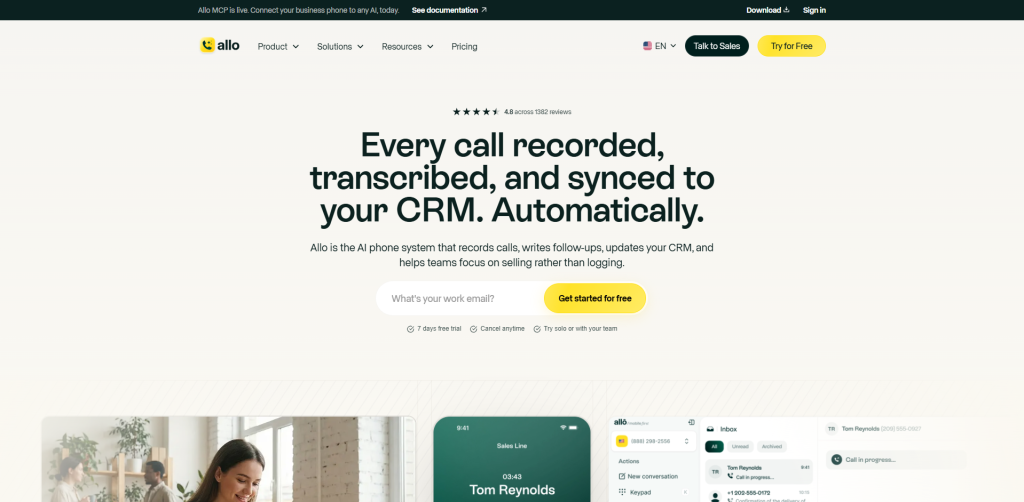
Allo was built from the ground up around CRM integration, and the difference shows in how the sync actually works. Most phone systems log a call entry and call it a day. Allo pushes call recordings, full transcripts, AI-generated summaries, and contact field updates into your CRM automatically, without any manual step in between.
The native integration library covers the CRMs that matter most for small and mid-sized teams: HubSpot, Salesforce, Attio, Apollo, Pipedrive, and Odoo. The HubSpot integration in particular has a 5/5 rating on the HubSpot marketplace with over 200 installs, which is a meaningful signal when most phone system integrations hover in the 3 to 4 range. For teams that use tools outside the native list, Zapier extends connectivity to over 1,000 additional apps, and an open API is available for custom builds.
What sets Allo apart from a CRM perspective is that the integration is not a paid add-on. It comes with the Business plan at $45 per user per month, and the AI features that power the transcription and summaries are included in every plan, not gated behind an upgrade. For a small team that relies on its CRM to stay organized, that makes Allo one of the most cost-efficient options on this list.
CRM Integrations
HubSpot, Salesforce, Attio, Apollo, Pipedrive, Odoo, plus Zapier and an open API
What Gets Synced
Call recordings, transcripts, AI summaries, contact field updates
Pricing
Starter at $25 per month (1 user). Business at $45 per user per month. No add-ons.
Best For
Small and mid-sized teams that want CRM sync to happen completely automatically, with no manual logging
Strengths
- Deepest out-of-the-box CRM sync on this list (recordings, transcripts, summaries, and contact updates)
- 5/5 on the HubSpot marketplace across 200+ installs
- AI included in every plan with no add-ons
- Mobile-first design built for teams that work outside the office
- 7-day free trial
Limitations
- No power dialer, which rules it out for high-volume outbound cold-calling operations
- Better suited to smaller teams than large enterprises with complex multi-level routing
2. Aircall
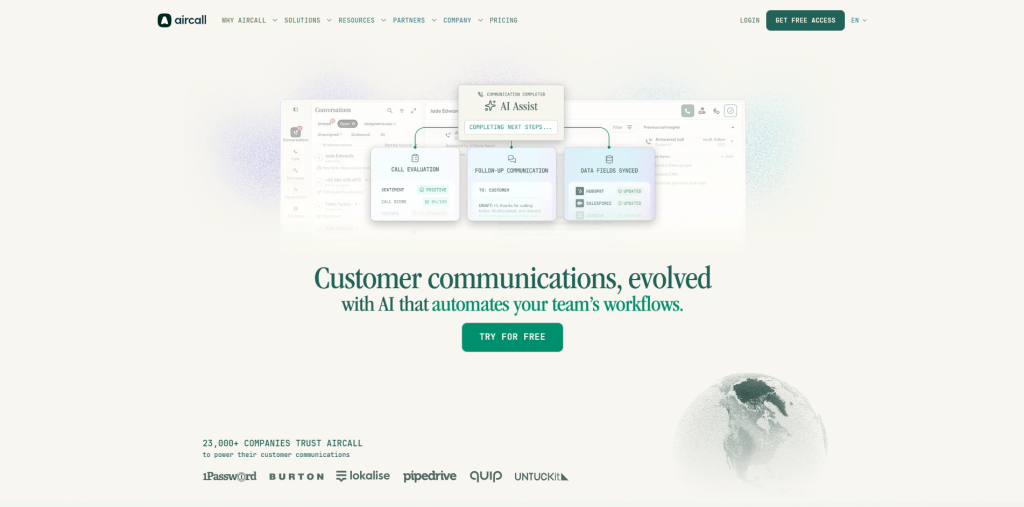
The Aircall CRM-integrated VoIP phone systems were selected based on depth of CRM syncing, automation capabilities, and real-world usability across sales and support teams.
Aircall is one of the most recognized names in CRM-connected telephony, and its reputation is earned. The Salesforce and HubSpot integrations go deeper than most competitors, with the ability to log calls, attach recordings, and pull contact context directly inside the CRM interface without switching tabs. Zendesk, Pipedrive, and Intercom are also well-supported.
The trade-off is cost. Aircall requires a minimum of three licenses; the base plan starts at $40 per license per month, and AI features are priced separately rather than included. For teams of three or more that prioritize integration depth over price, it is a solid choice. For smaller teams, the minimum seat requirement alone can make it an awkward fit.
CRM Integrations
Salesforce, HubSpot, Zendesk, Pipedrive, Intercom, and more across 38 countries
What Gets Synced
Call logs, recordings, notes, and contact data. Salesforce integration allows advanced activity logging.
Pricing
Essentials at $40 per license per month (3-license minimum). Professional at $70 per license per month.
Best For
Sales teams of three or more with a heavy focus on Salesforce or HubSpot workflows
Strengths
- Among the deepest Salesforce and HubSpot integrations available
- Strong call analytics and team reporting
- Wide country coverage across 38 markets
Limitations
- 3-license minimum adds cost for very small teams
- AI features priced as add-ons
- AI transcription limited to English and French only
3. JustCall
JustCall leads this list in raw integration count, with over 110 native CRM and business tool connections. Salesforce, HubSpot, Pipedrive, Microsoft Dynamics, Zoho, and dozens of others are supported natively, which makes it a strong fit for teams with varied or complex tech stacks. It also covers 90-plus countries, which matters for organizations with international sales or support operations.
The main limitation for CRM-focused buyers is that AI features, including transcription and summaries that make CRM entries more useful, are sold as add-ons rather than bundled in. The base plan starts at $39 per user per month with a two-user minimum, and the effective cost rises once AI is added.
CRM Integrations
110+ native integrations including Salesforce, HubSpot, Pipedrive, Microsoft Dynamics, Zoho, and Zendesk
What Gets Synced
Call logs, SMS, recordings, and contact activity across supported CRMs
Pricing
Team plan at $39 per user per month (2-user minimum). AI features as a separate add-on.
Best For
Teams with international footprints or complex tool stacks that need broad native integration coverage
Strengths
- Broadest native integration library on this list at 110+ connections
- 90+ country coverage for international teams
- Power dialer included for outbound-heavy operations
Limitations
- AI billed separately, raising the effective per-user cost
- Platform stability issues reported by some users
- Numbers occasionally flagged as spam in certain regions
4. RingCentral
RingCentral is the most established name on this list, and with over 300 native integrations, it connects to more CRMs and business tools than any other platform here. Salesforce, HubSpot, Microsoft Dynamics, Zoho, and ServiceNow are all supported, and the integration depth with Salesforce in particular is comprehensive. It has been the default choice for enterprises evaluating VoIP for decades.
For smaller teams, the value equation is less clear. The interface carries the weight of a platform built for large organizations first, and the pricing reflects it, starting at $30 per user per month and climbing with added features. Teams under ten people often find themselves navigating more complexity than they need.
CRM Integrations
300+ native integrations, including Salesforce, HubSpot, Microsoft Dynamics, Zoho, and ServiceNow
What Gets Synced
Call logs, recordings, contact data, and activity history across CRM platforms
Pricing
Core at $30 per user per month. Advanced at $35. Ultra at $45.
Best For
Mid-market and enterprise teams that need the widest possible integration coverage
Strengths
- Largest native integration library available at 300+ connections
- Strong reliability and uptime track record
- Comprehensive fax, video, and SMS alongside voice
Limitations
- Complex interface that can feel overwhelming for small teams
- Pricier than newer alternatives for comparable features
- Cancellation process is known to be difficult
5. Dialpad
Dialpad has invested heavily in its own AI model since 2018, and the practical benefit for CRM users is that call summaries and transcripts are genuinely useful rather than generic. When those summaries get pushed into a CRM, the contact record actually reflects what was discussed rather than just the time and duration of the call. Native integrations cover Salesforce, HubSpot, Zoho, and ServiceNow, and all plans include CRM connectivity without requiring an upgrade.
Some users report call quality inconsistencies, and the platform has a real learning curve. But for sales or support teams that want AI-enriched CRM data, Dialpad delivers it at a reasonable price point.
CRM Integrations
Salesforce, HubSpot, Zoho, ServiceNow, and Zendesk
What Gets Synced
AI summaries, transcripts, call logs, and activity data
Pricing
Standard at $27 per user per month. Pro at $35 per user per month.
Best For
Sales and support teams that want AI-enriched CRM records without paying extra for the AI layer
Strengths
- Proprietary AI built over years, producing better summaries than most
- AI and CRM integrations included at base plan level
- Clean, modern interface
Limitations
- Steeper learning curve than simpler alternatives
- Call quality issues noted in user reviews
- SMS approval process can take time
6. CloudTalk
CloudTalk is built for sales and support teams, and its CRM integration story reflects that focus. With 70 native integrations covering Salesforce, HubSpot, Pipedrive, Zoho, and noCRM, it covers the major platforms without requiring Zapier workarounds for most use cases. The HubSpot marketplace rating sits at 4.3 out of 5, which is solid without being exceptional.
The platform is praised for its clean interface and reliability, and it supports teams across 160-plus countries. The integrations tier starts at the Essential plan ($39 per user per month), so the Lite plan at $27 per user per month excludes them entirely. Teams buying purely for CRM connectivity need to account for that.
CRM Integrations
70 native integrations, including Salesforce, HubSpot, Pipedrive, Zoho, and noCRM
What Gets Synced
Call logs, recordings, and contact activity within supported CRM platforms
Pricing
Lite at $27 per user per month (no integrations). Essential at $39 per user per month (integrations included).
Best For
Sales and support teams that need solid CRM integrations across a broad range of platforms
Strengths
- Good UI with a low learning curve
- Reliable call quality and service uptime
- Strong country coverage at 160+ markets
Limitations
- Integrations locked behind the Essential plan — the cheapest tier excludes them entirely
- Some call quality complaints in customer reviews
- Support response times can be slow
7. Ringover
Ringover started as a telecom platform for small businesses and has evolved into a VoIP solution with a strong emphasis on sales teams. The CRM integration list includes Salesforce, HubSpot, Front, and Pipedrive across 88 native connections, and the integrations are noted for going deeper than call logging alone, recordings and transcripts transfer into the CRM as well. It covers unlimited calls to 90 destinations on the base plan.
The caveats are real. User reviews mention aggressive subscription renewal terms, unresponsive support, and issues with contact data handling. Teams that need a reliable support relationship as part of their vendor selection should weigh those factors carefully before committing.
CRM Integrations
88 native integrations, including Salesforce, HubSpot, Pipedrive, and Front
What Gets Synced
Call recordings, transcripts, and activity logs within supported CRMs
Pricing
Smart at $29 per user per month. Business at $54 per user per month.
Best For
Sales teams in staffing or recruitment verticals that need deep CRM sync with broad calling destinations
Strengths
- Recordings and transcripts included in CRM sync, not just call logs
- Unlimited calls to 90 destinations from the base plan
- Mobile app is well-reviewed
Limitations
- Subscription renewal terms can be aggressive — read the contract carefully
- Support team is difficult to reach and slow to respond
- Contact data handling issues reported by some users
8. Nextiva
Nextiva is a unified communications platform covering voice, video, team chat, and SMS in a single tool. For teams that want to consolidate their communication stack and keep CRM at the center of it, the appeal is real. AI features include real-time transcription, call summaries, and emotion scoring. The catch is that CRM integrations are locked behind the Engage plan at $50 per user per month, which makes the entry-level Core plan ($23 per user per month) largely unsuitable for CRM-focused buyers.
CRM Integrations
Salesforce, HubSpot, and other major CRMs — available from the Engage plan upward
What Gets Synced
Call logs, recordings, and transcriptions within supported CRM platforms
Pricing
Core at $23 per user per month (no CRM integrations). Engage at $50 per user per month (integrations included).
Best For
Growing teams that want a full UCaaS platform and are willing to invest in the Engage tier for CRM connectivity
Strengths
- Full UCaaS stack: voice, video, chat, and SMS in one place
- Strong reliability and uptime
- Good analytics and reporting at higher tiers
Limitations
- CRM integrations require the $50 per user per month plan — the entry tier has none
- Effective cost rises quickly once features are added
- Overkill for teams that only need phone and CRM sync
9. Zoom Phone
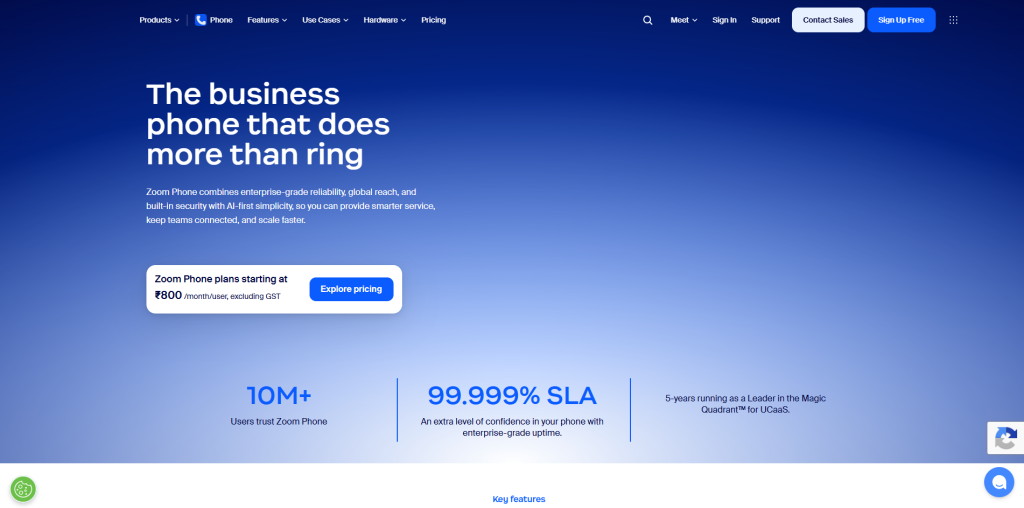
Zoom Phone is the most affordable option on this list at $15 per user per month, and it integrates with Salesforce, HubSpot, and Microsoft Dynamics. If your team is already inside the Zoom ecosystem for meetings, adding Zoom Phone keeps the stack consolidated without requiring a new tool to learn. The CRM sync covers call logs and basic activity data, which is enough for teams with modest requirements.
Where Zoom Phone falls short is depth. The integrations exist but they do not go as far as dedicated phone-first platforms in terms of what gets logged and how reliably it happens. Teams that rely heavily on CRM data for pipeline visibility or coaching will likely find the integration underwhelming over time.
CRM Integrations
Salesforce, HubSpot, and Microsoft Dynamics
What Gets Synced
Call logs and basic activity data within supported CRMs
Pricing
US and Canada Unlimited at $15 per user per month.
Best For
Teams already on Zoom that need basic CRM logging without adding a new platform
Strengths
- Lowest entry price on this list
- Excellent call quality and deep Zoom Meetings integration
- Easy onboarding for existing Zoom users
Limitations
- CRM integration is shallower than dedicated phone platforms
- No AI answering service
- Support can be difficult to reach for smaller accounts
10. 8x8
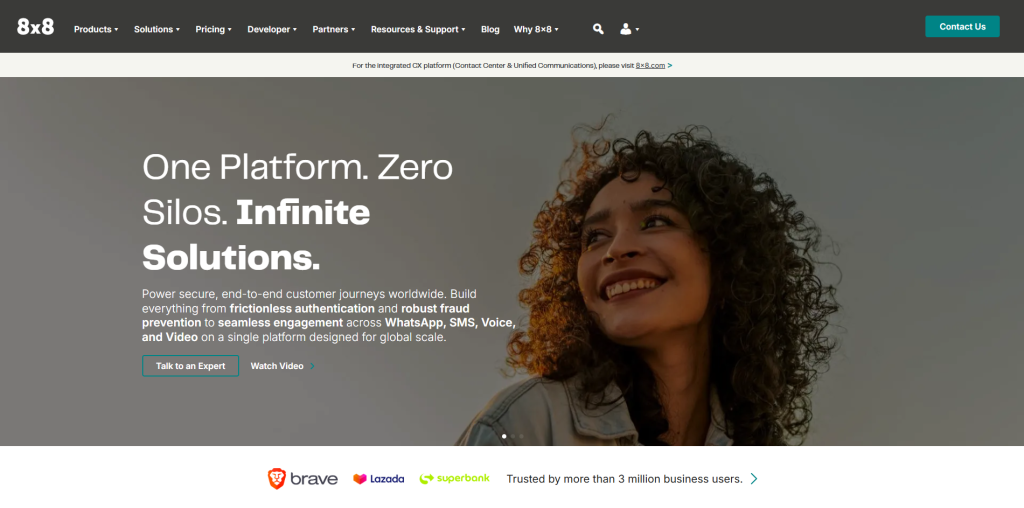
8x8 targets contact centers and enterprise-scale teams, but it makes this list because its CRM integration library includes Salesforce, HubSpot, and Pipedrive across 75 native connections, and the overall platform handles high inbound call volume well. For small businesses running structured support operations with real queue management needs, the feature set is genuinely comprehensive.
The notable limitation from a CRM perspective is that the integrations do not always sync the depth of data that more phone-native platforms do. The HubSpot integration carries a 1.2 out of 5 rating on the HubSpot marketplace, which is a meaningful data point. The platform is also complex to configure, and cancellation is consistently flagged as difficult in user reviews.
CRM Integrations
75 native integrations including Salesforce, HubSpot, and Pipedrive
What Gets Synced
Call logs, activity data, and recordings — though integration depth varies by CRM
Pricing
From approximately $24 per user per month (full pricing not publicly listed).
Best For
Small teams running high-volume inbound support who need contact center infrastructure
Strengths
- Reliable across devices with multi-channel support
- Strong supervisor and analytics tools for call center environments
- Wide native integration count at 75 connections
Limitations
- HubSpot integration rated 1.2 out of 5 on the HubSpot marketplace
- Complex to configure and manage without technical support
- Cancellation process is reported as difficult
What to Look For When Choosing a CRM-Integrated VoIP System
The number of integrations a platform lists on its website tells you less than you might expect. What matters is what actually gets synced. A platform that logs a call entry but skips the recording, transcript, and contact update is technically integrated with your CRM while still leaving most of the useful data out of it.
Before committing to any platform, check specifically whether call recordings land in the contact record, whether transcripts and summaries are included or cost extra, whether contact fields update automatically or require manual input, and whether the integration has independent third-party reviews (marketplace ratings are a useful signal here).
Choosing the right CRM-integrated VoIP phone system can significantly improve pipeline visibility, reduce manual logging, and help teams close deals faster.
Pricing also deserves a closer look than the headline number suggests. AI features, integration access, and minimum seat requirements often change the real per-user cost significantly from what is listed on the pricing page.
Frequently Asked Questions
Q1. What does a VoIP and CRM integration actually do?
At its most basic, it logs a record of calls inside your CRM automatically. At its best, it pushes the full call recording, a written transcript, an AI-generated summary, and updated contact fields into the right record without anyone doing it manually. The gap between those two levels is significant, and it varies widely between platforms.
Q2. Which CRMs are most commonly supported?
Salesforce and HubSpot are supported by virtually every platform on this list. Pipedrive, Zoho, Microsoft Dynamics, and Zendesk are also widely supported. More niche CRMs like Attio, Apollo, Odoo, and noCRM are supported by a smaller number of platforms, so if you are using one of those, it is worth verifying before choosing a VoIP provider.
Q3. Is CRM integration usually included in the base plan?
Not always. Several platforms on this list — including CloudTalk, Nextiva, and JustCall — restrict CRM integrations to higher-tier plans. Allo includes CRM connectivity in the Business plan, and RingCentral and Dialpad include it from their Advanced or Standard plans respectively. Always check which plan unlocks integrations before assuming the entry price includes them.
Q4. Do these integrations work with SuiteCRM or SugarCRM?
Direct native integrations with SuiteCRM and SugarCRM are rare among mainstream VoIP providers. Most platforms that support these CRMs do so through Zapier, an open API, or third-party connectors. If your team runs on SuiteCRM or SugarCRM, confirm API availability and check whether Zapier or a custom connector will meet your sync requirements before selecting a platform.