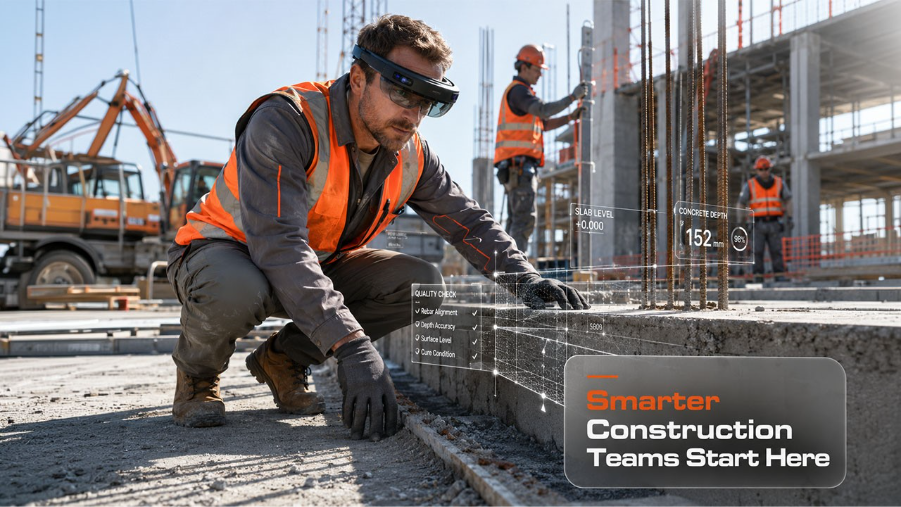






Real stupidity beats artificial intelligence every time.’ That line from Hogfather author Terry Pratchett was meant as satire, but it says something surprisingly useful about modern construction teams. Technology alone does not fix communication problems, missed deadlines, poor onboarding, or disconnected field crews. People do.
In 2026, top construction firms are getting smarter with the way they create systems for their employees. This includes better manager training, reduced administration red tape, integration of real-time field data, and providing technology that enhances rather than hinders the performance of daily activities.
The businesses are actively introducing AI in the construction tech and LMS strategies sector.
Build Better Training Systems Before Scaling Operations
Many construction firms consider training to be a reactive practice. New employees receive haphazard onboarding, site managers have to provide the same guidelines, repeatedly and compliance information is stored in spreadsheets or email messages that are never referenced.
It is only natural that such a situation becomes inconsistent.
Great teams are generally based on great learning processes, even as a company grows and operates numerous projects across various regions. A contemporary LMS is crucial in terms of streamlining information and filling training gaps, ensuring that employees have clear career development trajectories.
To illustrate this point, one may consider the case of Kallidus and its learning management system that allows workers to complete training and identify learning opportunities for themselves, while management gets better insights into employee development.
It’s particularly useful in helping managers train their workers to achieve the necessary business results, which can be considered vital for the construction sector, where leadership is often critical to successful business results. Centralizing the process makes it scalable as well.
Managers Need Development Too
One of the worst things in the construction industry is that having the technical knowledge does not necessarily mean you have good leadership qualities.
Often, project managers and supervisors are given enormous amounts of responsibility without prior management training. They have to take care of all communication, conflict resolution, time pressures, motivation, and reporting, alongside ensuring the successful completion of their projects.
This can be too much for even the most seasoned individuals.
Organizations that invest in their employees’ leadership training and leadership skill building are known to experience improved collaboration, reduced delays, and retention due to the fact that line managers determine the organizational culture. Learning management systems make such training more accessible.
Use AI Construction Software to Reduce Daily Friction
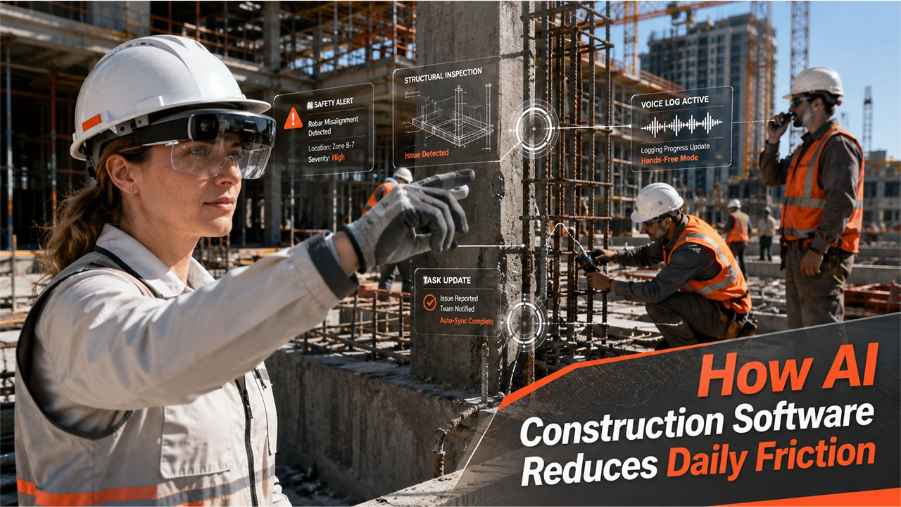
No longer is artificial intelligence in construction an idea based on nothing but hype. Almost all of the leading construction firms have begun to incorporate automated tools, predictive analytics, and AI-driven solutions in some way.
However, the key advantage that the construction tech and LMS strategies brings is in streamlining work processes.
Construction workers spend enormous amounts of time catching up with information changes, producing and correcting duplicate documentation, communicating to overcome misunderstandings, and logging their results manually. AI-driven solutions allow construction teams to reduce time spent on repetitive routine tasks to concentrate on actual work.
As for the benefits of adopting AI in construction provided by such software as Fieldwire, they may include more efficient issue tracking, better collaboration between field and office, real-time reporting, and improved project management during highly complicated constructions.
With such an application, construction workers no longer need to engage in scattered communication over multiple channels like text messages, e-mail, telephone calls, and paper notes.
AI Helps Teams React Faster
Construction delays usually start creeping up on a project because communication is inefficient.
There are issues on the construction site that get picked up too late. There are delays in material deliveries that aren’t communicated quickly enough. Communication problems with subcontractors lead to delays.
Using AI assistance can help detect these kinds of problems early due to automation and increased visibility within the project. The time spent looking for problems can be reduced, and managers can spend more time solving them.
These efficiencies become really valuable when you’re working on larger commercial projects.
Better Documentation Protects Everyone
Documentation is currently one of the most important safety measures within modern-day construction.
Transparency is what clients demand. Compliance regulations continue to become more stringent. Insurance conflicts have the potential to become very expensive.
With digital construction platforms, a more cohesive audit trail can be created, which includes approvals, progress, safety checks, and communication. In place of a pile of different paper documents, real-time tracking can occur.
Improve Communication Between Office and Field Teams
There’s nothing that can ruin team efficiency like miscommunication. In the office, management thinks they have their priorities straight, while their field workers only get part of the information. And in the field, managers think decisions are being made without considering the reality on the worksite.
Technology is supposed to help resolve these differences, not aggravate them. With mobile-first construction software solutions, important information is communicated instantly rather than at end-of-the-day meetings or emails that nobody bothers reading in the field.
Construction teams will function better if they’re all operating from the same playbook. That might be self-explanatory, but many companies still have fractured systems with scheduling, safety, procurement, and reporting rarely talking to each other.
Standardise Processes Across Every Project
There is one aspect that can explain why some construction companies develop effortlessly and why some stumble along the way.
If each project manager works in a unique way, quality assurance (QA) will be inconsistent. Some teams document correctly, and there are those who omit steps. While one project manager ensures clear communication, another relies on memory.
Technology facilitates the implementation of consistent workflows and helps everyone stick to certain patterns regardless of the scale and type of the project. It does not take away the element of flexibility inherent to the construction industry.
Some examples include:
- Consistent onboarding workflows
- Consistent safety practices
- Consistent reporting formats
- Consistent documentation methods
- Consistent QA processes
Teams work faster when expectations are predictable.
Invest in Mobile-Friendly Tools Workers Actually Use
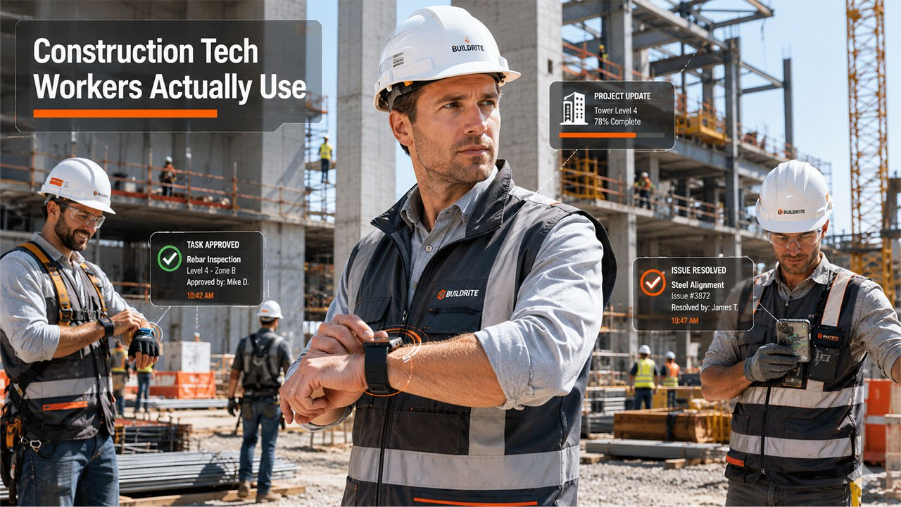
There are some major challenges with construction tech and LMS strategies as well. Some platforms may look great on paper but turn out to be a nuisance for the people on site daily. When software holds people back, adoption rates will drop significantly.
Construction tech and LMS strategies must feel like something practical, something that does not require any technical expertise from those using it every day.
Ease of use from mobile devices has become essential due to the way people communicate on-site nowadays. For the people who want to invest in new technology, the usability factor must be as important as functionality.
Just ask yourself some straightforward questions: Is it easy to learn how to use the product? Will it help eliminate bureaucracy and unnecessary paperwork? Is it capable of providing real-time updates? Will it facilitate communication? Will anyone actually use the software regularly?
If not, then all the capabilities in the world will not matter since the software will just be sitting there doing nothing at all.
Create Smarter Performance Tracking Systems
Performance evaluations are still too lax for most construction firms. Projects are either classified as success stories or otherwise, with no concrete information on why such an evaluation was made.
This results in poor construction tech and LMS strategies since it is difficult to determine the specific causes of project setbacks in terms of time overrun, budget overrun, and communication lapses.
With today’s technology for the construction industry, firms have greater capabilities to monitor performance.
This includes:
- Project duration time
- Frequency of reworks
- Number of safety accidents
- Efficiency in task accomplishment
- Employee productivity
- Machine downtime
- Training completion
The idea here is not surveillance but visibility.
Reduce Burnout Through Better Workflow Planning
Construction teams operate with constant deadlines amid such factors as labor shortages, climate disruptions, compliance issues, and customer requests. All this stress gradually impacts their efficiency and overall motivation.
Technology cannot eliminate the sources of stress, but it is able to eliminate most of them.
Scheduling software, automation of report creation, management of resources, and communication platforms allow for reducing many stressful issues.
This happens because stress tends to result in poor performance.
Better project planning helps improve one’s work-life balance, since less time will be needed for handling problems related to ineffective reporting and a lack of clear communication.
Neglecting burnout means losing highly qualified employees, who are not easy to replace.
Combine Human Leadership With Smart Technology
It is not only about the use of technology. Good management, effective communication, relevant training, and appropriate operational systems also play a vital role here. Technology, AI, and other innovations provide additional visibility and help eliminate repetitive operations, but they cannot compensate for the lack of trust, responsibility, and managerial skills.
The most successful businesses nowadays are those that simplify business processes, eliminate all the unnecessary bureaucracy, and focus on their employees. If people feel safe and confident about what they do, everything goes smoothly