





Introduction
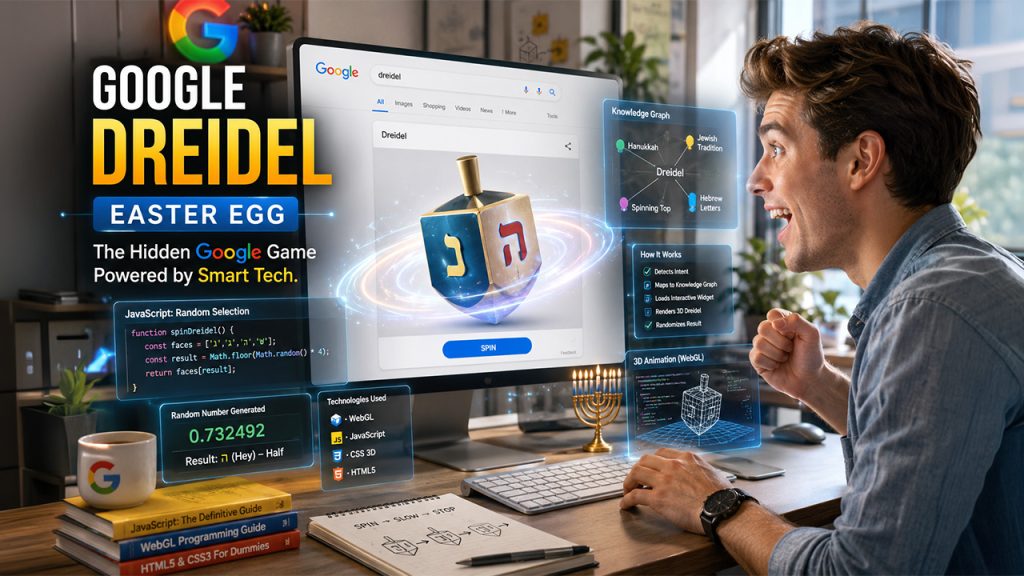
Once you enter the word “Dreidel” into Google Search, you will see something fun happening. A 3D spinning top shows at the top of your screen. You do not have to visit any website, or have to download any app, or create an account. You just have to click on “Spin” and the game starts.
This is known as the Google Dreidel Easter egg. At a glance, you might feel that it is simple. However, the technology that powers it is quite interesting to know. Google must identify what you are looking for, decide to display the game, create an animation in your browser, and ensure that the spin lands on a random or fair result. All of this happens in a matter of split seconds.
Wonder how this happens? In this blog, we will see how the mechanics of Google Driedel in a simple language.
What Is Google Dreidel?
Google Dreidel is an interactive and free mini game hidden in Google Search. It is what you call a digital version of the dreidel, a four-sided spinning top that is an old Hanukkah tradition, the Jewish Festival of Lights.
It looks simple, but it is very different from regular search results. Here is how:
- It appears not just a simple text on a page. It is a live, clickable, and animated game.
- It entirely runs inside your browser; you do not have to download anything to your device.
- It utilizes a random number system to decide which side the dreidel will land, just like an actual spin.
- It works on tablets, phones, and computers.
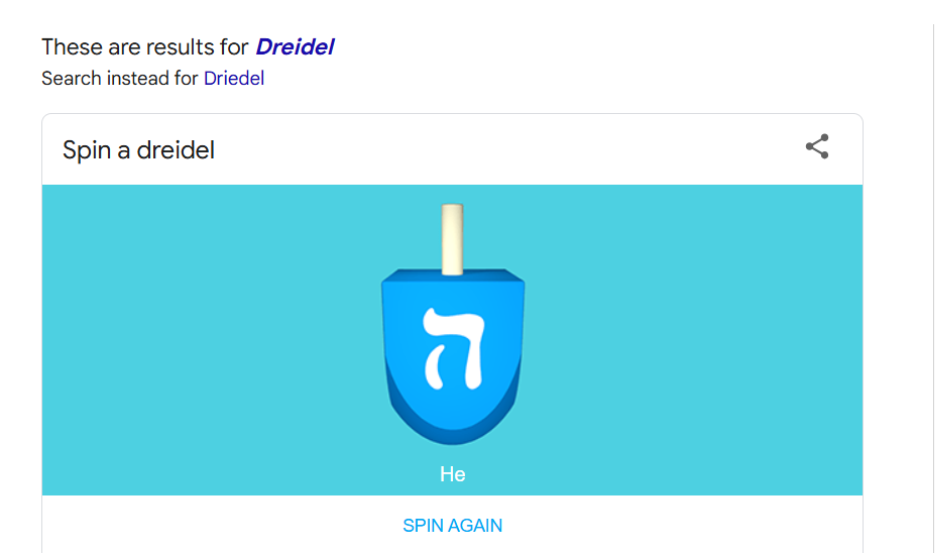
Google has a term for features like this one- “Easter Eggs.” They are hidden and small surprises in-built into their products. The dreidel Easter egg is only one among the long list that also includes Sonic Hedgehog animation, Thanos snap effect, and Super Mario Bros. coin block. Each of these Easter Eggs is triggered by a particular search term and is governed by the same underlying technology of Google.
How Google Knows to Show the Game?
When you enter a search term in Google search, it does not just find the matching terms. It understands what you are basically searching for. This system is known as the “Knowledge Graph.”
You can consider Knowledge Graph as the giant encyclopedia of real-world things in Google, including places, people, events, objects, and concepts. They are all connected by their relationships. When you search for the term “dreidel,” Google can look it up in this encyclopedia and finds: a four-sided spinning top, related to Hanukkah, Jewish cultural tradition, and Hebrew letters.
Once Google has confirmed that it has found the right results for the search terms (for example, “dreidel”), it also checks whether the entry also has a special interactive game associated with it. If it finds that Google has attached a game to the search query, it adds game widget to your search results page before adding it to your screen.
It does not just work on the exact search term but can also work on its related terms. This is why numerous distinct search terms triggers the same game:
- Google dreidel
- Dreidel
- Hanukkah dreidel
- spin a dreidel
- play dreidel
All these search terms point to the same entry in the Knowledge Graph. And, thus, they are triggering the same widget. Capitalization is also not so important. Dreidel, DREIDEL, and dreidel are all identical.
The game shows in the same spot where you see calculators, AI overviews, or unit converters, i.e., The panel at the side or top of the search results. panel at the top or side of the search results. Google just swaps the usual text box to display the spinning top game.
How does the game work technically?
The 3D Spinning Animation
The dreidel that appears on the screen is a 3D model created and displayed in your browser. Google utilizes on the among the two standard web technologies in order to do this:
- WebGL — this enables the browser to utilize the graphics chip of your device to smoothly draw 3D objects. This is very similar to how video games get displayed on the screen.
- CSS 3D Transforms — This is a very simple method that utilizes web code to move and rotate objects in 3 dimensions without requiring the GPU.
Either way, the result appears the same: a top that spins quickly, gradually slows down, slightly wobbles as it loses speed, and then just stops on one of its four faces. That slowdown and wobble is not random; it is coded to act like a real object that runs out of energy.
How a Random Result Is Selected?
The most critical aspect of the game is deciding which face the dreidel lands on. This is managed by a random number generator in-built in JavaScript. It is a programming language that operates on each web browser.
When you select the button “Spin”, the code executes an in-built function known as Math.random(). This creates a random number, which is converted then into one of the four options, i.e., 0,1, 2, or 3. Every number is mapped to one of the four Hebrew letters on drawn on the face of dreidel.
| Letter | What It Means | What You Do |
| Nun (נ) | Nothing | Nothing; the dreidel is passed to the next player |
| Gimel (ג) | All | You need to take everything in the pot |
| Hey (ה) | Half | You need to take half of the pot |
| Shin (ש) | Put in | Put one token to the pot |
The result is chosen first actually, and the animation is guided then to stop on that face. It looks quite real since the spin smoothly slows down, the way that an actual dreidel does.
Why Is It Effective on Any Device?
The widget utilizes simple web technologies that each modern browser supports already; i.e., Safari, Chrome, Firefox, and Edge all manage it without requiring any additional software. It also automatically adjusts between mobile (touch taps) and desktop (mouse clicks), so the experience appears consistent with any screen size.
What You Need to Do If the Game Does Not Appear?
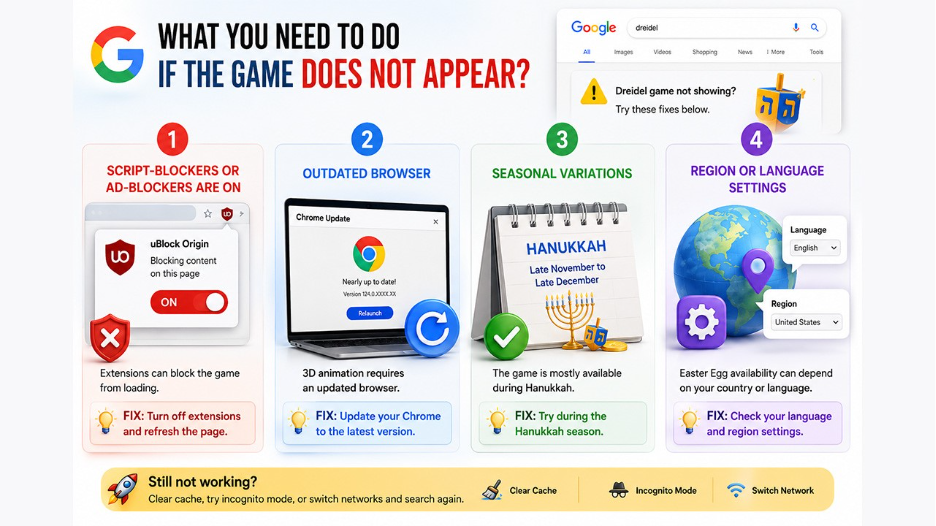
Now, if you want to test the Google Dreidel widget, sometimes it will not show up. Let us see the common reasons:
- Script-blockers or Ad-blockers are on: Extensions such as uBlock Origin can block the game accidentally from loading. Just see whether turning off the browser extensions and refreshing the page works.
- Outdated Browser: The 3D animation requires an updated browser. Update your Chrome to the latest version and then check whether it works or not.
- Seasonal Variations: The game is mostly available during the period of Hanukkah, which happens between late November and late December. It can appear to be less consistent during other times of the year.
- Region or Language Settings: You might not be able to see Easter Egg depending on your language or country settings.
Why Google Choose to Build These Games?
The Google Dreidel does not get created by accident. Google creates these Easter Eggs deliberately as part of its effort to be more culturally and relatable to the audience.
They take real engineering work. Google’s team has to:
- Train the search system to identify when a query is asking for a particular cultural object, not just general data.
- Create the game widget and ensure that it quickly loads without decreasing the speed of the rest of the page.
- Ensure that it correctly works across each device’s size and browser.
- Decide when and where to display it, and when not to.
The same system of Knowledge Graph that powers the Driedel Easter Egg also powers other features of interactive search. Looking for saxophones or drums, for instance, triggers Google to show playable sounds in Google Search. Each one is a distinct experience, but they all work with the same technical foundation.
Conclusion
The Google Dreidel is a small feature, but it depends on a deep technology that enables it. Google recognizes your search, checks its knowledge graph, includes a game widget to your results page, creates a 3D spinning top in your browser, selects a random outcome utilizing JavaScript, and directs the animation to match, all of this happens in a matter of seconds.
For the user, it is just searching for a term and clicking the “Spin” button. However, driving that click is a complete chain of understanding the query, browser rendering, and random number logic smoothly working together. The Google Dreidel is a good reminder that even the most simplest features might need a decent amount of engineering.
Related Post
Should You Remove Google Partner Setup? Everything Android Users Need to Know
Frequently Asked Questions : Google Driedel
In order to play Google Driedel, you just need to search the terms “Spin a Dreidel” or just “Google Dreidel” in the Google search bar. You will see an interactive spinner at the top of the results page. Just tap or click on the “SPIN” button to watch it spin.
The digital Dreidel follows the same game rules as the traditional Hannukah game.
While the mechanics and results are the same, Google Dreidel is basically an automated digital spinner. You do not actually have to spin a physical top. If you are playing the game and you do not have the actual top, this is a good backup option.
The meaning of the four results is as follows: Nun= Do nothing, Gimel= Collect everything in the pot, Hei= Take half of the pot, Shin= Add one piece to the pot.