






Product data is becoming increasingly fragmented, online catalogs are growing, while shopping channels are dispersing across marketplaces. This makes consumers expect clean searches, recommendations, and the ability to view consistent product details, pushing retailers' product data management capabilities.
Why Product Information Management Is Entering A New Phase
In the past, Product Information Management (PIM) acted like a central catalog for an organization. With the emergence of omnichannel commerce, however, PIM must operate like a product data operating system. For example, a retailer may need to provide clean product data for each SKU across their D2C site, various marketplaces, social commerce platforms, retail apps, and possibly even in-store touch points with each having its own set of rules and formats.
The product information management market is expected to rise from USD 3.01 billion in 2022 to USD 12.91 billion in 2029 at a CAGR of 23.1% during 2022-2029.
As a result of the increasing fragmentation of shopping channels, AI-generated personalized product recommendations, and stricter regulatory compliance, traditional, catalog-centric PIM systems are struggling to keep up. They were designed to manage and update product data in a relatively predictable manner, via periodic updates, using pre-defined template structures. Now there is pressure from growing numbers of shopping channels, consumer expectation of personalized recommendations generated through AI, and the need for stricter control over product data quality and integrity.
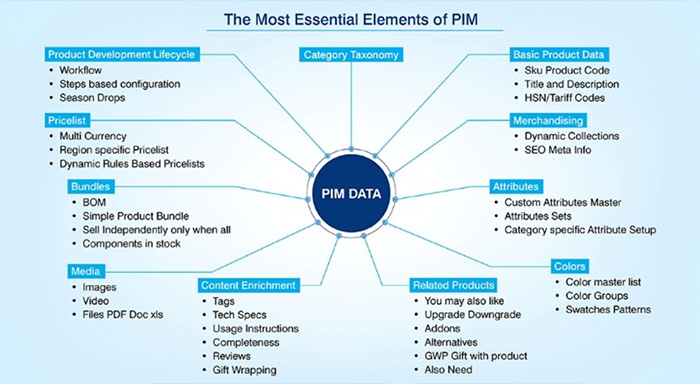
As such, PIM trends for e-commerce include transitioning from a support function to a strategic layer since inconsistent product data is perceived as lost visibility, increased product returns, and compliance risks. As complexity increases in terms of channels and regulation, product information will become an important driver of revenue growth.
Future Trends Impacting The Next Phase of PIM
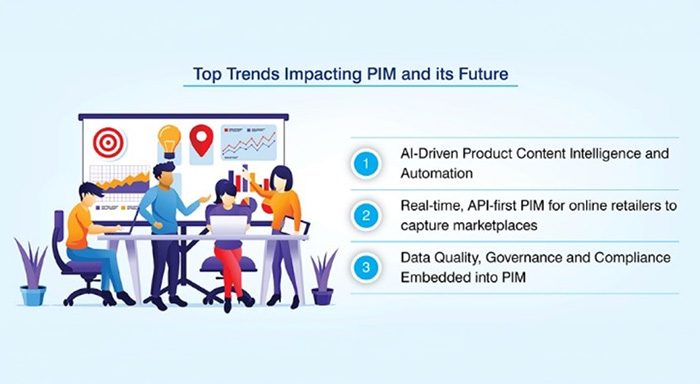
Three significant trends are impacting the PIM playbook: AI-enabled product content creation and maintenance, real-time syndication of product data, and product data governance. These three trends will transform PIM from a static product data repository to a dynamic system that manages the accuracy, adaptability, and publish-readiness of product data.
Trend 1: AI-driven Product Content Intelligence & Automation
AI enables the automation of manual processes associated with creating, maintaining, and enriching product content and attributes across multiple channels, thus improving consistency and reducing costs.
1. From Static Product Data to Intelligent Product Content
LLMs enable organizations to automate the generation of product content including descriptions, normalization of attribute values, and localization of product content that arrives in varying formats from suppliers. Organizations experience less messy variants that break filters, and less misclassifications.
PIM and PXM have distinct responsibilities. PIM governs correctness and structure. PXM governs the presentation of data across channels. While they are connected, they are separate problems.
2. Context-Aware Content Optimization
What constitutes "good" content varies significantly depending upon the channel, region, and shopper intent. AI in PIM enables organizations to generate channel-fit variations from a governed attribute base, and then refines those variations based on search and conversion signals.
3. Technical Implications for PIM Architectures
This trend supports headless, API-first PIM systems that enable content to be sent across front-end applications without duplication. Strong integrations with DAM, CMS, and CDP are critical, and feedback loops become key as teams fine-tune templates based on performance metrics.
Trend 2: Real-time, API-first PIM for Online Retailers to Capture Marketplaces
Organizations are moving away from scheduled feeds to real-time product catalog updates due to the impact of lag and drift on listing suppression, ad performance, and overall shopper experience.
1. The End of Batch-Based Product Syndication
Batch-based CSV uploads and nightly jobs introduce delays and those delays become costly when price, inventory, variant, and compliance fields change frequently. Real-time synchronization of product catalogs across marketplaces, social media platforms, retail apps, and branded storefronts reduce this delay.
2. Event-Driven & Microservices-Based PIM Models
Composable commerce is pushing PIM into a services role. Webhooks, event-streaming, and iPaaS style middleware enables organizations to publish changes in real-time, eliminate redundant copies of product data across channels, and enable fixes to be easily traced and rolled-back.
3. Scaling Product Data for High-SKU, High-Velocity Retail
Large product catalogs exacerbate weak business rules. API-first systems enable organizations to handle large volumes of updates without requiring manual re-work for each update, particularly when organizations must maintain consistent marketplace mappings and attribute discipline at scale.
Trend 3: Data Quality, Governance & Compliance Embedded into PIM
The automation of product information management only occurs when product data governance is incorporated into the PIM workflow. Therefore, product data governance is now included as an integrated feature within the core of most product information management (PIM) platforms rather than existing in separate documentation and manual checks.
1. Product Data as a Governance Challenge
New regulations around sustainability disclosures, country-specific labeling requirements, and accessibility standards increase the costs of inconsistencies in product information. Regardless of whether there is regulatory oversight or not, incorrect product information creates unnecessary return rates and customer service loads.
2. Embedded Validation, Rules Engines & Audit Trails
Most current product information management (PIM) implementations include checks for complete product information, enforce taxonomies, create rules-based validations per distribution channels to catch errors prior to publication, provide auditing trails and version controls to assist teams to track changes and rationale for such changes, this provides both operational and compliance benefits.
3. PIM as the Single Source of Truth (SSOT)
When product information management (PIM) is properly aligned across all systems including enterprise resource planning (ERP), product lifecycle management (PLM), and supply chains based upon common attributes and categories, it prevents duplicate work and maintains the stability of omnichannel publishing. This arrangement is necessary to maintain long-term scalability.
What do These Future Trends of PIM Mean for Online Retailers?
These PIM trends indicate that e-retailers should consider them as a transition to an entirely different operational model.
- Firstly, product data moves from a back-office function to a business leverage point; search results, filter options, and recommendations depend upon having accurate attributes and consistent hierarchies. If taxonomy and attribute tags do not remain consistent, product discovery will decrease and paid traffic will be less efficient.
- Secondly, product operations become continuous; real-time publishing means that product operations teams require defined rules, structured change processes, and visibility into what products are publishing to what channels. Batch thinking creates late fixes and frequent firefighting.
- Thirdly, governance is the foundation for artificial intelligence (AI) and scalability; without validation and auditing capabilities, AI-assisted enrichment and omnichannel distribution will amplify errors. With proper governance and validation, automated product data enrichment become scalable and repeatable.
Conclusion: Preparing Your PIM Strategy for The Next Commerce Cycle
Product information management (PIM) is evolving into a more strategic role due to the fact that modern commerce relies heavily on product data that is timely, consistent and governed. Artificial intelligence (AI) assisted enrichment, real-time distribution and embedded compliance are becoming expected standard features rather than advanced capabilities.
Retailers who develop their PIM strategy as a living system supported by a clear taxonomy, well-defined attribute disciplines and rigorous validation and testing will have the ability to move at scale with fewer costly errors. Retailers who desire this functionality but do not wish to build and manage a large internal data team may find a product data specialist partner beneficial in order to modernize, enrich, validate and scale product information for the next commerce cycle.