





The business environment of Saudi Arabia develops at an accelerated pace. The combination of Vision 2030 initiatives and rising digital-first customer demands and the expanding competition between banking, retail, logistics, healthcare, government services, and manufacturing sectors requires organizations to develop new software development methods.
Digital product engineering serves as the solution for this problem. The field extends beyond its traditional definition of software development. The discipline creates and maintains products that generate measurable business results through revenue growth and customer satisfaction and better operational performance and faster development of new solutions and security and reliability and compliance with regulations.
The guide provides an explanation of digital product engineering which shows its unique characteristics from project-based development and its current implementation in Saudi Arabia and the necessary evaluations for product development.
What is digital product engineering?
Digital product engineering is the end-to-end practice of designing, building, launching, operating, and continuously improving digital products. A “product” can be a customer-facing app, a B2B portal, an internal platform, or a data/AI-powered service.
Unlike one-time projects, product engineering assumes the product will evolve through:
- Customer feedback and analytics
- New features and integrations
- Performance and scalability improvements
- Security enhancements and compliance updates
- Ongoing cost optimization (cloud, infrastructure, tooling)
In other words, you’re not just shipping software—you’re building a capability for continuous delivery and improvement.
Why digital product engineering matters in Saudi Arabia
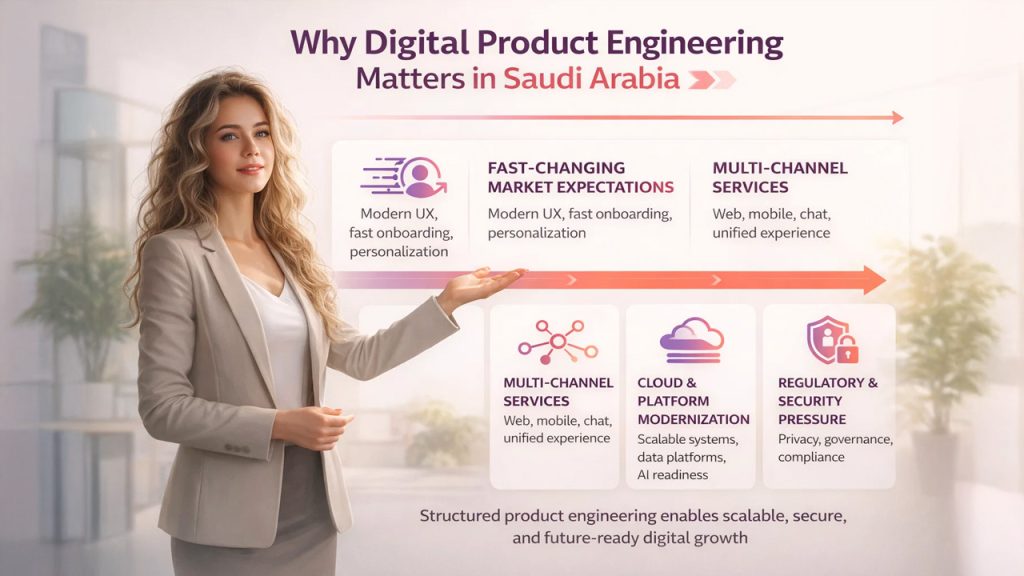
Saudi organizations often face a unique mix of rapid growth and complexity, making AI product engineering services essential for maintaining efficiency and scalability:
Fast-changing market expectations
Consumers and enterprise buyers expect modern UX, quick onboarding, personalized experiences, and reliable uptime. Switching costs are lower if your app feels slower or outdated. The pace at which emerging technologies reshaping business decisions across sectors means Saudi organizations cannot afford to fall behind on product quality or delivery speed.
Multi-channel services are now standard
Every service such as chat, mobile, web, call center systems, and partner channels need consistent experiences that are supported by a single source of truth.
Cloud adoption and platform modernization
Many businesses are now abandoning legacy systems and migrating to cloud platforms. They are modernizing their architecture and investing in data platforms so that they can leverage advanced analytics and AI systems.
Regulatory and security pressure
With increasing data, the need for privacy, access control, security monitoring, auditability, and governance are also growing.
Digital product engineering provides a structured way to build products that can keep up—without sacrificing quality, security, or maintainability.
Digital product engineering vs traditional software development
Traditional development often looks like this: requirements → build → handoff → maintenance. Digital product engineering is different because it is outcome-driven and continuous.
Here’s a practical comparison:
Traditional (project-based)
- Success metric: delivered scope and timeline
- Changes: handled via change requests
- Teams: ramp up/down per project
- Release cadence: infrequent, risky releases
- Ownership: limited after “go-live”
Product engineering (continuous)
- Success metric: business KPIs (conversion, retention, cost-to-serve, NPS)
- Changes: expected and planned through roadmaps
- Teams: stable cross-functional product squads
- Release cadence: frequent, controlled releases (CI/CD)
- Ownership: long-term product lifecycle accountability
For Saudi businesses pursuing digital transformation, the product model usually wins because it reduces long-term risk and increases delivery speed over time.
The end-to-end digital product engineering lifecycle
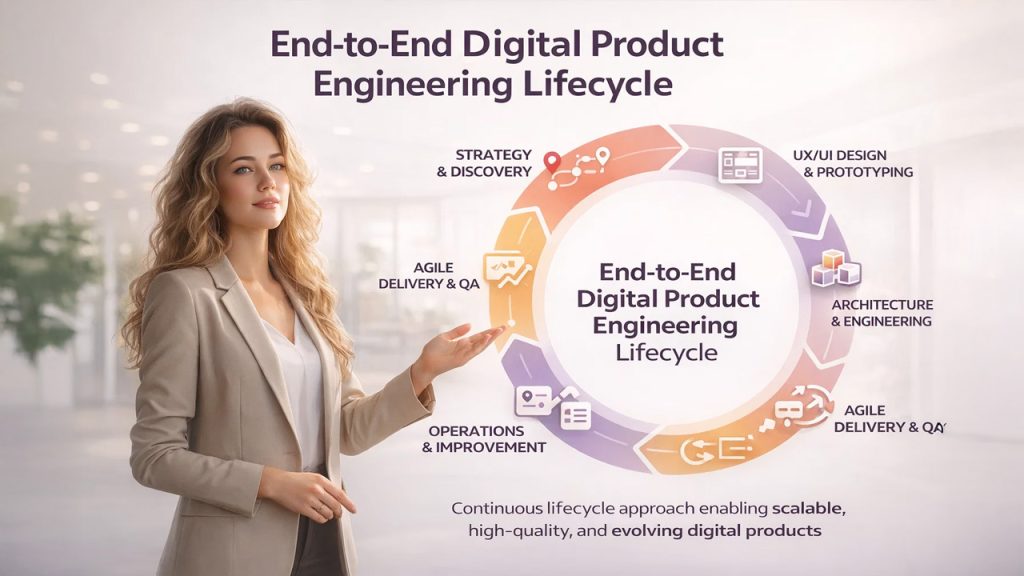
Most successful teams follow a lifecycle that keeps strategy, execution, and operations tightly connected.
1) Product strategy and discovery
This phase aligns stakeholders on the “why” and “what” before writing code:
- Define who are your target users and what are their pain points
- Map the entire customer journeys and main workflows
- Clearly mention what are your measurable outcomes and limitations
- Prioritize a roadmap based on value vs effort
- Identify dependencies such as data, integrations, compliance, vendors
Outputs usually consist of journey maps, personas, feature prioritization, and a clear MVP score.
2) UX/UI design and prototyping
A good design validates the flow early which lowers the cost and reduces risks:
- Wireframes and high-fidelity screens
- Information architecture and navigation
- Design systems to maintain consistency across products
- Track patterns in conversation and allows easy access
Prototypes are built to test with real users and gauge its functionality and useability before starting fully developing the product.
3) Architecture and engineering planning
This is where teams choose the approach that will scale:
- Monolith vs microservices (or modular monolith)
- Data modeling and API strategy
- Security architecture (authentication, authorization, secrets management)
- Observability (logging, metrics, tracing)
- Cloud topology and scalability patterns
At this step, Saudi organizations also evaluate needs for data residency, hosting, and third-party compliance requirements.
4) Agile delivery and QA
Delivery happens in iterative sprints with continuous testing:
- Backend and frontend development
- Automated unit/integration tests
- Testing performance of critical workflows
- Security testing (SAST/DAST), dependency scanning
- UAT and feedback loops with business users
For modern teams, QA is not a destination, rather it is an ongoing process.
5) DevOps, release engineering, and deployment
Release pipelines reduce risk and minimize downtime:
- CI/CD pipelines for build, test, and deploy
- Feature flags for safer rollouts
- Blue/green or canary deployments
- Infrastructure as code (repeatable environments)
6) Product operations and continuous improvement
The product is measured and improved using data:
- Analytics: funnels, retention, engagement
- Reliability: SLOs/SLAs, incident response
- Performance: latency, crash rates, scaling efficiency
- Cost: cloud spend optimization and capacity planning
This is the phase where product engineering delivers compounding returns: each cycle improves speed and quality while reducing future delivery friction.
Key benefits for Saudi businesses
With digital product engineering, organizations can move from “build and hope” to “build, measure, and improve.”
Common outcomes are mentioned below:
- Faster time-to-market: feedback loops are shorter and continuous releases
- Higher product quality: automated testing, offers improved architecture, and continuous monitoring
- Improved customer experience: design-led development and iterative UX improvements
- Scalability and reliability: systems are engineered to scale growth and uptime
- Lower long-term cost: rewrites are fewer, technical debts are reduced, and infrastructure is optimized.
- Better alignment: product teams main focus is on measurable business value
When Saudi Arabian organizations invest heavily in digitization, these benefits become a competitive advantage especially in those sectors where users’ expectations keep changing and rising.
Typical tech stack choices (and what to prioritize)
There’s no single “best stack,” but there are best practices that consistently reduce risk.
Frontend
- Web apps: React, Angular, or Vue (with strong design systems)
- Mobile: native (Swift/Kotlin) or cross-platform (Flutter/React Native) depending on UX and performance needs
Backend and APIs
- Common choices: .NET, Java/Spring, Node.js, Python, Go
- API styles: REST, GraphQL (when appropriate), event-driven integration for scalability
Data and integration
- Relational databases for transactional workloads
- Caching (e.g., Redis) for performance
- Message queues/streams for decoupling services
- Integration patterns for ERP/CRM and government systems
Cloud and DevOps
- Containerization (Docker), orchestration where needed (Kubernetes)
- CI/CD pipelines and automated quality gates
- Observability tooling for proactive monitoring
What to prioritize: maintainability, security-by-design, and clear ownership. A stack is only as good as the engineering practices behind it.
Compliance, security, and data considerations
In Saudi Arabia, enterprise buyers increasingly require strong governance around:
- Identity and access management (role-based access, least privilege)
- Audit logs and traceability for sensitive actions
- Encryption in transit and at rest
- Secure SDLC practices and vulnerability management
- Data classification and retention policies
Even if you don’t belong to a regulated industry, prioritizing security and governance concerns will help you prevent costly rework in future.
Cost and timelines: what influences them?
Digital product engineering budgets vary widely, but the drivers are consistent:
- Scope and complexity: number of user roles, workflows, and integrations
- Data and reporting needs: dashboards, analytics, and data quality work
- Performance requirements: high concurrency, low latency, and uptime targets
- Security and compliance: audits, hardening, and governance controls
- Team model: in-house vs partner-led squads; speed vs cost trade-offs
Rather than asking only “How much will it cost?”, ask:
- What is the MVP that proves value quickly?
- What is the roadmap after MVP?
- What engineering practices will prevent technical debt?
- How will we measure success and iterate?
That framing leads to better outcomes than fixed-scope planning.
How to choose the right digital product engineering partner in Saudi Arabia
If you’re working with an external partner, selection should be based on long-term product success—not just initial delivery.
Use this checklist:
- Product mindset: do they talk about outcomes, metrics, and iteration?
- Discovery capability: can they run workshops and reduce ambiguity?
- Engineering excellence: CI/CD, testing strategy, code quality standards, security practices
- Domain experience: familiarity with your industry and integration landscape
- Local context: ability to operate with Saudi business expectations, timelines, and stakeholder dynamics
- Transparency: clear reporting, predictable delivery cadence, and documented decisions
- Ownership and support: post-launch monitoring, optimization, and roadmap execution
Ask for sample artifacts (roadmaps, architecture diagrams, sprint reports, dashboards) and references from similar projects.
Conclusion
Digital product engineering serves as an essential capability that Saudi organizations need to compete in their increasingly digital business environment. The organization uses its integrated system which unites strategy, design, engineering, quality assurance DevOps and operational functions to deliver products that achieve faster market entry and dependable growth and product enhancements based on real user experience.
You should approach your digital product development process as a product journey instead of viewing it as a single project. The Saudi Arabian market for 2026 will favor organizations that establish continuous product engineering processes because these businesses will possess the strongest competitive advantage.