






Expanding a SaaS engineering team often acts as a fairly predictable hurdle for new and growing companies. The product plan is likely to develop at a quicker rate compared to the hiring process. The local talent market may become so competitive and expensive that it is difficult to find qualified candidates, and the gap between recognizing a vacancy and having a fully functioning employee in the role might, unfortunately, become longer, resulting in a significant loss of momentum. One of the more effective solutions to this issue is building nearshore development teams either wholly or partially for your engineering capacity in a neighboring country with good technical talent that has been transformed to a large extent by the problem.
For SaaS companies based in Europe and the UK in particular, technical talent in Eastern and Central Europe, combined with time zone matching and reduced costs is a very attractive option comparing with offshoring to Asia and Latin America which on the collaboration dimension cant really be considered as viable alternatives. When your nearshore team has between four and six working hours in common with your core team, the situation is quite different from outsourcing and resembles that of a distributed team, which is what the best realizations actually are.
Why SaaS Scaling Creates Specific Talent Pressure
SaaS growth curves present a unique hiring problem. The huge changes in engineering demand don't follow a smooth line; they come in waves caused by product milestones, fundraising rounds, customer commitments, and competitive pressure. A company that has to hire two backend engineers today might have to hire six after eight months. Then it may have to freeze headcount while it consolidates, then hire aggressively again when a new product line is launched.
Such variability in demand is extremely hard to manage with traditional in-house hiring alone. Recruiting cycles in competitive markets typically last three to six months from the initial discussion to a productive new hire, and the cost of carrying unfilled senior roles in terms of delayed features, overloaded existing team members, and missed delivery commitments is quite high. Nearshore development teams provide a quicker path to capacity without incurring the entire overhead of permanent headcount in high-cost markets.
The Time zone and Collaboration Advantage
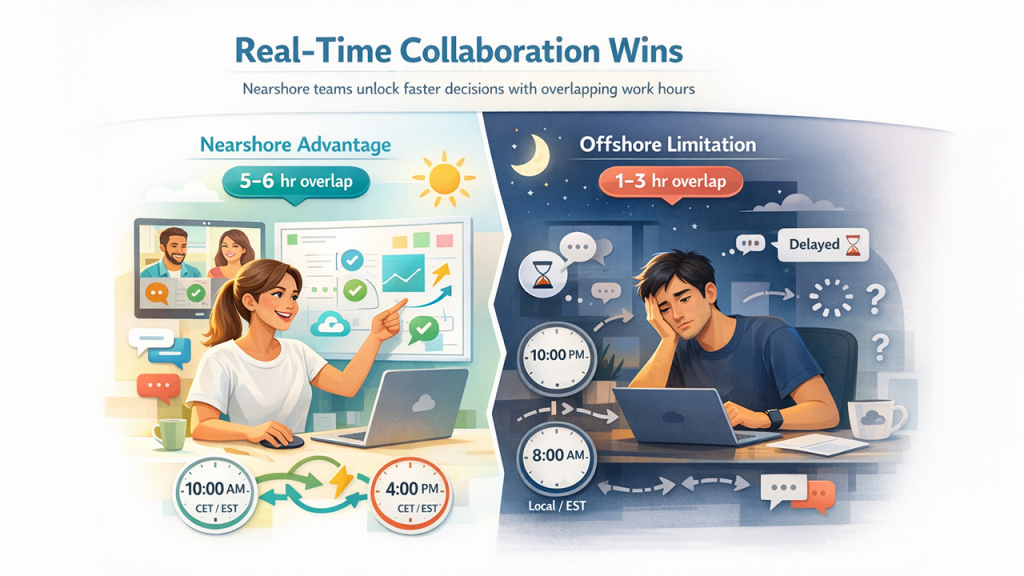
The main reason why nearshore consistently surpasses offshore for SaaS companies that deeply value collaboration is the working hours. For example, a team based in Serbia, North Macedonia, Poland, or Romania is on Central European Time, which means UK companies get five to six hours of daily overlap and Western European companies get almost full working day alignment. It is this overlap where the benefit of integration truly resides in the standups, architectural discussions, and quick feedback loops when something is not going as expected.
In contrast, offshore teams in Southeast Asia or South Asia usually can only offer 1-3 hours of overlap with European companies at best, which leads to communication being forced into asynchronous patterns that introduce latency in every decision-making. Given a SaaS product being actively developed where the requirements change swiftly and engineering decisions have effects downstream, this latency will become a real hindrance to speed.
How Good Staffing Partners Accelerate the Process
The operational overhead to build a nearshore development teams from scratch is quite significant. You have to locate candidates, evaluate them technically through an unfamiliar market of talent, get acquainted with local employment and contractor laws, ensuring compliance with payroll, and finally, integrating new hires into a working team - all these require time and local knowledge that most SaaS companies typically don't have in-house.
Staffing and recruiting partners who have expertise in the particular region can easily help you with this issue. They not only have the continuous flow of the candidates who have been pre-vetted but also are knowledgeable enough of the local market to be able to discern quality candidates from those that are merely available. Besides, they also take care of the operational and compliance requirements which make the work arrangement feasible. The SaaS firm thus gains access to top talent without needing to set up a local presence to discover and keep it.
This is the kind of work that Connect does in North Macedonia and the broader Western Balkans region, matching SaaS and tech companies with vetted engineering and professional talent and managing enough of the operational complexity that the client can focus on integration and output rather than recruitment logistics. For growth-stage SaaS companies where management attention is genuinely scarce, that operational lift matters as much as the talent quality itself.
Building Integration That Actually Works

The technical quality of nearshore engineers from Eastern and Central Europe is, by now, very well known. This region has given rise to engineering talents who have contributed to companies like Grammarly, GitLab, Pipedrive, and UIPath, to name just a few. The factor that decides if a nearshore setup can really help a SaaS company scale faster is, quite often, the quality of integration rather than technical skills.
The starting point of integration is the way nearshore engineers are placed in the team. Those companies that need to build a SaaS product that scales reliably treat nearshore developers as genuine team members rather than an external delivery function involving them in planning, product context, and architectural decisions from the outset. Developers who know what they are building and why they are doing it tend to make better decisions at all levels, and this knowledge can only come from genuine inclusion rather than managed separation.
The Compounding Returns of Getting It Right
The case for nearshore development teams in SaaS scaling goes beyond merely solving a capacity problem at the time. Rather, it is about creating a structural leverage that brings continuous benefits. If a nearshore team is deeply involved with the product team, it becomes a sort of extension of the engineering capabilities that develop alongside the company, rather than just a contractor relationship that is dismantled and recreated at each growth phase.
The cost savings yield funds for product development, sales, and other drivers of growth that SaaS companies are competing on. The time-to-market benefits in both initial hiring pace and in the enhanced collaboration quality caused by time zone alignment result in faster iteration cycles. And the possibility to tap on specialized skills at short notice means that technical expertise doesn't limit the product's capabilities.