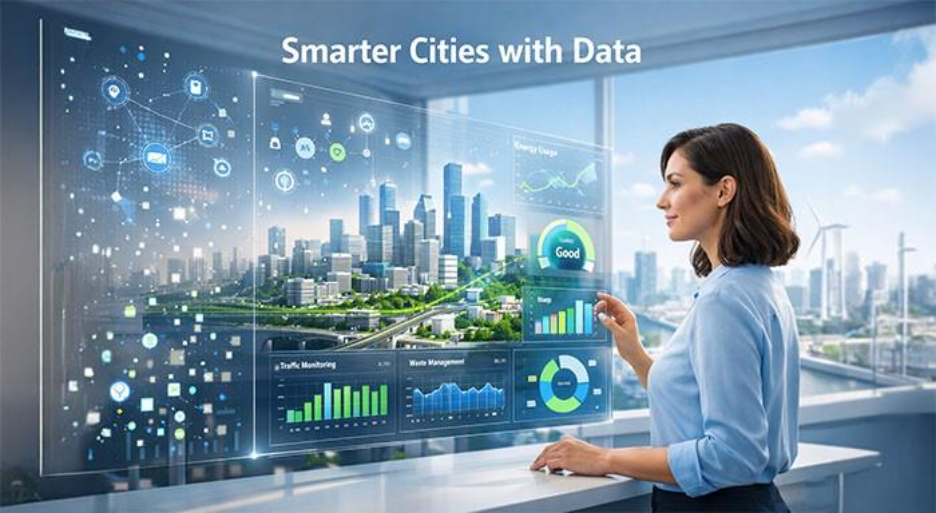






The evolving demographic shift ensures that in the upcoming years, more people are moving from rural areas to cities in search of better opportunities and lifestyle enhancement. This significantly increases the demand for effective management of mobility, security, sustainability, and waste management. This raises the importance of data in smart city management.
Smart cities are the evolving part of urban infrastructure that leverage advanced technologies to increase efficiency, sustainability, and residence comfort. This innovation layer is spreading fast, moving from IoT-enabled devices to governance models that use real-time data to make decisions. However, the growing volume of this data has become a major concern, making it difficult for governing teams to manage, process, and utilize them effectively.
Despite having numerous campaigns for smart city data management, why is it becoming a serious concern and fostering the need to adopt more modern, integrated, transparent data management practices? This guide will break down everything in simple terms, helping you understand why data is crucial for smart cities.
What is Smart City Data Management
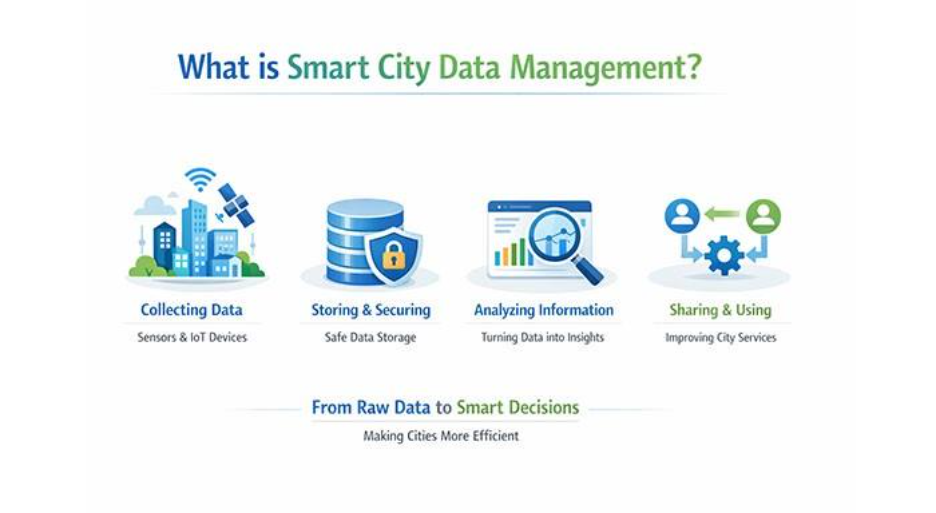
Smart city data management is the process of collecting, organizing, processing, and sharing the massive amounts of data that a city generates — so that it can be used to make better decisions and run services more efficiently.
It covers everything from how data is gathered (sensors, IoT devices, third-party apps) to how it's stored, who can access it, how it flows between departments, and how it's turned into useful insights.
Without proper data management, a city might have thousands of sensors collecting data that just sits unused, or departments that can't share information with each other, or systems that react too slowly to be useful.
Where Does Data Come From
Smart cities extract and aggregate data from a wide range of sources, including:
Internal city database: This involves GIS (Geographic Information Systems), building management systems, parking and lighting supervisors, finance data, and current surveillance framework.
IoT sensors: These are the most crucial and visible source of smart city data. IoT sensors integrated in roads, drains, streetlights, and public amenities are constantly tracking and sharing the physical insights of the city.
Third-party providers: They are energy providers, cloud platforms, weather services, public transport operators, and systems like navigation tools—each platform is dedicated to feeding data into the city's ecosystem.
Citizens: People are the first and foremost contributors to valuable data collection through mobile apps, service requests, and even social media.
What are the Biggest Challenges
Data Silos:
City departments typically use separate systems that do not communicate and share data. This creates “data silos.” For example, traffic, utilities, and waste systems work well individually, but they cannot share information. As the city infrastructure grows, these problems worsen and increase maintenance costs. Resolving these issues is not just about better technology but also needs collaboration across departments and common rules on how city data should move.
Insufficient Financial Resources:
For creating a smart city system, a significant investment in infrastructure, technology tools, and expert professionals is required. Many governance firms operate within their budget and focus on crucial public services such as sanitation, healthcare, and transportation. Therefore, this has become challenging for investing funds for modern data systems or intelligent platforms. Additionally,
A Lack of Business Models
Defining long-term business models for smart city data management campaigns is one of the major concerns for businesses. However, technology solutions help them refine efficiency, but it’s difficult to define how these systems will drive growth, generate revenue, or sustainable financial returns. This is why revolutionizing business processes with IoT helps cities to adopt the latest technologies to accelerate innovation and increase the potential benefits of smart infrastructure.
Lack of Professional Data management expert
As considering the growing volume of urban data, businesses require expert professionals to understand data governance, cybersecurity, and platform integration. Businesses often face a lack of experienced data analysts, data scientists, and IT experts, making it difficult to manage data efficiently and turn data into actionable insights. This significant gap can delay smart city projects and minimize the complete value that informed systems can offer.
The 3Vs in Smart City Data Management
Data professionals often describe the core challenge of big data using three Vs. In a smart city context, these three Vs explain exactly why data management is hard.
Volume is the sheer amount of data being generated. A single city can produce billions of data points every day. Traditional database systems weren't designed for this scale.
Velocity is how fast data is created and how quickly it needs to be acted on. A flood sensor reading from ten minutes ago might already be too late. Real-time data pipelines are essential for any time-sensitive decision.
Variety is the diversity of data types and formats. City data includes GPS coordinates, video streams, temperature readings, text messages, energy consumption records, and more — all in different formats, from different systems, with different update frequencies.
Managing all three simultaneously is the core technical challenge of smart city data management.
How Raw Data Turns into Useful Insights
Raw data on its own doesn't mean much. A number from a water level sensor is just a number until it's linked to rainfall data, drain capacity records, and historical flood maps. This process of adding context is called data enrichment, and it's where raw data becomes actionable information.
The common flow looks like this:
- Data is gathered from sensors and systems.
- Organized into consistent formats
- Optimized with additional context from other sources
- Stored, processed, and analyzed
- Then, the system turns this raw data into valuable information that cities perform and automated systems can act on.
APIs (Application Programming Interfaces) play a big role here. Instead of every city department creating its own data pipelines from scratch, APIs let systems connect to each other and share pre-processed, contextual-ready data. For example, connecting to an air quality monitoring body's API provides you with transparent, expert-verified readings rather than raw sensor noise.
Conclusion
For years, cities have been understanding that the essence of roads, water systems, and energy systems sets the foundation for the growth of infrastructure. When managed effectively, smart city data management is invisible to citizens, and its impact is almost everywhere. The data complexity happening underneath doesn't matter. What matters is that the city works better — more efficiently, more responsively, more sustainably. That's the real goal of smart city data management. Not the technology itself, but the better city that good data management makes possible.