






We can all face it now. AI video editing tools won the race. You think they won because they were futuristic and exciting? They won because editing has always been expensive, either in time, in labor, in cognitive energy, or in all at once. And yes, it was about the money, sorry.
The economics of video production deserve some attention. Yes, seemingly simple. Every additional minute of finished content required disproportionately more work behind the scenes. A widely cited rule of thumb among editors is that one finished minute can require anywhere from 30 to 60 minutes of editing time, depending on complexity. That means a 10-minute video can easily demand 5-10 hours of post-production before revisions, thumbnails, distribution formatting, or repurposing even enter the picture. That’s labour. Expensive labour. Many an online video editor caught on quickly. Clideo offered AI capabilities pretty early on. But let’s get back to our muttons.
Attach pricing to the time. Freelance video editors on platforms like Upwork often charge around $35 per hour as a median rate, while experienced specialists are charging more. Even conservatively, that places a standard 10-minute video in the $175-$350 editing range. That’s assuming limited revision cycles. And let’s not pretend any video content can go without additional revision costs.
Video Creators View AI As The Superman
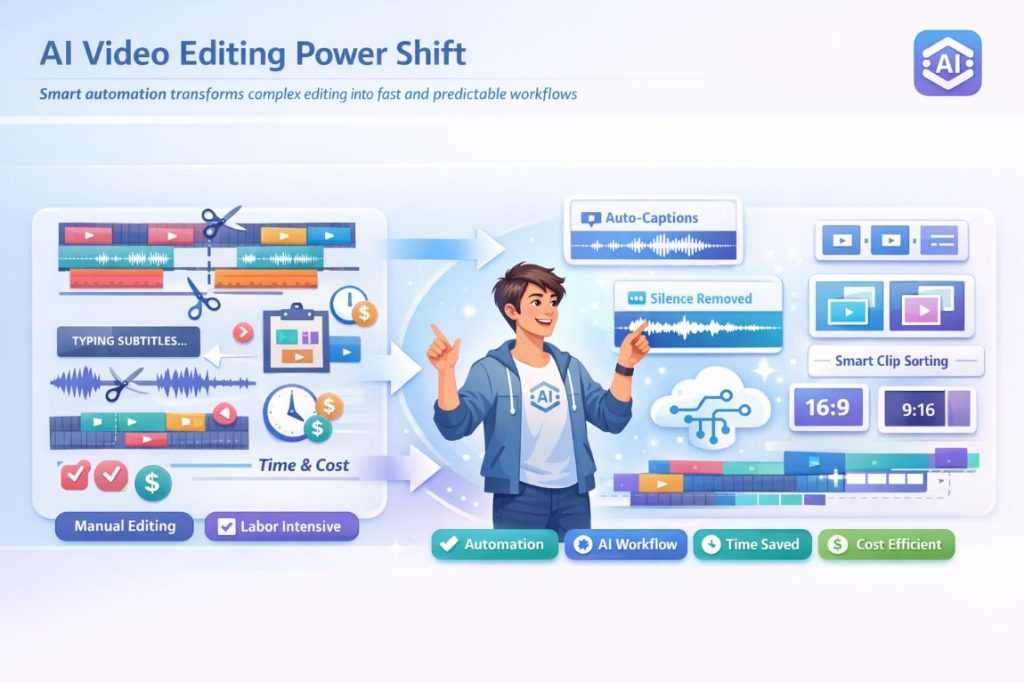
Silence-trimming, captions, clip sorting, reframing. Add to that rough assembly, add subtitles to video, and other tasks. Not to mention that for all of that creators pay subscription fees.
Let’s go over this. Yes, Clideo doesn’t charge. Look at others. Descript (starting around $16/month), CapCut Pro (around $19.99/month), Kapwing (starting around $16/month billed annually), Runway (around $12/month entry tier), and repurposing tools like OpusClip offer automation that absorbs much of the first-pass workload.
See the pattern? Editing labor moves from variable hourly cost to predictable software operating expense, a shift accelerated by generative AI solutions for businesses. Thanks to AI. If a creator or small team saves even two or three hours per week through automated transcription or silence removal, a $20-$50 monthly subscription pays for itself within days.
Can You Say Cost Collapse?
Just dotting the ‘I’s and crossing the ‘T’s. Cost collapse does not mean total spending declines. Yes, production’s cheaper per unit. But hey, output expectations are rocketing also. Because social platforms reward volume. Algorithms are all about consistency and if you put out one video per week, no one will blink twice in your direction, believe you me. Brands also demand multiple formats per campaign. Smells like creative inflation to me.
Shift the focus to short-form consumption. Everyone else already did, so let’s look at YouTube shorts. They have publicly reported roughly 200 billion daily views. They’’re not alone by the way, TikTok sees tens of millions of videos uploaded daily. What does that tell us? Only that short-form distribution has become industrialized a while ago, and we have no indication of a trend shift as of 2026.
What are platforms to do but adjust, right? YouTube recently updated Shorts view counting to register a view as soon as playback begins, aligning more closely with TikTok-style metrics, while maintaining separate engaged view thresholds for monetization. In other words, scale is the king.
Scale = Volume
Artificial Intelligence video tools make it easier to catch up with rocketing demands, we all can attest to that. Ever been tasked with a long-form video? Thanks to AI it can now be auto-transcribed, segmented into highlights, reformatted into vertical aspect ratio, captioned, distributed as five or ten short clips without you skipping lunch or working through the night. I think that’s beautiful, don’t you? You don’t pay an editing assistant. That’s a productivity bomb, or how your grandma would say it, a curse and a blessing...
A blessing, well, obvious why… And a curse because the baseline is very different. Competition drives the market, my friend. If Neighbor-Joe can produce 20 pieces of content per week, your 5 just won’t fly, honey. Automationblew the roof off output ceilings and once ceilings are blown, expectations follow.
Besides, don’t even get me started on advertising trends, because all they do is double the pressure.
Industry reports project creator ad-spend in the United States reaching approximately $37 billion in 2025, with significant year-over-year growth. Also, deliverables multiply as marketing budgets flow into short-form and creator-led formats. Campaign briefs increasingly specify multiple cutdowns, platform variations, captioned versions, localized edits, and rapid turnaround timelines.
AI Now Dictates The Flow. Take It Or Leave It
AI tools make this deliverable explosion feasible. But feasibility often morphs into obligation. Remember I called it creative inflation? I stand by it. Lower cost per asset, higher total asset demand.
Critics came up with another delightful term, AI slop. Studies cited in media reporting suggest a large percentage of videos shown to new users on major platforms consist of low-quality, AI-generated, or algorithmically assembled content optimized for volume rather than substance. Content supply surged and marginal production cost approaches zero. Noise! So much noise! But attention is still scarce, though. And through that, differentiation becomes more expensive.
If AI reduces the cost of rough cuts, it raises the competitive bar for storytelling, branding, and creative direction. Human judgment, i.e., pacing decisions, narrative arc, emotional timing, brand tone, becomes more valuable precisely because technical friction disappears. In this environment, AI video editing does not eliminate editors. It changes what editing means.
Historically, editing involved a heavy technical component: syncing audio, scrubbing through footage, managing bins, trimming filler words, formatting exports. Increasingly, AI absorbs these tasks. Adobe’s Firefly ecosystem, for example, has introduced “Quick Cut” features designed to assemble initial drafts automatically based on transcribed dialogue and clip analysis. The first draft, once the most time-consuming stage, becomes algorithmic.
Intent’s Still Human
There is a transition of editors to imaginative system designers. Their leverage lies less in timeline micromanagement and more in high-level decisions: Which clips communicate brand voice? Where does tension build? What segments should be given focus? What are the differences in a story between Tik Tok, YouTube and LinkedIn? We can refer to it as creative reallocation.
The momentum can be measured at the market level. Analysis companies projected the AI video market to be in the range of 3.8 -4.5 billion in 2024-2025, and it could reach tens of billions by the end of the decade. The wider video editing software market is in a consistent growth phase though there is a faster growth in AI-enhanced parts. TSuch increased growth is not hype. It is a transformation of form: video has taken over as the most dominant digital media, and editing has become a bottleneck. Remove the bottleneck and distribution scales.
When cost collapses, ambition expands. What are we to do with that?
Weekly publishers were formerly monthly publishers. Previously sponsored brands would hire a single hero video but today, ten clips that derive the video are needed. Agencies previously carrying out quarterly campaigns currently have rolling content calendars. The resultant economic impact is not always lower expenditure. It is redistribution. Money shifts to infrastructure. Budgets move over to manuals to tool stacks. Creative teams get smaller and output intensive. The fixed cost of experimentation reduces, making it possible to conduct additional A/B tests, additional hook variations, additional thumb nail tests. AI video editing enhances the productivity of individual workers in the economy. In common terms, it makes the game faster.
Whether AI makes video cheaper is not the main question, then. It evidently does at the unit level. The more significant issue is whether it alters the balance of cost, quality and volume. When the process of production is virtually fixed, the competitive advantage is moved upwards, to strategy, originality and audience insight.The floor rises; the ceiling remains human.
AI did not interfere with video editing because it rendered art useless. It has interfered with it by commoditizing the rough cut. The price of the entry becomes lower as a result of cost collapse. Creative inflation increases the cost of differentiation. And that is where the best economics of AI video editing can be found: a space where automation removes obstacles, increases supply, competition intensifies, and creative value is eventually redefined.