






It is important to note that an AI system is not forever reliable. As data, user behavior, and business needs change over time, even a well-developed system may degrade if it is not properly managed. In this case, it is important to consider an AI lifecycle management approach. The approach offers a framework for designing, deploying, as well as managing an AI system during its operational life to ensure it remains reliable and compliant with long-term business objectives.
Comprehensive Summary of AI Lifecycle Management
| Key Topic | Key Insight |
| AI Lifecycle Definition | AI lifecycle management is the structured process of designing, deploying, monitoring, and improving AI systems throughout their operational life. |
| Core Stages | The lifecycle spans six interconnected phases — from problem definition and data preparation to deployment, monitoring, and retirement. |
| Governance & Compliance | Effective governance ensures AI systems remain ethical, transparent, and compliant with evolving regulatory standards. |
| Common Challenges | Data drift, model degradation, siloed teams, and lack of oversight are among the most common pitfalls businesses face. |
| Best Practices | Continuous monitoring, cross-functional collaboration, and version control are critical to sustaining AI performance. |
| Business Impact | A well-managed AI lifecycle reduces costs, improves reliability, and helps organizations extract long-term value from their AI investments. |
When a Working Model Stops Working
A team develops an AI model. They've spent months on it. It performs exceptionally well in testing. It performs exceptionally well after going live. Three months later, its accuracy declines. Complaints start pouring in. No one really knows what went wrong.
This is more common than most firms will admit. The model didn't just start failing. It failed gradually because no one had thought about the post-launch strategy. That's called AI lifecycle management.
What Is AI Lifecycle Management?
The lifecycle management of AI refers to the entire process of managing an AI system from the time it is conceived to the time it is eventually decommissioned. It is a framework that helps in the development, deployment, monitoring, and enhancement of an AI system to ensure it is accurate and reliable over time.
Unlike other forms of software, where deployment is a singular event, models based on AI are constantly evolving. This is because, in the first place, they are based on data, and data is constantly in a state of evolution.
Why It Matters for Businesses
Organizations that ignore lifecycle management will likely experience the following:
- AI models that perform poorly in the real world
- Increased costs without an identifiable return on investment
- Security threats and compliance issues
- Frustrated employees because the tools no longer support their workflow
Organizations that prioritize lifecycle management will benefit from increased resiliency and scalability, and confidence in their AI investments.
The 6 Key Stages of the AI Lifecycle
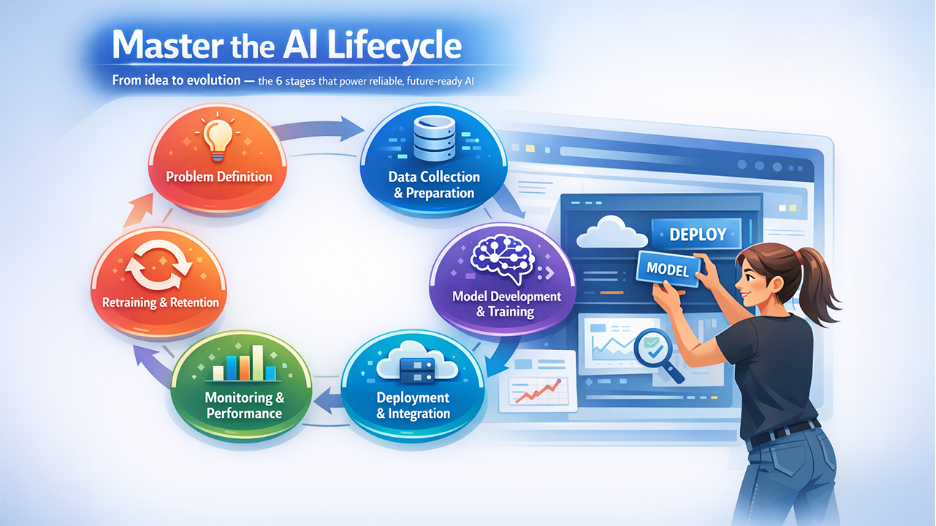
The key to developing a sustainable AI strategy is to understand the stages of AI lifecycle management. These stages are interconnected. Leaving out any of the stages means that the entire system is compromised. While the AI project cycle focuses on building and launching AI solutions, lifecycle management extends that thinking further — ensuring the system continues to perform, adapt, and remain governed well after the initial deployment.
1. Problem Definition and Goal Setting
At the heart of every AI effort is a clear question: What is the specific problem that this AI is supposed to solve? This process is about alignment, success criteria, and making sure that AI is even the right solution. Without it, we often build very impressive AI models that solve the completely wrong problem.
2. Data Collection and Preparation
Data is the base on which every AI system is built. This phase requires data to be identified, collected, cleaned, and structured for training. Some of the activities carried out during this phase are data cleaning to remove errors, handling missing data, and ensuring data is representative and unbiased. Poor data management is one of the major reasons for AI project failure before deployment.
3. Model Development and Training
With clean data in hand, the data scientists can choose the right algorithm and test it against the success metrics. At this point, there is also feature engineering and testing against a baseline. The objective of this phase is to have a model that works in the real world and not in a test environment only.
4. Deployment and Integration
Finally, deployment is where the model is moved from development to production. This is where integration with existing business systems is critical, along with scalability and stress testing. However, a deployable model is not only technically correct but must be operationally viable for those who must use it.
5. Monitoring and Performance Evaluation
This is one of the most important and most overlooked aspects of AI lifecycle management. Once deployed, the AI models must be monitored for accuracy, data drifts, concept drifts, and cost of operation. If the models are not monitored, the degradation will happen without any symptoms until it impacts the business.
6. Retraining, Updating, and Retirement
The reality is that AI models are not permanent. There is a need to retrain the models on new data sets, to prompt and tune the models, and to retire the models when they are no longer relevant. Thinking about this as the norm, as opposed to the exception, is what sets the companies that excel at maintaining their AI performance apart from those that are constantly battling the performance of their AI.
The Role of Governance in AI Lifecycle Management
Governance ensures that AI systems function within set boundaries that are ethical, legal, and operational. Therefore, effective governance in the lifecycle management of AI includes the following:
- Transparency of the AI system’s decision-making process
- Accountability and ownership of the AI system at every lifecycle stage
- Compliance with the latest regulations on AI systems, including the EU AI Act
- Monitoring of biases through audits of the outputs of the AI system
Governance is an ongoing process that occurs simultaneously throughout the lifecycle of the AI system. Its importance increases as the AI system becomes more extensive.
Common Challenges to Plan For
Even well-resourced teams encounter obstacles in AI lifecycle management. The most common include:
- Data drift and concept drift — gradual shifts in data patterns that cause model accuracy to silently decline
- Lack of clear ownership — AI models sitting in a grey zone between data, IT, and business teams with no single accountable party
- Insufficient monitoring — deploying models without the tooling required to track ongoing performance
- Budget constraints — treating AI as a one-time capital expense rather than a sustained operational investment
Understanding these challenges in advance allows organizations to plan for them before they become costly problems.
Best Practices for Sustainable AI Lifecycle Management
The following practices have consistently proven effective across industries:
- Build cross-functional teams that include data scientists, engineers, business leaders, and end users
- Monitor continuously, not periodically — real-time tracking catches issues far earlier
- Plan and budget for retraining from day one, not as an emergency response
- Maintain clear documentation for every model including training data, methodology, and change logs
- Invest in data infrastructure — pipeline quality directly determines model quality
Conclusion
The difference between an AI program that performs well over time and one that underperforms, deteriorates, and finally loses the trust of its stakeholders lies in AI lifecycle management. The choice of whether or not to use AI technology has already been made in most organizations. The choice now is whether or not to properly manage it.
Organizations that invest in a structured approach to AI lifecycle management—from data preparation through ongoing monitoring and governance—are far more likely to adapt to changing conditions, manage costs, and sustain the reliability their business requires. Lifecycle management is not optional for any organization developing or growing its AI capabilities. It is the foundation on which those investments will prove successful over time.
Frequently Asked Questions for AI Lifecycle Management
It is the end-to-end process of governing an AI system from design through deployment, monitoring, retraining, and retirement to ensure it remains accurate and aligned with business goals.
Data drift and concept drift — changes in underlying data patterns — cause models to degrade over time when retraining and monitoring are absent.
Post-deployment monitoring is consistently the most neglected stage, with many organizations treating deployment as the endpoint rather than the beginning of ongoing management.
Governance is an ongoing discipline within lifecycle management that covers ethical use, regulatory compliance, bias monitoring, and clear accountability across all stages.
Most structured frameworks identify six core phases: problem definition, data preparation, model development, deployment, monitoring, and retraining or retirement.