






AI governance maturity models give structured frameworks for assessing how businesses design, implement, track, and administer AI platforms across technical controls, policy development, validation processes, risk management, tracking mechanisms, and accountability frameworks. As AI platforms go from isolated pilots to enterprise-based deployments, approaches based on ad hoc governance greatly fail to align with compliance regulations, scalability goals, and stakeholder trust. In 2026, AI governance maturity models have become vital components for evaluating readiness of organization, prioritizing investments, recognizing governance gaps, and allowing responsible AI developments at scale while maximizing Return on Investment.
10 Second Overview AI Governance Maturity Models
- Monitor AI governance progress of your business reliably by conducting structured assessments consistently.
- Comprehensively document the assessment process and outcomes, including evidence aligning with assessment service criteria.
- Take counsel from knowledge experts from across businesses throughout the process.
- Utilize the results from assessments to create clear and in-depth improvement plans to enhance AI governance maturity of your business.
Comprehending AI Governance Maturity Models
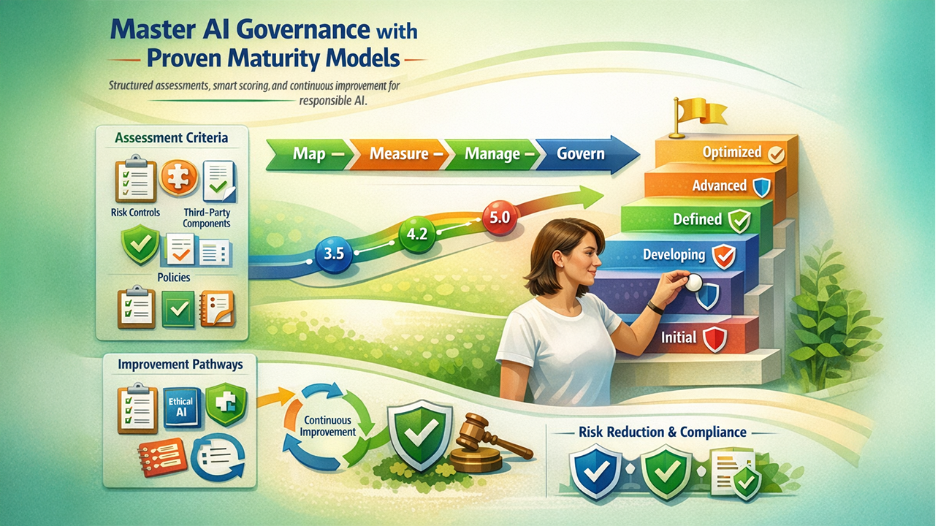
As described, AI governance maturity models are tracking devices for evaluating the progress of the businesses in executing the consensus AI governance guidelines and suggestions. While distinct models cover diverse structures, a few of the common components include the following:
Assessment Criteria:
The assessment criteria describe the dimension along with which you can measure the AI governance maturity. They can involve questionnaires that you can answer, statement to assess the accuracy degree, or rubric descriptions that are placed within tiers (like “Initial Stages” or “Optimized”).
The NIST-driven maturity model, for instance, adopts the approach of providing statements and sub-statements about distinct areas of AI governance, which are provided scores between 1-5 for higher accuracy level. One key statement, for example, is as follows “We document the system risk controls, including third-party components.”
On the other hand, the Data Ethics Maturity Model provides rubric for distinct areas involving in-depth overall assessment of company procedures and policies within such areas. The evaluator can choose which description fits the company most closely being assessed from “Initial” to “Optimized.”
Scoring and Aggregation:
The assessments on the individual assessment criteria are compiled and scored, with numerous maturity models aggregating scores on maturity tiers or levels. The precise scoring procedure varies between maturity models. The NIST-driven maturity models involve aggregating methods along with the “Responsibility Dimensions” of the NIST framework. These are the AI governance tasks like “Measure,” “Map,” “Manage,” and “Govern.”
Improvement Pathways:
While all maturity models can aid in enhancing AI governance by highlighting improvement areas. A few maturity models also provide particular suggestions for executing enhancements. For instance, the “AI Ethics Maturity Continuum” provides an “Action for Improvement” within every ethical value, including distinct actions as per maturity level and business stage.
The Significance of AI Governance Maturity Models
The objective of an AI Governance Maturity Model is to aid in reducing AI risks of businesses via comprehensive governance. The following three subsections explain main ways in which such models achieve their objectives.
Structured Assessments:
It is quite obvious that evaluating AI governance practices is important in handling AI risks. Using an organized approach to assessment by leveraging maturity models renders distinct benefits over an ad-hoc assessment method. With a complete maturity model, you have less possibilities to ignore any facets or AI governance areas. Furthermore, a structured approach is repeatable and documented, enabling progress in AI to be tracked over time reliably.
Consistent Enhancement:
Maturity models recognize weakness areas in risk management and AI governance, accentuating pathways of improvement and allowing businesses to take actions to resolve such vulnerabilities. With organized assessments performed consistently, AI governance maturity progress is reliably tracked, and which policy changes are efficient becomes greatly significant.
Comparison and Benchmarking:
With the broader adoption of AI governance maturity models, businesses will have a simpler measure to compare their AI governance approach with that of their competitors. This empowers startups and small businesses to execute the right practices and delivers evidence to experienced businesses regarding the effectiveness of their approach to governance.
AI Governance Maturity Levels
Models of AI governance maturity generally define levels or tiers of AI governance readiness and maturity. Data Ethics Maturity Model determines five maturity levels. In the ascending order of maturity, these are Repeatable, Initial, Defined, Optimizing, and Managed.
- Initial: Formal governance practices are either completely ad-hoc and non-existent with no oversight or documentation.
- Repeatable: Formal governance frameworks are present but are individually determined by distinct units and teams with no standards across the business.
- Defined: Formal governance practices are standardized and documented across the business but might not be fully adopted or implemented with all business areas.
- Managed: Formal governance rules are fully implemented, documented, and tracked to monitor compliance and effectiveness.
- Optimization: Formal governance practices are documented, fully documented, and monitored. Along with that, the practices are also consistently updated, enhanced, and adapted to comply with strategic initiatives and evolving regulatory frameworks.
| Maturity Level | Governance Features | General Capabilities | Deployment Success Rates (in terms of Reach Production) | Timeline Advance |
| Initial | No formal policies, Ad hoc processes, individual heroes, reactive incident response | Basic testing, Informal peer review, no tracking, scattered documentation | 15-30% | Baseline State |
| Developing | Standard policies set up, emerging awareness, some standardization | Risk classification, model inventory, approval templates, validation processes | 30-50% | 6-12 months from Initial Level |
| Defined | Documented procedures, standardized processes, and consistent application | Bias testing, tracking infrastructure, three lines of defense, and audit trails | 60-75% | 12 to 18 months from developing level |
| Managed | Metrics driven, quantitative management, continuous tracking | Real-time tracking, automated testing, performance dashboards, complete KPIs | 70-85% | 12 to 18 months from Defined Level. |
| Optimized | Consistent innovation, improvement, industry leadership | Automated remediation, Predicative risk management, organizational learning, and best practice sharing | 85% | Ongoing Optimization |
Leveraging AI Governance Maturity Model
AI governance maturity models are helpful tools for enhancing overall AI governance posture when properly utilized. The below section leverages the distinct uses of such models and right practices for every use.
Conducting Evaluations
The main functionality of an AI Governance Maturity Model is conducting evaluations of AI governance maturity of business. They can use a few common tips to effectively do this:
- Document the assessment process and outcomes thoroughly.
- There should be adequate paper trail so that process can consistently repeated, and the outcomes can be understood in the right context.
- If possible, you can make this documentation public to improve transparency related to AI governance
- Document the evidence you used to assess AI governance maturity.
- Get insights from organization members who are knowledgeable on the right practices when implementing assessments.
Recognizing Gaps and Opportunities:
Use risk areas’ aggregate scores and individual assessment criteria to recognize weaknesses in present AI governance practices and improvement opportunities. For example, maturity models can find metrics gaps for evaluating bias or a lack of documentation related to data collection practices. Steps can then be taken to focus on such gaps by executing bias-based metrics in assessing AI outputs and creating documentation concerning the external or internal collection of data. This is especially important because AI Transformation Is a Problem of Governance, requiring organizations to continuously evaluate, refine, and strengthen their oversight frameworks as AI adoption grows.
Creating Plans for Improvement:
Effective plans for improvement emerge from maturity models' assessment and weaknesses are identified clearly. This is true specifically when assessments are conducted clearly by documenting evidence and including a broad range of business units impacted by AI governance practices. When evaluators have evidence in hand once documentation is documented and completed, the evaluators have a comprehensive roadmap for enhancing AI knowledge and organizational insight on who can execute each facet of that roadmap.
Conclusion
AI governance maturity models ensure businesses with a structured and measurable path toward deployment of AI tools. By continuously assessing practices of governance, recognizing vital gaps, and implementing customized improvement plans, businesses can minimize AI-based risks while boosting stakeholder trust. As regulator pressures intensify and AI deployment scale across the enterprise, progressing through maturity levels, ranging from ad hoc processes to practiced and optimized governance becomes a strategic importance instead of being an optional exercise. Businesses that emphasize governance today can position themselves for compliant, sustainable, and high-performing AI processes tomorrow.
Frequently Asked Questions for AI Governance Maturity Models
The common stage of AI governance maturity involves the following: Repeatable, Initial/Ad-hoc, Defined, Managed, and Optimizing.
AI maturity tracks technical capabilities like talent, data quality, and infrastructure. On the other hand, AI governance maturity particularly examines control, policies, risk management frameworks, and accountability.
Low maturity often leads to situations like “Shadow AI” where, without any oversight, businesses can face risks such as “algorithmic bias,” “data breaches,” “regulatory penalties,” and “reputational damage.”
It gives you a roadmap to adhere to regulations such as the EU AI Act by documenting, standardizing, and testing AI platforms.
Assessments generally assess five main pillars: roles/responsibilities, policies, risk controls (security, bias), ongoing oversight, and accountability frameworks.