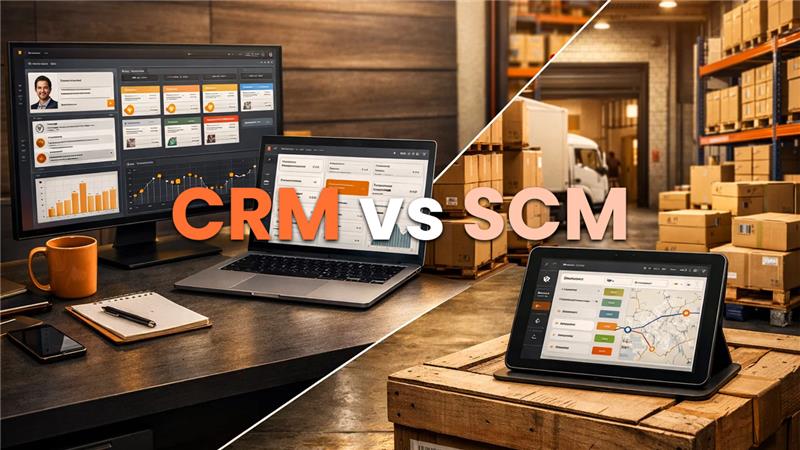






In a competitive business landscape today, you must utilize all platforms to achieve success. While there are many solutions out there, CRM and SCM are non-negotiable. Both platforms deal with large volumes of data that can give actionable insights. However, they are utilized in distinct use cases since they deal with a wide variety of data. If you are planning to invest in such platforms, you are in a perfect place. In this blog, let us first go over the basics and understand the fundamentals of CRM and SCM and then find out how the two are different. Ultimately, we will also see how you can incorporate the two for seamless flow of processes.
What Is CRM?
First, let us see what is CRM. (short for Customer Relationship Management) is a kind of system that is purpose-built to help you engage customers with customized relationships. They collect as well as assess data such as previous interactions, contact data, and completed purchases. Leveraging this data, you can get an in-depth view on your customer tastes and preferences. This will allow you to strategize and implement marketing strategies that they find attractive.
Distinct verticals of your business can benefit a lot from CRM platforms. Your marketing teams will be in a better position to monitor their campaigns and get an insight into the usefulness of each one. Your sales team can leverage data regarding previous interactions to enhance their communication with customers. Apart from that, you can also log feedback and customer complaints into the system, which will aid your customer service representatives to more effectively manage issues.
The main objective of a CRM platform is to enable you to strengthen relationships with customers, irrespective of whether they are businesses or individuals.
Understanding SCM
SCM stands for Supply Chain Management systems that allow you to simplify your supply chain processes. They do this by providing you with functionalities like product distribution and tracking, inventory management, and supply and demand prediction. Similar to CRM, numerous departments in your business can benefit from SCM software. For instance, customer service representatives can leverage tracking functionalities to reply to customer queries regarding shipments. The inventory management feature can allow your manufacturing department to make sure that they never run low on stocks. Even your accounting department can leverage data from SCM platforms to create budget and future predictions.
The main goal of SCM platforms is to make sure there is smooth production flow, starting from raw materials to all the way to customer’s residence.
What Are the Main Differences Between CRM and SCM?
As you can already find out from the definitions, supply chain management and customer relationship management play key roles at distinct points in the customer and product lifecycle. You should know that there are key differences between the two as far as goals and revenue are concerned. Let us dissect them from the following table-
| Customer Relationship Management | Supply Chain Management |
| Handles customer relationships with the help of analytics and data features as well as communication platforms. | Manages service and product inventory via the data-based approach that allows you to predict sales and monitor deliveries. |
| Onboard new customers, improve revenue, and make sure that present deals are closed soon. | Optimizes costs by streamlining various areas in the supply chain. |
| Ensure new sales through personalized marketing and retain customers through tailored management of relationships. | Enhances present sales processes by removing bottlenecks and expediting delivery times via automation. |
| Focuses on making sure that the customers are satisfied with the services and products of the business. | Focuses on making sure that your services and products are available whenever needed and delivered on time. |
Which One Must You Prefer?
Choosing between the platforms can be a tricky task, especially if you are starting out. The short and direct answer is that you should prefer both. Each of the software has unique advantages and serves distinct use cases. To make sure that your business functions smoothly, you require both platforms. Having said that, your business workflows will define which of these platforms is more significant to you.
If your business caters to a vast clientele and a long sales cycle, it is important to invest more in a CRM platform. For example, B2B transactions are generally quite personalized and complex. In such cases, CRM platforms can help you monitor the evolving requirements of your client.
Alternatively, if your core concern is to create and deliver products in a timely manner, then there is no better software for you than SCM. For example, if you manufacture car parts for one or two car manufacturers, you can manage things easily without a CRM for manufacturing. However, an SCM will be non-negotiable for you.
A wide range of businesses prefer integrating both platforms. Proper integration between SCM and CRM platforms can provide you with key insights that can allow you to overtake your competitors. We will see the main benefits of integrating CRM and SCM in the next section-
Advantages of Integrating CRM and SCM
- It Enables You to Remain Updated with Your Customer Preferences and Demands:
By monitoring buying patterns, phone calls, and franchise visits, your CRM can provide in-depth analysis of which products appeal the most to the customers. You can incorporate this with the SCM platform and deliver more products to top-value locations. This will make sure that you are always meeting the evolving demands and preferences of the customers.
- You Will Always Have an Organized and Updated Database:
Efficient SCM and CRM systems can empower you to monitor all types of data in real-time. Since your supply chain can impact customers (e.g., delivery delays) and vice versa (e.g., order cancellations), having accessibility to updated data will make sure that all stakeholders are kept in the loop.
- You Can Make Accurate Predictions:
With sufficient data, you can utilize a powerful CRM platform to assess trends in browsing behavior and purchasing. By feeding this data to the SCM, you will get insights to make accurate predictions about customers’ demands and preferences. In this way, you can design services and products in a way that targets the unique demands of the customers.
Where OutRight Store Stands in Your Journey?
At OutRight Store, you can get end-to-end CRM development, installation, integration, and customization services. Especially if you are using SuiteCRM and SugarCRM, then securing services from OutRight Store will help you to maximize their utilization. We offer around 60+ SuiteCRM and SugarCRM plugins that can transform your business processes and maximize your ROI. You can connect with us at sales@outrightcrm.com if you have further queries on whether you should purchase SCM or CRM. Feel free to check out more blogs like ERP vs CRM that can boost your technical understanding about the kind of infrastructure you need for your business.
Conclusion
Both CRM and SCM platforms are important in contemporary business processes but serve different roles. While CRM emphasizes cultivating strong customer relationships and ensuring sales growth, SCM ascertains efficient productions and delivery in a timely manner. The decision between them greatly depends on your particular business model. B2B businesses dealing with complex sales cycles may emphasize CRM, while manufacturers can require powerful SCM platforms. However, incorporating both systems ensures adequate competitive edge, ensuring real-time insights, precise demand prediction, and smooth coordination across all departments. Carefully assess your workflows to find which platforms need your instant investment, then plan for complete integration.
Frequently Asked Questions on CRM vs SCM
Yes, both platforms can help small businesses. Begin with the one that focuses on your most vital need—SCM for inventory and delivery optimization and CRM for customer relationship management.
Execution time changes as per complexity and business size, generally varying from just a few weeks for standard setups to several months for enterprise-driven personalization and integration.
Absolutely. Incorporating both platforms ensures data sharing in real-time, allowing effective demand prediction, inventory planning, and customer service via coordinated insights.
Costs change widely as per scale and features; both vary in the range of cost-effective cloud-driven solutions for small businesses to enterprise platforms costing thousands of dollars on a monthly basis.