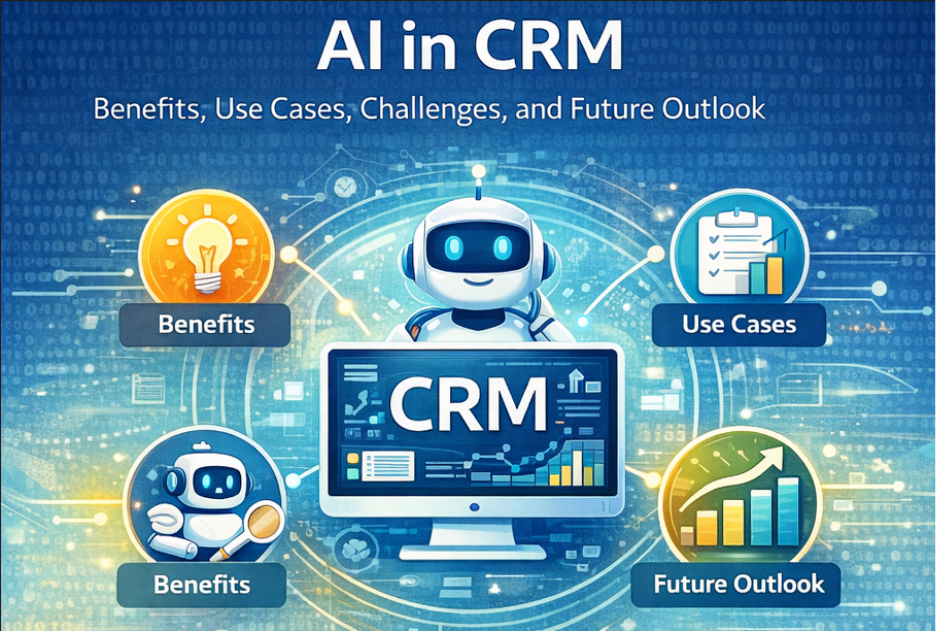






Integrating AI (Artificial Intelligence) in CRM (Customer Relationship Management) allows businesses to automate workflows and operations by streamlining and handling customer data with ease. AI offers something called predictive intelligence that vastly enhances workflow capabilities and aids organizations to develop more customized interactions with the customers. To aid businesses make sure that AI is effectively utilized in CRM, businesses must have privacy measures and data accuracy in place. The basics of customer engagement and customer relationships depend on the security of the organization and customers having a lot of trust in the organization.
60 Second Overview of AI in CRM
- The Growth of AI in CRM: The integration of AI in CRM has grown from an addition to standard databases to sophisticated generative platforms that improve data management and customer interactions.
- AI in CRM Advantages: AI-driven CRM ensures customized experiences, predictive analytics, sentiment analysis, customized experiences, lead scoring, and effective unstructured data management.
- Challenges of AI in CRM: Execution challenges involve cybersecurity risks, time-intensive setup, high costs, and balancing automation with human connection.
- Use Case Examples of AI in CRM: AI applications cover business intelligence, customer service chatbots, marketing customization, IT automation, predictive analytics, and lead management.
- Future of AI in CRM: AI will continue to revolutionize customer experiences through voice recognition, hyper-personalization, augmented reality, and greatly advanced CRM capabilities.
The Growth of AI in CRM
Integrating AI-driven tools with CRM platforms introduces a data-based approach to customer communications and enhances those communications for both business and consumers. Incorporating and automation and AI in CRM allows organizations to take management of customer data to the next level. It ensures in-depth insights on needs and preferences, customer behavior, among other critical factors. But how did AI become so important in the CRM industry? Customer engagement has become the main element in CRM. As technology has improved, the requirements of customers have also evolved. While CRM software providers have always supported the use of AI, only recently has it gained immense popularity and is transforming how companies and customers interact.
The following points explain the growth of AI in CRM-
- The original CRMs were nothing but a large database of customer data and customer interactions. They were mainly used by the accounting departments.
- As time went by, systems began to integrate more tools and features for other departments like sales teams, marketing, and customer support.
- With accelerated growth, businesses experienced evolving customer expectations and certain challenges in customer retention.
- This is why generative AI platforms have emerged and have transformed the way CRM platforms operate today.
Nowadays, organizations have diverse options if they are looking to integrate AI-driven CRM. For example, they can go for OutRightCRM (AI-powered features), IBM CRM (IBM watsonx Assistant), HubSpot CRM (ChatSpot), Salesforce CRM (Einstein GPT), Zoho CRM (Zia), Freshworks (Freddy AI), and Pipedrive CRM (AI Sales Assistant).
What Are the Advantages of AI in CRM?
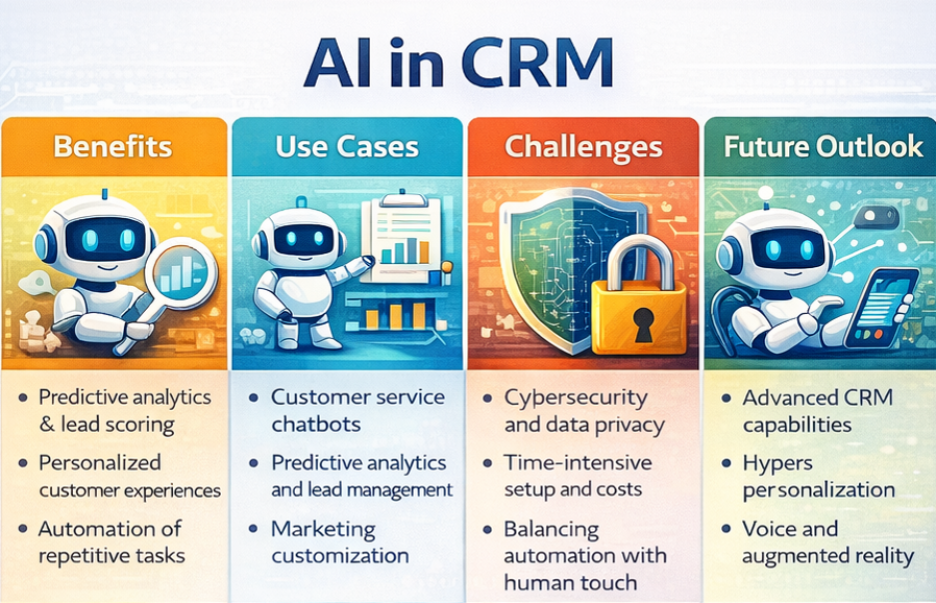
The main benefits of AI in CRM are given in detail in the following points-
Improved Reporting and Predictive Analytics-
One of the most valuable contributions of AI to CRM is predictive analytics. AI CRM platforms have improved the capabilities of data analysis that assess customer behavior and historical data. Factors like these empower businesses with data insights, sales forecasting, and simplifying certain demographics to target.
It also gives businesses centralized intelligence and unique voice on how data analysis is to be collected and utilized. The predictive system can also aid in handling customer churns and recognize key changes to the sales process.
More Customization-
AI can attract key prospects with its highly customized experiences. The AI can assess customer data through algorithms and suggest services or products that are tailored to customer requirements. Customized experience can be a major selling point for sales representatives and works as an enormous sales opportunity. This approach works across all channels including online, in-app, or in person.
Improved Automation-
Automation and AI are different tools, but both are extremely crucial to one another. AI-driven automation platforms such as virtual assistants and chatbots can manage repetitive customer interactions and around-the-clock customer support. Separately, automation platforms like AI-driven chatbots can minimize response times and provide employees more time to concentrate on more complex tasks.
More Emphasis on Sentiment Analysis-
We live in the age of social media and one thing Artificial Intelligence can significantly help is assessing text and social media channels for customer reviews. Real-time tracking of such channels allows companies to provide responsive follow-up attention as required and can play a key role in lasting customer retention.
Better Scoring of Leads-
Teams can more efficiently prioritize leads and check the possibilities to convert with AI-based lead scoring. Factors like behavior and demographics allow salespeople to target the right leads, enhancing overall upselling and sales. Apart from that, AI can also aid in segmenting leads and handle campaigns on behalf of the team.
Handle Unstructured Data-
A CRM platform manages a vast volume of data, including complex enterprise data and unstructured data that is being collected from distinct communication channels. AI in CRM can leverage tools like Machine Learning (ML) and Natural Language Processing (NLP) to assemble and streamline data in a structured way that would otherwise be disorganized. Also, it can expedite the implementation of plans as per the collected data.
Challenges of AI in CRM
Integrating AI in CRM is not going to be a smooth walk. A recent study by IBM Institute for business has revealed that around 78% of professionals feel that their business has an approach for expanding the use of generative AI in employee and customer experiences. However, the rest still are figuring out how to ascertain consistent quality. In fact, the same report suggests that 56% of professionals feel that there is no process in place to explore generative AI output and fix issues. These involve:
- Time: The starting setup of Artificial Intelligence in a CRM platform can be time-taking considering how large a business is and what particular business requirements might be. For things to run seamlessly in implementation, it is important to have an effective team interaction. The greater complexity of Artificial Intelligence in the CRM platform naturally leads to higher financial investment in integrating technology.
- Cybersecurity: The journey to top-level customer service is ensuring internal and external data entry. Most of this is the sensitive personal data of customers. It must be contained securely and only collected as per the law. Customers must also know how their information is being utilized and stored, ensuring transparency in purpose. AI in CRM must satisfy three goals of cybersecurity.
- A Balance Between Human Services and Artificial Intelligence: AI CRM can be automated at a high level and require less human connection. Customers can then feel disconnected from the organization and miss the personal conversation they had with the conventional customer service department. Furthermore, it is significant for the business that AI can only provide informational assistance. It can never be a replacement for the human voice.
What Are the Use Case Examples of AI in CRM?
The applications of AI in CRM are large and can change as per the business objectives:
- Customer Service: AI platforms, like the AI chatbots, can be utilized in the customer service strategy of the business to render quick and precise responses to inquiries. AI-driven chatbots can improve customer service and around-the-clock support for customers’ queries.
- Business Intelligence: AI platforms provide businesses with a fresh approach for distinct business areas, including marketing, sales, and customer service. AI renders insights and ideas into customer data that can allow sales representatives to make more intelligent choices and address customer requirements.
- IT Efficiency: Within CRM platforms, AI combined with automation can make processes extremely efficient by automating straightforward tasks. IT departments that leverage AI can quite easily automate tasks like diagnostics and ticket routing.
- Marketing Customization: AI-driven CRM platforms can customize marketing material and organize customers as per the incoming data points, including engagement and purchase history.
- Lead Management: By leveraging AI tools for scoring leads, the business can quite easily automate scoring process and lead qualifications within the CRM platforms. Separately, machine learning models can collect information related to the characteristics of leads and behavior further personalizing the outreach approach.
- Predictive Customer Analytics: The AI’s data capabilities are broad, especially when it comes to integration of AI in the CRM platforms. With Artificial Intelligence, businesses can leverage historical data to make accurate forecasts about customer behavior and predict the needs of the customer in advance.
- Process Optimization: When AI is integrated into a CRM platform for a certain process, not only does it streamline the operation, but it can also locate inefficiencies that are difficult to notice otherwise. Businesses can leverage AI to assess workflows and spot bottlenecks on the platform.
- Sales Optimization: AI technology aids organizations to enhance their CRM sales modules by leveraging predictive analytics to segment leads and give priority to high-value prospects. The automated workflows simplify sales processes, while the predictive analytics can help in predicting customer behavior.
What Is the Future of AI CRM?
Businesses are expected to prioritize customer experience further as hyper personalization is already the norm in the industry. Nearly, all organizations are selling a product online and competing in a landscape where personalized experience is of paramount importance to attract customers. This is where generative AI is most significant and promises to enhance as customers require recommendations, sale offers, and unmatched customer service. The way generative AI has transformed the e-commerce industry is only an indication for the things to come. As the technology of AI evolves further, businesses can only expect more sophisticated AI capabilities and AI-driven tools to boost the CRM process.
The future of AI in CRM looks promising as more AI platforms continue to be created, like augmented reality, voice recognition, and others. In the future, AI will continue to transform the way a business communicates with customers and impacts the way the world perceives customer experience. Businesses that adopt AI and smoothly integrate into the CRM process are setting themselves to enjoy great success in the future.
Conclusion
AI in CRM has vastly improved how organizations handle their customer relationships by integrating predictive analytics, automation, and customization. Ranging from sentiment analysis and lead scoring to sales forecasting and process optimization, AI-based CRM platforms allow data-based decision-making at score. However, specific challenges such as implementation costs, cybersecurity, and customers’ need for human interaction must be carefully addressed. As expectations of customers continue to rise, organizations that incorporate AI responsibly within CRM will ensure trust, enhance efficiency, and establish lasting customer loyalty in a greatly competitive digital environment.