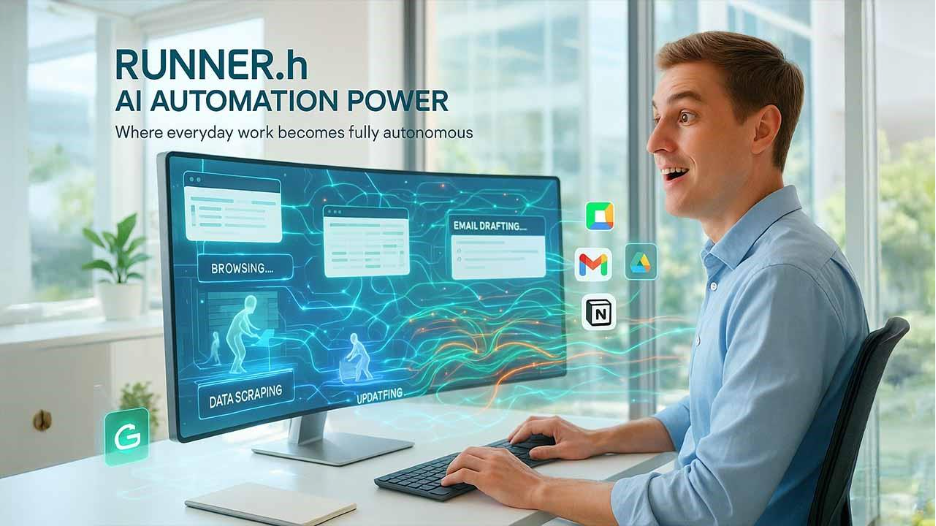






The world of Artificial Intelligence has changed from traditional one-dimensional chatbots to a more advanced execution-driven platform capable of finishing complete workflows autonomously. Runner.h showcases a major shift in this transformation, providing developers and businesses with an advanced platform that removes routine tasks via smart automation. Built by H Company, an AI startup based out of Paris and powered by $220 million funding, Runner.h has positioned itself as a flagship platform in the era of Agentic AI, providing unforeseeable automation capabilities that dynamically adjust to evolving web environments.
This complete guide explores how Runner.h is transforming web automation, its main features, use cases, and revolutionary advantages it introduces to contemporary businesses.
What is Runner.h?
Runner.h can be defined as an autonomous AI agent platform specialized in automating complex and multi-step tasks across file systems, web browsers, and business applications. The platform integrates orchestration, memory, execution, and deep application to manage tasks that conventionally needed manual intervention. Contrary to traditional automation platforms that depend on rigid scripts, Runner.h achieves a stunning success rate of around 92.2%, showcasing cutting-edge performance in computer-use technology.
The platform works easily through natural language commands, enabling users to describe critical objectives without writing a single line of code. Runner.h segments these goals into smaller processes and assigns them to dedicated sub-agents, including its browsing agent Surfer H and connected applications. This overall approach of orchestration coordinates numerous AI assistants simultaneously, ensuring finished tasks instead of simply providing inputs.
Main Architecture
Runner.h is driven by proprietary compact models such as H-LLM and H-VLM with just 3 billion and 2 billion parameters respectively. Despite its reduced size, such models outperform the Computer Use of Anthropic by 29% on WebVoyager benchmarks, showcasing specialized architecture can go beyond large generalist models in particular domains.
The memory-plus-orchestration-plus-execution framework of the platform makes sure that tasks are efficiently handled with effective retention of context throughout complex workflows. This architecture focuses on a few pressing challenges related to large language models, especially weak execution capabilities, and fragmented context.
Runner.h: Main Features and Capabilities
Automation of Natural Language
Runner.h enables users to create workflows through simple commands, reducing the need for programming expertise. Users need to detail their objectives in natural language, and the platform converts these instructions into implementable automation sequences. This accessibility makes automation quite easy to access, allowing both non-technical personnel and technical personnel to utilize sophisticated AI capabilities.
Self-Healing Technology
One of the major innovations in Runner.h is its capability of self-healing. The system adjusts to changes automatically in web interfaces without manual intervention, making sure that applications and websites evolve. Conventional automation scripts fail when interface components change their structure or position; runner.h recognizes such modifications and accordingly adjusts its interaction patterns.
This capability of adaptation is especially crucial in dynamic environments where updates occur frequently. Teams of quality assurance no longer require to continuously update test scripts, and process automation workflows remain working in spite of changes in interface.
Application Integration
Runner.h smoothly integrates with present enterprise software environments. Native connectors involve Google Calendar, Gmail, Drive, Notion, Sheets, and Slack, allowing direct integration with commonly utilized business apps. With platforms that do not have native integration, the system can ensure connections through Zapier, extending its reach virtually across any web-driven service.
This capability of integration transforms runner.h into a central hub of orchestration, coordinating actions across numerous tasks to finish entire workflows. For instance, the agent can extract data from Google Sheets, process it as per the particular criteria, update CRM system records, and send notifications via Slack—all through a single command.
Surfer H Browsing Agent
The platform hosts Surfer H, a dedicated browsing agent potent in navigating websites and extracting real-time information. This component allows runner.h to collect present information from the web, process it as per the user's needs, and incorporate it into automated workflows. Whether tracking competitor pricing, monitoring job listings, or collecting data on market research, Surfer H ensures the web intelligence required for data-driven automation.
Secure Management of Data
You can rest assured that the data is stored in workspace-specific and encrypted vaults with files retained only for task context and never utilized to train public models. Users ensure complete control over their data and can delete files at any point of time. This privacy-based approach addresses all concerns of enterprise related to regulatory compliance and data security, especially significant for businesses managing sensitive financial or customer details.
What Are the Benefits of Runner.h?
Improved Productivity
Runner.h transforms how teams approach routine tasks fundamentally. It removes the hours spent on manual maintenance and debugging, enabling teams to prioritize top-value tasks. Through automation of workflows that previously needed consistent manual interference, organizations can easily reallocate manual resources to strategic initiatives that need judgement, creativity, and interpersonal skills.
The productivity gains go beyond standard time savings. The platform can work consistently without any fatigue, manage tasks during off-hours, and ascertain work progress around the clock. This acceleration allows businesses to respond quickly to market opportunities and customer requirements.
Cost Efficiency
Compact models that enable Runner.h minimize costs by up to 5.5 times as compared to Anthropic, OpenAI, and Google. This efficiency comes from dedicated architecture streamlined for particular automation tasks instead of natural language understanding. Organizations attain substantial savings on both human effort and computation resources that required manual interference previously.
The capability of self-healing further minimizes costs by reducing maintenance needs. Conventional automation platforms demand consistent investment in script updates and debugging when interfaces evolve. Runner.h manages such adjustments automatically, minimizing the overall cost of ownership over the lifecycle of the platform.
Reliability of Operations
The high-success of the platform makes sure that the tasks get completed dependably, which is important for business processes that need constant implementation. Runner.h ensures state-of-the-art performance, outperforming market-leading solutions on public benchmarks, ensuring confidence that automated workflows will be successfully completed.
Self-healing automation particularly addresses that brittleness that besets conventional automation tools. When changes in interface do occur, systems that do not adapt well simply fail. Runner.h recognizes such situations and adopts its approach, ensuring operational continuity that businesses can depend upon.
Scalability
Irrespective of whether you are catering to individual users, large organizations, or startups, runner.h is specialized for scalable automation requirements. It adapts to numerous operational scales and different levels of complexity. Organizations can begin with simple workflows and progressively expand coverage as they become more comfortable with the capabilities of the platform.
The architecture of orchestration allows parallel execution of tasks, enabling numerous workflows to simultaneously run without any interference. This parallelism is important to make sure that the automation capacity grows with the requirements of organization, avoiding bottlenecks as usage improves.
Applications Specific to the Industry
Runner.h ensures greater value across diverse sectors:
- E-commerce: Automates inventory monitoring, product discovery, and price tracking while adjusting to regular website interface modifications.
- Financial Services: Simplifies onboarding processes via automated verification and compliance checks, minimizing processing time while ensuring accuracy.
- Recruitment: Revolutionizes recruitment workflows by automating sourcing of candidates, application screening, and scheduling of interviews from a single prompt.
- Quality Assurance: Transforms software testing by creating and executing test cases automatically that adjust to changing applications.
Practical Implementation
Get Started in a Simple Way
Organizations can easily access Runner.h via the platform of the company, available in beta version for the public. The overall process of setup involves the following:
- Create an account and set up settings on the workspace.
- Connect crucial business apps through Zapier or native integrations.
- Define starting automation workflows via natural language descriptions.
- Track implementation through H-Studio, the companion platform for developing and monitoring automations.
Real-World Application
Consider a manager in sales operations who requires updated lead data before weekly forecast calls. Leveraging Runner.h, they issue a simple instruction: "Pull the last 3 weeks job listings for CRM developers in Europe and United States, filter by companies with 200+ employees, include qualified prospects to Salesforce and create customized introduction emails for each.”
The Browse agent then proceeds to find and scrape listings; a data-based agent streamlines data in Google Sheets, and a writing agent creates custom emails, while ensuring that the team remains informed through Slack notifications. Within a few minutes, the manager checks the complete work and goes ahead with the outreach, removing the countless hours that goes into manual research and data entry.
Right Practices
To extract the right value from Runner.h, businesses must:
- Begin with routine and well-defined workflows that consume a substantial amount of time.
- Articulate task goals in natural language, ensuring appropriate constraints and context.
- Track initial implementations to validate expected outcomes and fine-tune instructions as required.
- Expand automation gradually as your confidence in the platform expands.
- Track security protocols by regularly assessing data access.
Conclusion
Runner.h showcases a foundational transformation in how businesses approach automation, going beyond rigid scripts to smart and adaptive platforms that autonomously implement entire workflows. The combination of natural language interfaces of the platform, self-healing technology, and smooth application integration addresses long-term challenges in web automation. By ensuring considerable productivity advantages, cost efficiency, and operational reliability, Runner.h allows businesses to redirect human talent toward smart initiatives that ensure competitive benefits. As AI evolves consistently from a conversational platform to an autonomous agent, Runner.h has emerged as the forefront solution in this transformation, prepared to make the most of the efficiency advantages that Agentic AI platforms provide.