





Most businesses don't track employees just to snoop. Rather, the goal is company safety. Many small businesses now have remote teams that rely on shared digital tools. These setups are useful, but they also create security risks, especially data breaches.
Employees want privacy and trust. However, the average cost of a remote work-related breach in 2025 rose to $4.56 million. Thus, it seems like responsible online monitoring can protect a business. However, extensive tracking can cause other problems, including legal issues.
Why Businesses Monitor Online Activity
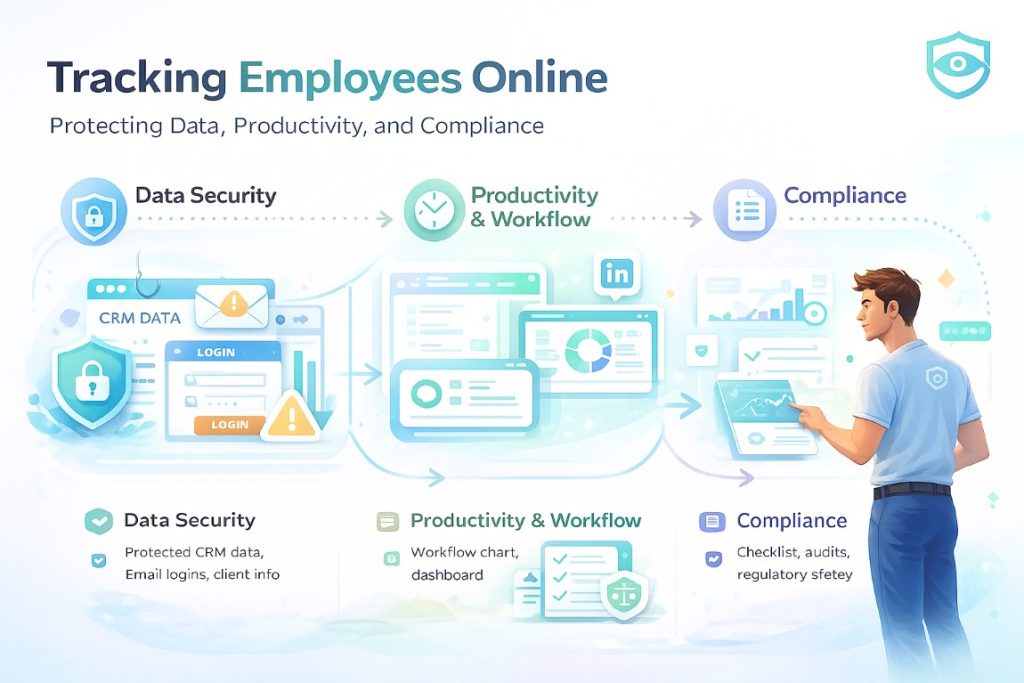
Both employees and employers often misunderstand why monitoring happens. Here are the main reasons.
Protecting Sensitive Data and Reducing Security Risks
Security is the biggest reason for employee tracking. Cyberattackers know that employee devices hold sensitive data, including:
- Company email logins
- CRM accounts
- Financial documents
- Personal information of clients
As a result, company devices often become targets for phishing and credential theft. That's where automated monitoring tools come in, flagging unsafe downloads or suspicious connections. Ultimately, it helps stop an attack before it spreads.
Improving Productivity and Workflow Visibility
Monitoring employee online activity can also improve productivity and workflow visibility across distributed teams. When businesses understand how employees use digital platforms during work hours, they can identify inefficient tools, communication gaps, and workflow delays. In many organizations, employees are also responsible for managing professional platforms like LinkedIn video marketing, where secure access, consistent publishing, and proper usage directly affect brand reputation. Responsible tracking helps ensure that work-related tools are used appropriately without interfering with employee privacy or creativity.
Meeting Compliance Requirements
Remote work increases the risk around financial records, healthcare data, and contract-related information. Because of this, proof of tracking is required by law. It also shows that staff are following proper procedures. In most cases, the process is straightforward and not as invasive as people assume.
The Risks and Drawbacks of Monitoring
Monitoring your employees can be a double-edged sword. That's why you need to think through all the implications.
Impact on Employee Trust and Morale
Trust is the biggest issue here. Employees may see monitoring as a sign of suspicion, and that can harm morale and teamwork. It can also lead to higher turnover or lower motivation.
Employers can alleviate the risks with transparency. Keep the process open and avoid tracking anything unnecessary. After all, secretive or excessive monitoring will only ever increase workplace tensions.
Legal and Ethical Boundaries
Even if employees accept monitoring, it must still follow the law. In the U.S., rules may vary, but the main requirements include:
- Providing reasonable notice
- Following consent laws
- Complying with state-specific surveillance rules
- Distinguishing a line between tracking company devices and personal ones.
To stay compliant, document why monitoring is needed and how the data will be used. Without specific clarifications, a business risks lawsuits, complaints, or reputational damage.
Privacy Concerns and Data Over-Collection
Over-collection is another major problem, as monitoring should always be intentional. Privacy issues appear when tools capture personal emails, medical details, or private browsing. Of course, this is rarely the employer's goal, but it must be prevented. Collect only the minimum amount of data necessary for security and compliance.
How to Safeguard Employee Monitoring to Maximise Potential
Monitoring plays an important part in company security, but it works best when supported by other measures.
Encouraging Secure Employee Habits
Firstly, training is essential. Employees need to understand basic cybersecurity and compliance rules. When they know why monitoring exists, it feels less intrusive. Good training also reduces the need for strict surveillance.
Detecting Credential Exposure
Some threats sit outside the company network, with credential leaks being one example. Many people reuse their personal passwords at work, which increases phishing risks. That's deeply concerning, as a stolen login could lead to fraud or business identity theft.
Dark web monitoring tools present a solution for this. They systematically scan data marketplaces for leaked accounts or documents. Employees won't notice these leaks themselves, so external checks are necessary.
Managing Remote and Hybrid Work Challenges
Monitoring office networks is simple compared with monitoring remote workers. Digital nomads may use public Wi-Fi, and home networks are far more likely to be unsafe. Open networks and the use of personal devices can make your company's data extremely vulnerable.
Remote teams face more risks, but remote work is now common. To find a middle ground, employees should be taught to use VPNs, MFA, and secure networks. Personal devices must also be registered, and the monitoring system must integrate with them.
The Balance is The Key
It's fantastic how technology is making our work more convenient each year. Our businesses benefit greatly from online tools and collaborative platforms, but there is a lot of room for error. Sadly, this means that tracking employee online activity can be unavoidable for many businesses.
However, as long as you are transparent about your monitoring policy, it shouldn't backfire. Stay mindful, track what is only truly necessary, and make sure you remain compliant with U.S. laws. Most importantly, never assume that monitoring eradicates the risk of a data breach, and don't forget other protection measures.