





Introduction
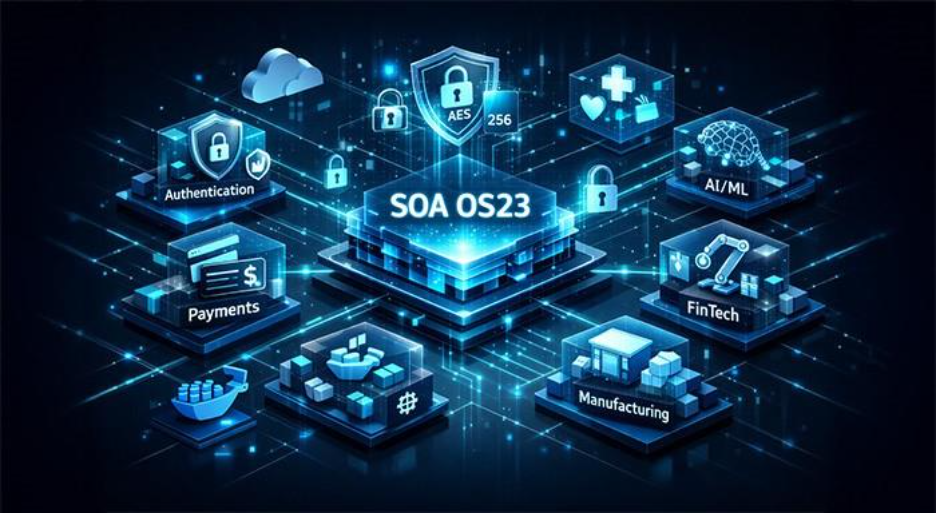
SOA OS23 (Service-Oriented Architecture Open Standard 23) is an advanced framework that divides software into reusable and modular devices. Such services coordinate with one another via standardized APIs. This design makes sure that platforms are more scalable, versatile, and simpler to integrate. The architecture emphasizes developing modular services that you can integrate seamlessly and re-utilize in a broad range of applications. It leverages standardized protocols that aid diverse platforms to collaborate with one another.
SOA OS23 adopts a microservices approach, quite different than conventional monolithic architectures where all things work as a single unit. Every service manages one particular business tasks such as payment processing, authentication, or data extraction. Such services operate independently but clearly need APIs. The number “23” in the name indicates that it is a 2023 version, which introduces new characteristics.
Importance of SOA OS23
SOA OS23 is developed on key principles of composability, reusability, and close collaboration. The system goes beyond by including event-based service hooks, support for diverse languages such as Python, Node.js, Java, Rust, and Go, offering ways to tether microservices with legacy platforms, decentralized identity modules, and message flow that ensure zero trust rules.
A considerable number of DevOps engineers, enterprise architects, and system integrators provide support to this open model. The SOA OS23 was developed from scratch to make it smoothly work with containers, manage high-availability setups, and handle tasks that do not happen instantly. This makes it a right option for IoT backends, AI platforms, financial technology and business apps that require little to no coding.
Main SOA OS23 Features
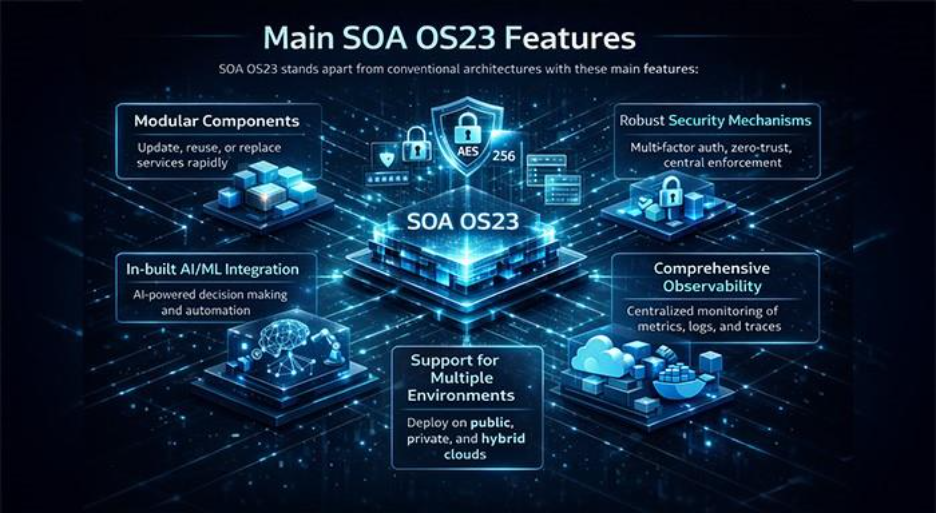
SOA OS23 stands apart from conventional architectures with these main features:
- Modular Components: You can update, reuse, or replace services on your own. This accelerates development and allows businesses to quickly roll out new characteristics with minimum risk.
- Robust Security Mechanisms: The system leverages multi-factor authentication, zero-trust policies, and central policy enforcement. The restricts how far security incidents can extend.
- In-built AI/ML Integration: It supports AI and machine learning naturally to make more effective decisions and automate processes.
- Comprehensive Observability: Teams can monitor performance through well-defined metrics, logs, and traces in centralized dashboards. This aids them in identifying dependencies and modifications at the time of incidents.
- Support for Multiple Environment: You can deploy it on public, private, and hybrid clouds. It naturally works with platforms such as Docker and Kubernetes via in-built containerization. Recent industry studies indicate that more than 80% of businesses now notice APIs as critical for digital transformation. In 2025, around 80% of businesses will operate containerized applications in 2025.
How SOA OS23 Operates?
SOA operates through a microservices architecture that allows us to design, deploy, and independently handle individual services. Every service does a particular job while remaining separate from other parts. This facilitates a simple and adaptable platform. Such services coordinate with one another through a well-defined API, i.e., Application Programming Interface.
This is quite similar to the way advanced API management software establishes multi-protocol communication across diverse enterprise platforms. This ensures there is seamless integration across a broad range of technologies and platforms while making sure that dependencies between distinct components remain minimum. Let us analyze its working with the help of the below-mentioned points:
- Managing Input Data: A consumer sends input information to a service in SOA OS23 to request data. The service then processes the information, performs its assigned task, and sends back the relevant responses. This back-and-forth communication follows conventional protocols such as Restful HTTP, Simple Object Access Protocol, Apache ActiveMQ, Apache Thrift, or Java Message Service. SOA OS23 can manage numerous protocols instantly in a single execution.
- Smart Orchestration Platforms: The architecture utilizes intelligent orchestration systems to handle complex workflows across the platform. Such platforms ensure that diverse services work effectively together. SOA OS23 implements direct one-to-one service communication with logs of messages that can be replayed instead of sending everything via central brokers.
- Security Layers: The SOA OS23 security setup has dependable protocols in-built from the very beginning. Strict measures of authentication safeguard integrity of data, and only authorized platforms can gain accessibility to the platform. The overall security framework has end-to-end payload encryption through AES256, embedded JWT (JSON Web Tokens), and call graph editing for each request. This in-depth approach makes sure that sensitive data always remains confidential throughout the platform.
- Integrating Distinct Architecture Parts: Every service endpoint operates as a self-declared module with plug-in compatibility through metadata descriptors in YAML, JSON, or ProtoBuf formats. This standardization aids in blending distinct aspects of architecture seamlessly.
- Tracking Features: SOA OS23 in-built up-to-date tracking features that showcase how effectively the platform performs. Users can quickly identify possible bottlenecks or operational problems and resolve them quickly to ensure that the platform runs seamlessly. The tracking framework connects with Promotheus and OpenTelemetry for in-depth visibility of the system.
Advantages of SOA OS23 Architecture
SOA OS23 introduces considerable advantages to enterprise IT processes. It ensures trackable enhancements in reliability of the system, speed of development, integration, and adaptability.
- Quick Development and Deployment:
SOA OS23 accelerates software delivery cycles. Development teams develop and implement applications more quickly by utilizing reuseable services instead of developing code from scratch. Reports suggest that financial companies leveraging this architecture have minimized processing time by at least 30% and enhanced satisfaction of clients. The predefined compliance of the architecture expedites development cycles. Businesses that leverage modern SOA frameworks can complete application development at least ten times more quickly than conventional methods.
The modular design completely modifies development workflows. Here, every service operates on its own, so developers can update specific aspects without impacting the entire application. This approach reduces downtime and ensures that maintenance is a lot simpler, just like workflow automation software simplifies multi-step processes across enterprise platforms. Teams can work on distinct parts simultaneously, which simplifies complex enterprise application development.
- Enhanced System Resilience:
SOA OS23 enhances system stability through isolation of faults. Its modular structure avoids problems in one service from causing failures across the system. The architecture also has changelogs, rollback features, and version control for vital features. Such characteristics allow platforms to quickly recover with minimum disruption.
The architecture goes beyond just a straightforward resilience. It establishes in-depth security measures that boost system integrity. Users get encryption protocols, role-driven access controls, secure deployment practices, and complete regulatory compliance. Services operate in isolated sandbox environments, so vulnerabilities in one module cannot affect others.
- Simpler Integration with Legacy Platforms
SOA OS23 specializes in linking old and new technologies. Its standardized interfaces and middleware translation layer seamlessly combine with legacy platforms and advanced applications. Businesses can keep their present investments while gradually enhancing their infrastructure.
Businesses can keep on utilizing their present services with this architecture. The money can be saved by re-utilizing services or converting them into public assets. The integration is more effective with third-party databases and applications through pre-developed connectors that support SOAP, Rest, and GraphQL protocols.
- Scalability Across Edge and Cloud
SOA OS23 quite easily adjusts to evolving business requirements. The architecture manages evolving workloads without any level of performance problems. It provides support to both horizontal and vertical scaling and smartly distribute traffic among a wide range of services.
This scalability works beyond conventional cloud setups and reaches edge computing. SOA OS23 locally operates services in distributed environments and provides support to microservices-driven solutions at the network stage. Such characteristics streamline bandwidth usage and minimize latency. Both of these are vital requirements for geographically spread platforms and IoT applications.
The architecture distributes network bandwidth, CPU, and memory to services as per the updated demands. This ascertains peak performance under evolving conditions.
Real-world Applications of SOA OS23
SOA OS23 aids organizations in diverse companies to solve complex challenges in operations through its standardized architectures and modular architecture.
Enterprise IT Platforms:
Organizations with complex environments leverage OS23 to develop interconnected and resilient platforms. Such systems work without any dependencies while ascertaining cohesion. Large-scale enterprises with legacy platforms can modify their architecture without re-creating an application from scratch. This approach safeguards their present technology investments. The architecture’s modular nature empowers individual departments to work independently. They remain within the wider organizational framework. The majority of companies leverage SOA mainly for the process of business process automation. This leads to measurable improvements in efficiency in logistics, finance, and retail processes.
Data Exchange in Healthcare:
Healthcare businesses leverage SOA OS23 to integrate electronic medical records with telemedicine applications and patient portals. This allows distinct digital health platforms to work smoothly together. Healthcare institutions implement on-premises SOA with live tracking systems for labs, patients, and medications. Such platforms lead to regulatory compliance and high availability. The architecture allows HL7 data exchange between diagnostic labs, hospitals, and insurance APIs. It utilizes identity tokens and rulesets compliant to HIPAA. Patient data securely moves between insurers, providers, and regulatory bodies via this integration.
Internet of Things and Edge Computing:
Manufacturing ecosystems with IoT-connected devices benefit from service communication and data management capabilities of SOA OS23. The architecture ensures a compact framework for all applications of IoT. This framework is quite effective for devices that require remote updates and local execution. Setups based on edge computing benefit from solutions based on microservices at the network edge. Such solutions minimize latency and effectively streamline bandwidth. SOA OS23 provides support to COAP, MQTT, and WebSocket protocols.
Integration of Financial Services:
Banks utilize SOA OS23 to integrate legacy systems with mobile apps. This accelerates transaction processing and enhances customer experience. Approximately 60% of financial institutions work on executing solutions by 2025. SOA ensures versatile framework that these integrations require. A fintech startup in Europe observed that their deployment has grown approximately by 42% and 30% reduced infrastructure expenses by adopting SOA OS23. Financial businesses often link fraud detection engines, KYC strategies, and payment gateways via this architecture. This generates workflows that ensure compliance without any downtime.
Intelligent Manufacturing:
SOA OS23 provides industry 4.0 environments with a flexible OS framework. This framework ensures communication between machines, efficiently processes data, and quickly responds to diverse data streams. Businesses in the manufacturing sector combine cloud services with edge devices. These connections support IoT implementations that automate their decision-making. The architecture involves modular routine services that dynamically adjust warehouse workflows. Mobile devices get real-time status updates. Businesses streamline their supply chain management by efficiently monitoring production schedules and inventory levels.
Future of Emerging Trends and SOA OS23
The development of SOA OS23 continues as emerging technologies modify the map of the architecture. Modern industries that adjust to the ever-evolving digital world have extended this framework beyond its present capabilities through strategic collaborations.
AI-based Service Orchestration:
Current trends indicate that SOA OS23 integrates AI capabilities much more deeply. This accelerates processes and is more accurate while businesses minimize costs and enhance accuracy. AI will likely handle future SOA platforms by streamlining service interactions, tracking performance, and fixing problems with minimum human intervention.
Businesses might leverage AI-driven tools to automatically create services as per business need, which minimizes development time greatly. Platforms now implement machine learning to integrate service compositions as per evolving business conditions. This leads to self-adoptive functionalities of SOA.
Blockchain Integration:
SOA OS23 integrates blockchain technology to deliver immutable audit trails and decentralized service coordination where industries just require transparency and trust. This integration enhances transaction verification and security across distributed platforms. Smart contracts automate complex processes of business while ensuring compliance with regulatory needs. This transforms organizational workflow approaches into digital environments. Financial industries specifically find blockchain integrations crucial as it includes security layers that boost present SOA implementations.
Digital Credentialing:
Modern systems ensure instant tracking and management features that streamline certification processes within SOA OS23 ecosystems. Such digital platforms simplify processes and streamline compliance across businesses. The architecture provides support to verification protocols that verify credentials across distributed platforms. Digital credentialing enhances corporate responsibility while aligning regulatory needs through standardized verification processes.
APIs Standardization:
API standardization remains vital to the overall development of SOA OS23, focusing on centralized protocols that streamline integration. Future versions will likely align with service mesh technologies and container orchestration. The principles of SOA OS23 continue to mix with serverless, cloud-native, and AI-based orchestration platforms. This makes architecture more adjustable to evolving needs.