





In an age when traditional marketing is about running an ad and crossing your fingers that it will work, performance marketing has brought data-driven precision to your digital marketing efforts. Performance marketing allows you to track clicks, leads, sales, installs, etc., which allows you to make informed decisions.
Accountability is what performance marketing is about. You only pay for actions that are meaningful to you (i.e. sales leads, website visits, etc.) and therefore have complete control over where your marketing dollars are being spent. This makes it possible for startups with limited budgets to achieve their goals, while also allowing rapidly growing brands to demonstrate increased return on investment (ROI) that traditional marketing often misses.
This guide will walk you through what performance marketing is, how it works, the main channels, key benefits, challenges, and how to build a strategy that delivers measurable growth.
What Is Performance Marketing?
Performance marketing is a result-driven digital marketing/advertising approach where advertisers pay only when a specific action is completed. That action could be:
- A form submission
- A website click
- A product purchase
- A qualified lead
- An app installed
Unlike traditional advertising methods, where advertisers must spend money to be seen first, brands invest in outcomes that directly impact growth and provide advertisers with a measurable, quantifiable ROI. It is also one of the most affordable and data-driven marketing models available today.
Performance Marketing vs Brand Marketing
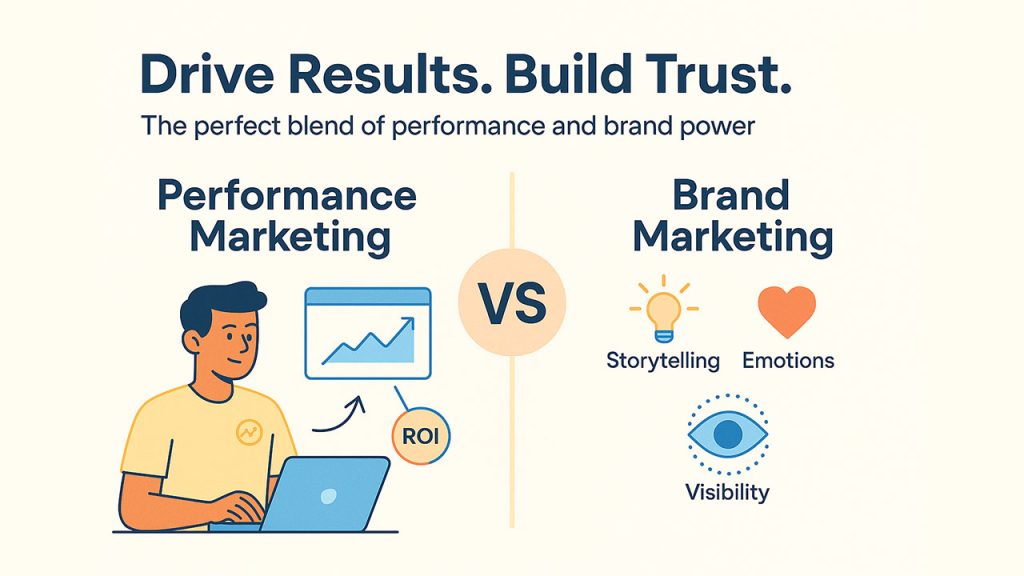
Often performance marketing and brand marketing are compared, but they both serve entirely different purposes. However, successful businesses use both together.
Performance marketing means getting measurable results in a short time. You run ads to drive specific actions like clicks, leads, or sales. Every rupee or dollar spent is tracked, and decisions are made based on real performance data. If something isn’t converting, it’s tweaked or switched off. This makes performance marketing ideal for customer acquisition, revenue growth, and campaign-level ROI.
Whereas Brand marketing seeks to create a long-lasting visibility of the business and build emotional connections based on how customers feel about the product or service offered. Think of sponsorships, high-impact video ads, storytelling campaigns, and social presence that shapes trust over time. The results here are real, but they’re harder to measure in a direct, short-term way.
Here’s how they differ at a glance:
| Performance Marketing | Brand Marketing |
|---|---|
| It prioritizes conversions and direct response. | It prioritizes awareness, recall, and emotional connection. |
| It is driven by data and optimization. | It is driven by storytelling and consistency. |
In practice, the most successful businesses don’t choose one over the other. They use brand marketing to build trust and recognition, then use performance marketing to turn that trust into action. Together, they create both short-term wins and long-term growth.
How Performance Marketing Works
Performance marketing follows a clear, repeatable process. Each step builds the next, creating a system that improves with every campaign you run.
1. Set a Clear Goal
At the outset of a performance marketing campaign — a clearly established goal. Whether this is to drive product sales, acquire qualified leads, drive traffic to your site or increase app downloads, having a clearly stated goal helps keep you focused on the objective of your campaign. It enables you to effectively measure your success. By knowing precisely what you want to accomplish, every aspect of your campaign (targeting, budgeting, and so forth) will become sharper.
2. Launch Targeted Campaigns
The next step is selecting the right platforms and building your campaigns. This includes selecting channels like search, social media, or display networks, defining your audience, creating ad creatives, and setting up the budget. Rather than broadcasting ads to everyone, performance marketing is more about reaching people who are most likely to take action.
3. Drive and Track User Actions
Once your ad is live, users begin to click on your ad. They visit your website, sign up for your newsletter, and/or purchase products. This activity can be tracked using various types of analytic tools and conversion tracking systems. This tracking enables you to have true visibility into how people are interacting with your campaign, rather than just knowing that they have viewed your ad.
4. Measure Results in Real Time
One of the greatest benefits of performance marketing is that it allows you to view data in real-time as well as impressions, clicks, conversions, costs, and revenue as they happen. With this instantaneous feedback, you will have a much better idea of what is working and not working immediately, without having to wait weeks for reports.
5. Optimize for Better Performance
Because of the availability of live data, marketers are able to continuously adjust and improve their strategy as they see the campaign develop. Changes may include adjustments to targeting, new creative ad tests, changes in bidding strategies, or improvements to landing pages. All these adjustments have one goal in mind—to lower costs while increasing conversions. Mastering the modern funnel means understanding how users move from awareness to action and optimizing each stage accordingly. Optimization turns average campaigns into high-performing ones over time.
6. Scale What Works
Once a campaign proves profitable, it’s time to grow it. Budgets should be increased carefully; winning audiences expanded, and top-performing creatives rolled out more widely. Scaling is strategic, not rushed, so growth stays sustainable.
Together, these steps form a powerful feedback loop. You plan, launch, track, improve, and scale repeatedly. That’s what makes performance marketing such a reliable engine for measurable business growth.
The Core Channels Used in Performance Marketing
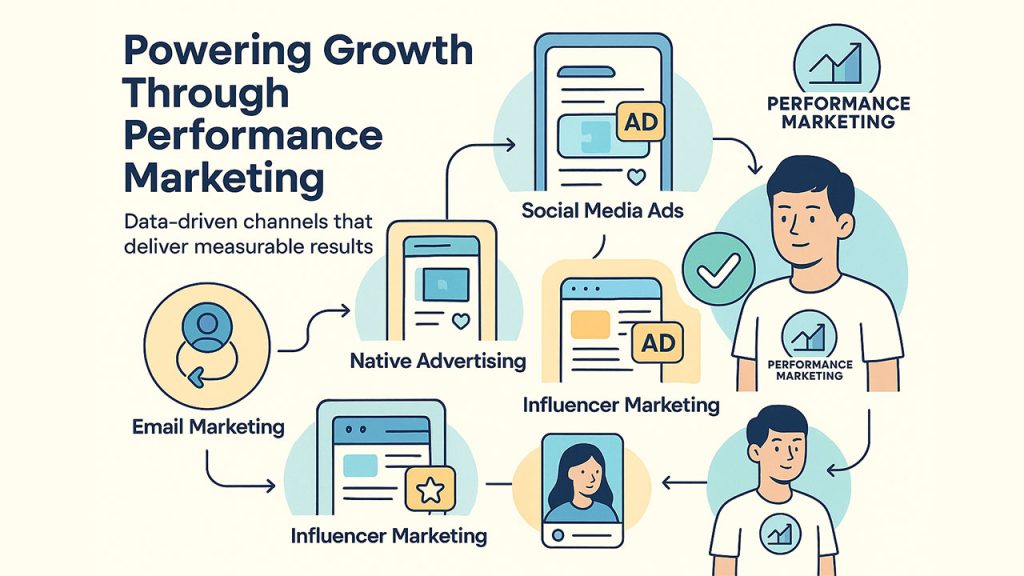
Performance marketing isn’t limited to one platform. It works across multiple digital channels, each serving a specific purpose.
1. Paid Search (PPC Advertising)
Paid search is one of the most reliable performance marketing channels. These are the ads you see at the top of Google or Bing search results.
- How it works: You bid on keywords your audience is actively searching for.
- Why it’s effective: These users already have intent; they’re looking for something specific, making conversions more likely.
- Best for: Lead generation, product sales, and capturing demand at the exact moment someone is ready to act.
2. Social Media Advertising
Platforms like Facebook, Instagram, LinkedIn, TikTok, and X offer incredibly detailed audience targeting.
- How it works: You run images, videos, carousel, or story ads targeted by interests, behavior, demographics, or custom audiences.
- Why it’s effective: You can reach people based on who they are, what they like, and how they behave online, not just what they search for.
- Best for: Brand awareness, engagement, retargeting, and lower-funnel conversions.
3. Native Advertising
Native ads blend seamlessly with the content on websites, news portals, and apps, appearing like recommended articles or sponsored posts.
- How it works: These ads match the format and tone of the platform they appear on.
- Why it’s effective: Since they feel more like content and less like ads, users engage with them more naturally.
- Best for: Driving traffic to content, educating users, and nurturing interest before pushing for conversions.
4. Affiliate Marketing
In affiliate marketing, other creators, bloggers, publishers, or influencers promote your product and earn a commission for every sale or lead they generate.
- How it works: You partner with affiliates who place your links, banners, or reviews on their platforms.
- Why it’s effective: You only pay for actual results—no upfront ad spends, no wasted budget.
- Best for: E-commerce brands, SaaS companies, and businesses looking to scale without high advertising costs.
5. Email Marketing
Email is one of the highest-ROI channels in the performance marketing world.
- How it works: You send targeted emails to segmented lists, welcome sequences, promotions, newsletters, and more.
- Why it’s effective: It’s direct, personalized, and incredibly measurable. PLUS, you own the audience—no algorithms or bidding wars.
- Best for: Retention, upsells, nurturing leads, and pushing users toward repeat purchases.
6. Influencer Marketing
Influencers help brands reach audiences in an authentic, relatable way.
- How it works: Creators promote your product through posts, videos, or stories, and you track performance using affiliate links, promo codes, or UTM parameters.
- Why it’s effective: People trust people more than ads. Influencers provide social proof and reduce friction in the buying process.
- Best for: Brand awareness, product launches, and boosting credibility with highly engaged niche communities.
Key Benefits of Performance Marketing
Performance marketing offers several advantages that make it one of the most reliable growth engines in digital marketing today. Here are the most impactful benefits:
1. You Only Pay for Results
Unlike traditional advertising where you pay for visibility, performance marketing charges you only when users act—click, sign up, download, or buy. This eliminates guesswork and keeps your spending efficient.
2. Highly Measurable and Trackable
Every campaign, click, conversion, and cost is captured in real time. This visibility makes it easier to understand what’s working and what needs improvement.
3. Easy to Optimize and Scale
Because everything is measurable, you can quickly adjust targeting, budgets, and creatives. High performing campaigns can be scaled instantly to boost results.
4. Lower Risk, Higher ROI
Paying only for outcomes means you control your costs. You’re constantly directing money toward what generates returns, giving performance marketing one of the highest ROIs.
5. Highly Targeted Reach
You can reach audiences based on interest, intent, demographics, behavior, platform activity, and more. This precision ensures your message gets in front of the right people.
6. Works Across the Entire Funnel
Performance marketing isn’t limited to sales. It supports awareness, engagement, lead generation, and retention, making it useful for businesses of all types.
Metrics That Define Performance Marketing Success
These essential metrics are your go-to for gauging how effectively your campaigns are performing:
- CPC (Cost Per Click): Shows how much you pay every time someone clicks on your ad.
- CPA (Cost Per Acquisition): Measures the cost involved in acquiring a lead, subscriber, or customer.
- CPM (Cost Per Thousand Impressions): Indicates how much you pay to show your ad 1,000 times.
- ROAS (Return on Ad Spend): This shows the revenue you earn for every dollar you invest in ads.
- Conversion Rate: This is the percentage of users who take action after clicking on your ad.
- CTR (Click-Through Rate): Measures how many people click on your ad after seeing it.
- LTV (Lifetime Value): This reflects the long-term value a customer brings to your business.
- Bounce Rate: Helps understand the quality of your traffic and the experience on your landing page.
- AOV (Average Order Value): Indicates how much customers usually spend on each purchase.
Common Challenges in Performance Marketing
Even though performance marketing is powerful, it comes with its own set of challenges. Here are the most common ones:
1. Rising Ad Costs
Competition across Google, Meta, and other platforms increases every year. Higher CPCs and CPMs can make it harder to maintain profitability.
2. Algorithm Dependence
Platforms constantly update their algorithms. A sudden change can affect your reach, targeting accuracy, or campaign performance.
3. Attribution Difficulties
With users interacting across multiple devices and channels, pinpointing where a conversion really came from can be tricky.
4. Creative Fatigue
Ads stop performing when audiences see them too often. You need a regular supply of fresh creatives to maintain performance.
5. Limited Organic Insights
Since performance campaigns are heavily focused on paid channels, brands sometimes overlook long-term, non-paid growth drivers.
6. Complex Tracking Requirements
Setting up pixels, UTM tracking, conversion of APIs, and analytics tools can be technically demanding, and errors can lead to wasted spend.
Best Practices for Successful Performance Marketing
Getting performance marketing right isn’t about complicated tactics; it’s about staying focused and intentional. Here are some streamlined best practices to sharpen your strategy:
- Set Clear, Measurable Goals: Know exactly what you want—sales, leads, traffic, or installations. Clear goals guide your targeting, budget, and reporting.
- Understand Your Audience Deeply: Great campaigns speak directly to real needs. Learn about your audience’s motivations, behavior, and interests to tailor ads that actually resonate.
- Test Creatives Often: No ad is perfect forever. Rotate headlines, visuals, and CTAs to avoid fatigue and keep performance strong.
- Optimize Your Landing Pages: A fast, simple, benefit-focused landing page can double your conversions. Don’t send good traffic to weak destinations.
- Use Data to Make Decisions: Let the numbers; not assumptions drive your choices. Pause what’s draining budget, scale what’s performing.
- Diversify Your Channels: Don’t rely on just one platform. A mix of search, social, email, and partnerships builds a more stable strategy.
- Automate Smartly: Use automation for bidding, retargeting, and reporting to save time and reduce manual errors.
- Stay Updated with Platform Changes: Algorithms and ad policies shift often. Keeping up helps you adapt before performance suffers.
Conclusion
Performance marketing offers businesses a clever way to grow—pay only for the results you achieve, quickly discover what works, and scale up with confidence. By blending precise targeting, data-driven insights, and continuous optimization, performance campaigns can provide consistent, measurable growth. It’s not merely about running ads; it’s about creating a system that gets better every day, helping your brand thrive in a competitive digital landscape.