






Understanding the Impact of Connectivity on AI Performance

As hybrid work environments solidify their place in the modern business landscape, organizations increasingly lean on artificial intelligence (AI) to drive operational efficiency, enhance customer engagement, and foster innovation. AI-powered tools-from automated analytics to intelligent virtual assistants-are transforming how teams collaborate and make decisions. However, one critical factor often flies under the radar when deploying AI solutions: the quality and reliability of the internet connection that underpins them.
Hybrid teams, by nature, depend heavily on cloud-based AI applications accessed remotely. These applications demand fast, stable, and low-latency internet connections to deliver real-time insights and seamless user experiences. Without adequate bandwidth or consistent connectivity, AI workloads can suffer from delays, errors, or outright failures. According to a recent report, 67% of businesses experienced a decline in AI performance attributed to bandwidth limitations or latency issues, highlighting that connectivity can be a significant bottleneck for AI adoption.
This statistic underscores the urgency for businesses to evaluate their current internet infrastructure critically. If your connection cannot keep pace with AI demands, your investment in these transformative technologies may not yield the expected returns. Moreover, as AI systems become more sophisticated and data-intensive, the strain on network resources will only increase, making connectivity a foundational pillar for future-proof hybrid workplaces.
The 2026 NBN Audit: What It Means for Hybrid Teams
In recognition of the growing digital demands placed on broadband infrastructure, the Australian government has scheduled a comprehensive National Broadband Network (NBN) audit for 2026. The audit’s primary goal is to assess the current state of broadband across the country and identify areas requiring upgrades to support emerging technologies, including AI, Internet of Things (IoT), and 5G integrations.
For hybrid teams, this audit represents both a challenge and an opportunity. Seamless access to cloud AI tools, real-time data processing, and collaborative platforms hinges on broadband networks that meet stringent performance criteria. Organizations must scrutinize their existing connections to determine whether they comply with the audit’s evolving standards and are capable of supporting AI workloads without interruption.
Navigating the complexities of this transition can be daunting. Businesses should consider partnering with trusted IT providers who specialize in connectivity solutions tailored for AI-driven hybrid environments. For example, Lumintus in Durham offers bespoke services designed to optimize network infrastructure, ensuring that AI workloads run smoothly regardless of team location or device. These partnerships can provide invaluable expertise, helping organizations align their broadband capabilities with the requirements set forth by the NBN audit.
Cybersecurity Considerations Amid Connectivity Upgrades

While upgrading broadband infrastructure is essential for AI performance, it also introduces new cybersecurity challenges. As AI becomes more deeply integrated into business processes, the volume and sensitivity of data transmitted over networks increase substantially. Hybrid teams accessing confidential information from diverse locations heighten the risk landscape, making robust cybersecurity measures indispensable.
Enhanced connectivity can inadvertently expand the attack surface, exposing vulnerabilities if not managed properly. To mitigate these risks, organizations should engage with specialized cybersecurity firms that understand both AI and network security intricacies. Companies like NexaGuard IT for Westminster businesses offer comprehensive cybersecurity solutions tailored to businesses adapting to new broadband standards, ensuring that connectivity improvements do not compromise data integrity or privacy.
These experts can assist with deploying advanced encryption protocols, real-time threat monitoring, and secure access controls-critical components to safeguard AI workloads in hybrid settings. Integrating cybersecurity into connectivity upgrades is not merely a best practice; it is a necessity for maintaining trust and compliance in an increasingly regulated digital environment.
Measuring Your Current Connection’s AI Readiness
Determining whether your internet connection is fit for AI workloads requires a nuanced approach beyond simply checking download speeds. Key network metrics such as latency (the delay before data transfer begins), jitter (variability in packet delay), packet loss, and upload speeds can all profoundly impact AI application performance. This is especially true for real-time AI functionalities like video conferencing with AI enhancements, collaborative data analytics, or virtual reality experiences.
Recent studies have shown that even modest increases in latency can reduce AI application responsiveness by up to 30%, severely affecting user experience and productivity. For hybrid teams relying on instantaneous AI feedback, these network characteristics are critical performance indicators.
To assess AI readiness, IT teams should conduct comprehensive network performance tests that simulate AI workloads under typical operating conditions. Tools that measure jitter, packet loss, and round-trip time can reveal hidden bottlenecks that standard speed tests might miss. Understanding these parameters enables targeted interventions, such as upgrading hardware, optimizing routing, or increasing bandwidth allocations, to ensure AI applications operate without lag or disruption.
AI-driven tools such as content generators and humanizers rely heavily on stable connections for accurate results. For example, platforms like AI humanizer tools require consistent processing speeds to maintain natural output quality.
Preparing for the NBN Audit: Steps for IT Teams
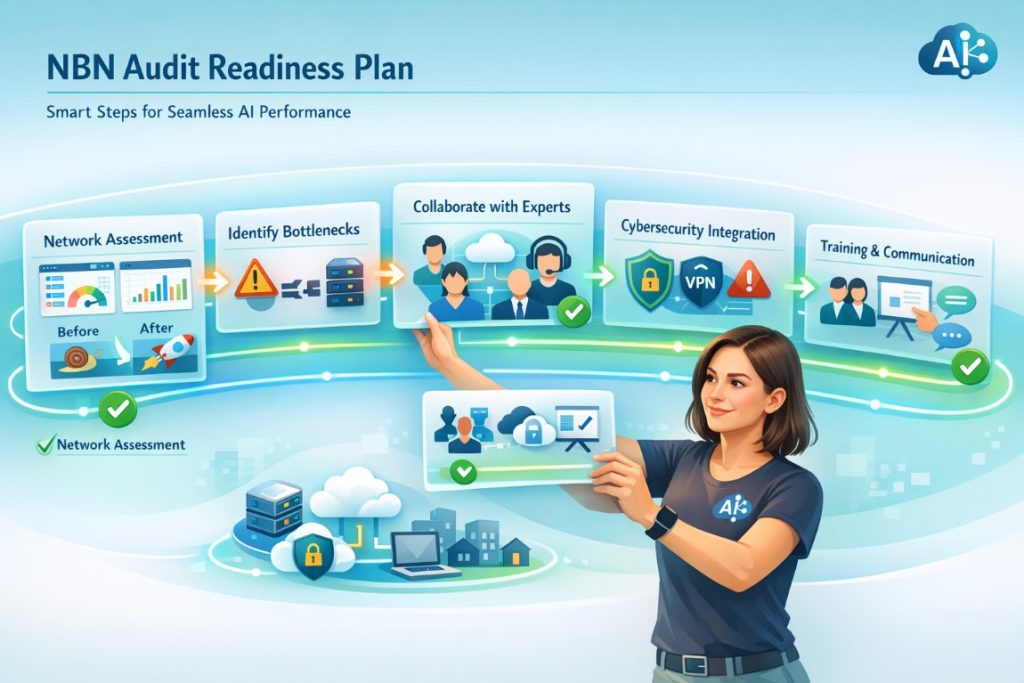
With the 2026 NBN audit on the horizon, IT teams play a pivotal role in preparing their organizations for the broadband upgrades necessary to support AI in hybrid work settings. A proactive and systematic approach will help minimize disruptions and maximize the benefits of enhanced connectivity.
Key steps include:
- Conducting Detailed Network Assessments: Evaluate current infrastructure with a focus on latency, jitter, packet loss, and bandwidth utilization specific to AI workloads.
- Identifying Bottlenecks: Pinpoint hardware limitations, outdated equipment, or network configurations that impede AI performance.
- Collaborating with IT Service Providers: Engage experts who can develop tailored upgrade roadmaps aligned with both NBN audit requirements and organizational AI strategies.
- Integrating Cybersecurity Best Practices: Ensure that connectivity enhancements are accompanied by robust security measures, including firewalls, VPNs, and intrusion detection systems.
- Training and Communication: Prepare hybrid teams for upcoming changes through training sessions on new technologies and updated security protocols.
By embracing these steps, organizations can position themselves to leverage the full potential of AI without compromising network stability or security during the audit process.
The Business Case for Upgraded Connectivity in Hybrid Workplaces
Investing in advanced broadband infrastructure transcends technical necessity; it is a strategic imperative that drives measurable business outcomes. For hybrid teams, upgraded connectivity translates into reduced downtime, faster data processing, and enhanced collaboration capabilities-key factors that boost productivity and foster innovation.
A recent survey revealed that businesses upgrading their broadband to support AI applications experienced a 25% increase in operational efficiency within the first year of implementation. This significant uplift illustrates the direct correlation between connectivity investments and improved business performance.
Beyond efficiency, enhanced broadband facilitates better customer experiences by enabling AI-powered personalization, quicker response times, and seamless omnichannel interactions. It also supports scalability, allowing organizations to expand AI initiatives without being constrained by network limitations.
Moreover, robust connectivity underpins employee satisfaction in hybrid setups by minimizing frustrations caused by slow or unstable connections. This, in turn, supports talent retention and engagement, critical components in today’s competitive labor market.
Future Trends and Connectivity Considerations
Looking beyond the immediate horizon of the 2026 NBN audit, businesses must anticipate evolving connectivity demands driven by AI advancements. Emerging technologies such as edge computing, 5G integration, and augmented reality will place new pressures on network infrastructure.
Edge computing, for example, processes data closer to the source to reduce latency-a boon for AI applications requiring instantaneous responses. However, this approach necessitates networks capable of handling distributed data flows efficiently. Similarly, 5G promises ultra-fast speeds and low latency but requires complementary broadband networks to maintain consistent connectivity across hybrid teams.
Organizations should adopt a forward-looking mindset, incorporating flexibility and scalability into their network upgrade strategies. This ensures that investments made today remain relevant and effective as AI and hybrid work models evolve.
Conclusion: Future-Proofing AI in Hybrid Teams
As the 2026 NBN audit approaches, the imperative for organizations is clear: critically assess whether current internet connections can sustain the growing demands of AI in hybrid work environments. Connectivity is no longer a background utility but a strategic asset that determines AI’s effectiveness and, by extension, business success.
Partnering with specialized IT and cybersecurity providers will streamline the transition, ensuring that broadband enhancements translate into improved AI performance and secure operations. These collaborations empower businesses to navigate the complexities of infrastructure upgrades confidently.
By prioritizing connectivity upgrades now, organizations unlock the full potential of AI, enabling hybrid teams to thrive in an increasingly digital and interconnected world. The 2026 NBN audit is not just a regulatory checkpoint-it is a catalyst for innovation, productivity, and resilience in the hybrid era.