






Java is often regarded as the “Write Once Run Anywhere” language. It is more secure, portable, and platform independent. Its powerful features have positioned it at the forefront of the software development landscape for over two decades. All software developers who want to establish a rewarding career path must be proficient in Java programming language. In this write-up, we will briefly discuss the fundamentals and features of Java and understand why it is so popular around the world.
Why Is Java So Popular?
There is no doubt that Java is one of the top 7 in-depth technical skills to learn in 2026. The popularity of Java in the programming landscape can be traced to the combination of platform independence, a powerful ecosystem, and higher flexibility. One of the key features of Java is its principle of “Write Once Run Anywhere.” This empowers developers to develop applications that can smoothly run on distinct platforms without modification. The platform independence is implemented through Java Virtual Machine (JVMs), which processes the Java bytecode. Furthermore, the object-oriented nature of Java enhances reusable and modular code, improving scalability and maintainability.
The simplicity and readability of the language contribute to its broad adoption, making it accessible to both new and proficient developers. The commitment of Java to strong memory management, automatic collection of garbage, and in-built security characteristics facilitates the development of powerful and secure apps, minimizing the risk of system crashes.
The extensive standard library of Java and consistent updates make sure that it remains relevant and aligned with the evolving requirements of the industry. With its reliability, versatility, and broad usage in vital industries like healthcare, finance, and telecommunications, Java is still one of the pillars of software development, attracting both expert professionals and the ones who are new to the field.
What Are the Features of Java with Examples?
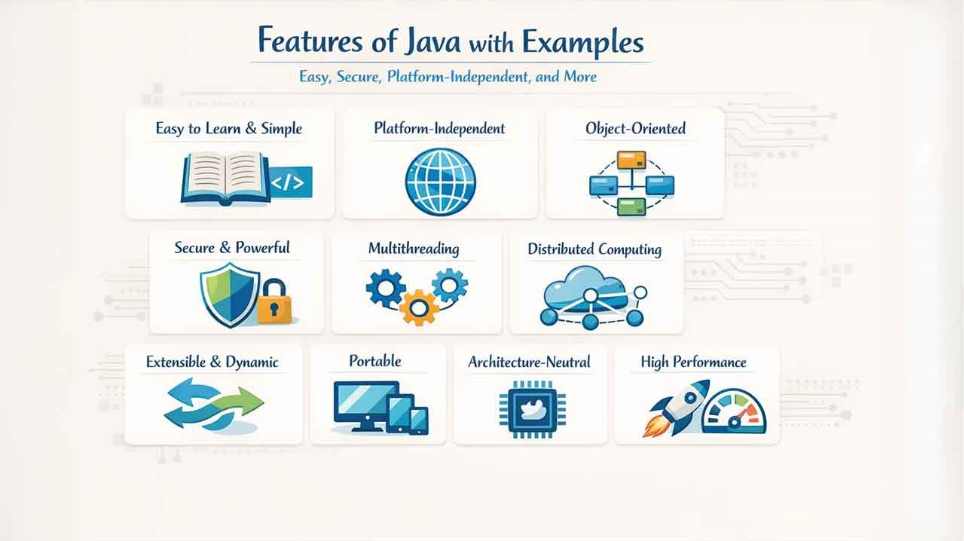
Easy to Learn and Simple:
The syntax of Java is designed to be simple and developer friendly. With its similarity to other coding languages such as C# and C, web developers consider it accessible and easy to learn.
Platform-independent:
One of the main characteristics of Java is its platform-independence. The principle of “Write Once Run Anywhere” allows Java code to be compiled into a bytecode that can operate on any device with a JVM (Java Virtual Machine). This platform independence allows developers to develop apps to create applications that can run smoothly on distinct platforms without modification.
Object-oriented:
Java is a comprehensive object-oriented language, focusing on the use of objects and classes. This approach emphasizes reusability, modularity, and a clear structure in the organization of code.
For instance, in Java, a developer can create a class “Car” with attributes such as “color” and “model” and instantiate numerous objects that represent cars.
Secure and Powerful:
The design of Java puts emphasis on robustness and reliability. It involves characteristics such as exception handling, automatic garbage collection, strong memory management, and minimizing the possibilities of system crashes.
The security characteristics in Java, like the absence of secure runtime environments and explicit pointers, improve its reputation as a reliable programming language to develop secure apps.
Multithreading:
Java provides support to multithreading, enabling concurrent implementation of numerous threads within a code. This feature improves responsiveness, performance, and effective utilization of systems’ resources.
Developers can leverage thread class of Java or execute the runnable interface to generate multithreaded apps.
Distributed Computing:
Java is apt for distributed computing. Its Application Programming Interface and Remote Method Invocation for socket programming streamline the distributed application development.
Understanding the features of Java is vital to establish a rewarding career path in Full Stack Development. Sign up for a complete course in Full Stack Development to understand its industry significance.
Extensible and Dynamic:
The dynamic nature of Java enables developers to adjust and change the code at the time of runtime. This extensibility facilitates the development of adaptable and scalable software.
Portable:
The portability of Java comes from its capability to operate on any system that has a Java Virtual Machine (JVM). The feature stems from a platform-independent bytecode that Java programs convert into when they are compiled. This bytecode is workable across all machines that have a JVM, without requiring changes to the code.
Architecture-Neutral Design:
Java works on architecture-neutral design. This means that once the code is compiled, the bytecode can operate on any processor type. Java can achieve this by overlooking features that are particular to the specific architecture in both its runtime and language. Consequentially, Java operates the same way across distinct hardware setups.
Interpreter:
Java compiles programs and creates a bytecode. The JVM interprets the bytecode and runs it. This ensures a lot of flexibility in Java. The code that is once compiled can easily work across any device that has a JVM. This is irrespective of what the core architecture is.
Ever evolving:
Java is ever-changing as it provides support to loading, linking, and unloading of classes as the program runs. This enables programs to evolve and change at the time of execution, making certain features possible such as runtime polymorphism and the capability to load classes over a network.
High-performance:
Java is a highly interpreted language. However, it renders robust performance through JIT (Just-in-Time) compilation. The JVM converts bytecode into native machine code while the program runs. This can enhance the performance of the code paths that are executed often.
What Are Different Applications of Java in 2026?
The distinct features of Java make it suitable in different applications. The diverse applications of Java language are given as follows:
1.Web Development: Java is used frequently to develop client-side and server-side applications.
2. Mobile Application Development: In industries, the key language that is utilized to develop Android apps is Java.
3. Enterprise Software: CRM (Customer Relationship Management) software and other reliable, large-scale, and scalable enterprise apps are built frequently via Java.
4. Desktop Apps: Java is a relevant language for developing desktop apps because of its cross-platform characteristics.
5. Embedded Systems: Java is utilized in embedded systems including Internet of Things devices and smart cards.
6. Healthcare: Java is a useful programming language used in the development of telemedicine applications, healthcare information systems, digital health apps, and medical imaging software.
7. Ed-tech Solutions: Java is utilized frequently to develop ed-tech tools like learning management systems, interactive instructional tools, student portals, etc.
Conclusion
The different features of Java have made it a great choice in the landscape of software development. Its platform independence, simplicity, strong security, and object-oriented design make it a top choice to develop a broad range of applications. As developers continue to explore dynamic capabilities and versatility of Java, it remains one of the standard tools in the ever-evolving technological landscape.
Understanding Java is vital for developing powerful applications and lays out the foundation for becoming a proficient programmer. Irrespective of whether you are an experienced developer or a novice, if you want a lucrative career in software development, then Java is one of the pivotal skills you can learn.