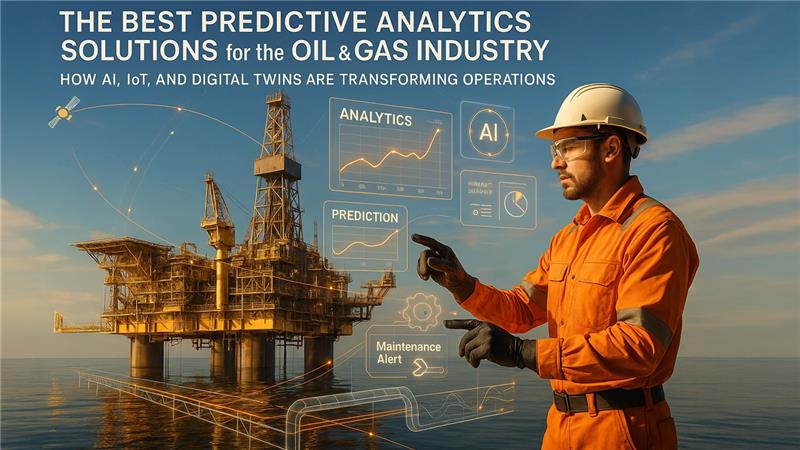






The oil and gas industry has been under serious pressure in recent years — unstable prices, tighter environmental rules, and growing competition. Companies need to predict issues before they hit, from failing equipment to shifts in demand. That’s exactly where predictive analytics in oil and gas industry comes into play.
In simple terms, it analyzes huge volumes of operational data to forecast what happens next. Sensors on rigs stream millions of data points, algorithms detect patterns, and teams get early warnings — whether it’s a breakdown days in advance or the right moment to drill a new well.
In this article, we’ll look at how the predictive analytics market is evolving, the technologies driving the change, and the companies offering the most compelling solutions today.
What's Happening in the Market: New Tech and Experiments

The market for analytics in the oil and gas sector now feels like a full-scale tech testing ground. Companies are experimenting with everything — machine learning, digital twins, advanced sensors — and a few trends clearly stand out.
First, IoT integration has gone mainstream. What used to be a handful of sensors is now dense networks covering every inch of equipment. This creates massive real-time data streams: temperature, pressure, vibration, chemical composition — all sent to the cloud and processed by analytics engines.
Second, we’re seeing early systems that blend predictive analytics with satellite imagery. Companies analyze landscape changes around fields in order to predict geological risks or optimize logistics. For example, Shell introduced a system that can track methane emissions from space and predict potential leak zones.
Another emerging direction is AI-driven price forecasting. Companies are building models factoring everything from weather patterns in key regions to political news. The accuracy isn't perfect yet, but the progress is notable.
Digital twins — virtual replicas of physical assets — are becoming more common too.
Operators can practice scenarios on a virtual model of a platform or pipeline without risking the actual equipment. This will be very useful when planning for complex maintenance.
Finally, predictive analytics in oil and gas industry is reaching beyond upstream. Downstream operations-refining and distribution-are using analytics to streamline processes and reduce emissions. This shift is becoming a necessity in light of new, stricter environmental regulations in Europe and North America.
Ten Developers Worth Watching
Time to meet the companies building tools for oil and gas predictive analytics. Some are giants with years of experience, others are young startups with revolutionary ideas.
1. DXC Technology
Let's start with DXC Technology, a company that develops comprehensive solutions for the energy sector. From geological modeling to operations optimization, the whole chain is represented on this platform. Along with predictive analytics in the oil and gas industry, DXC is actively developing renewable energy software development to help companies diversify portfolios and be ready for energy transition. Smart moves, as many oil giants are investing in wind and solar right now.
DXC takes an interesting approach to integration: they don't just sell software; rather, they work more like partners, customizing the systems based on the particular needs of each client. The predictive maintenance solution provided by them cuts unplanned downtime by 30-40%, which for a big field means millions of dollars saved. How Analytics Improves Customer Retention? In the energy sector, this means long-term partnerships with industrial customers by showing consistent reliability and operational excellence with data-driven insights.
2. IBM Watson IoT
Everyone has heard of IBM, but the oil and gas industry solutions they have available must be highlighted specifically. Utilizing artificial intelligence, Watson IoT can quickly evaluate and analyze massive amounts of data from thousands of available sensors simultaneously. This allows the system to build a profile of normal operating conditions through machine learning techniques and enables the identification of abnormalities, providing alerts of potential issues days or weeks before failure occurs.
IBM's particularly strong with data visualization. Their dashboards are intuitive even for people without technical backgrounds. A manager sees the status of all assets in real time and can make decisions fast.
3. GE Digital (Predix)
General Electric built Predix — a platform specifically for industrial IoT. For oil and gas they developed modules monitoring turbines, compressors, and pumps. Predix collects data on vibrations, temperature, load and builds equipment wear models.
Cool feature — you can compare performance of identical equipment across different sites. If one pump works better than another, the system suggests which parameters to adjust.
4. Microsoft Azure AI
Microsoft offers a cloud platform with ready-made modules for predictive analytics. Their advantage — scalability. A small company can start with a basic package, then expand functionality without switching systems.
Azure integrates well with other corporate tools — from ERP to HR systems. This lets you build end-to-end analytics: from the field to financial reports.
5. Siemens MindSphere
Siemens bets on digital twins. Their MindSphere platform lets you create virtual copies of plants and wells, then test different scenarios on them. Want to know how changing operating mode affects productivity? Run a simulation and see results in minutes.
MindSphere's especially popular in Europe, where companies value German quality and reliability. The system works well for complex technological processes with many interdependent elements.
6. SAS Advanced Analytics
SAS is a veteran in the analytics field. Their tools are used in science, finance, medicine. For oil and gas they offer specialized models that forecast field depletion, optimize drilling programs, and manage risks.
SAS's strength — working with unstructured data. The system can analyze geologists' text reports, core photos, even social media to identify factors affecting operations.
7. Oracle Analytics Cloud
Oracle offers solutions covering the entire project lifecycle. From exploration planning to field decommissioning. Their analytics platform integrates with Oracle ERP systems, making implementation easier for companies already using this vendor's products.
Oracle Analytics handles financial modeling well. You can forecast not just technical metrics but economic project efficiency accounting for fluctuating oil prices.
8. C3 AI
C3 AI is relatively young but has already worked with Shell, Baker Hughes, and other giants. Their platform uses machine learning to optimize the entire supply chain—from well to gas station.
C3 AI's distinction — fast implementation. They promise to launch a basic system in 3-6 months, while competitors might take years.
9. Emerson Plantweb Optics
Emerson specializes in automation and control. Their Plantweb Optics system focuses on predictive maintenance of critical equipment. It tracks the condition of valves, regulators, pressure controllers and warns about needed servicing.
The system's especially useful for offshore platforms, where every service crew visit costs tens of thousands of dollars. Planning maintenance ahead saves enormous sums.
10. Accenture Industrial IoT
Accenture develops software, but above all, it consults clients with regard to digital transformation. Their typical solutions for oil and gas predictive analytics combine a number of technologies: IoT, AI, blockchain for tracking supplies.
Accenture is working with the clients long-term, helping them not just to implement systems but to train personnel, build processes, and measure ROI. This approach suits large corporations ready to invest in deep changes.
Why Big Companies Bring in Outside Developers
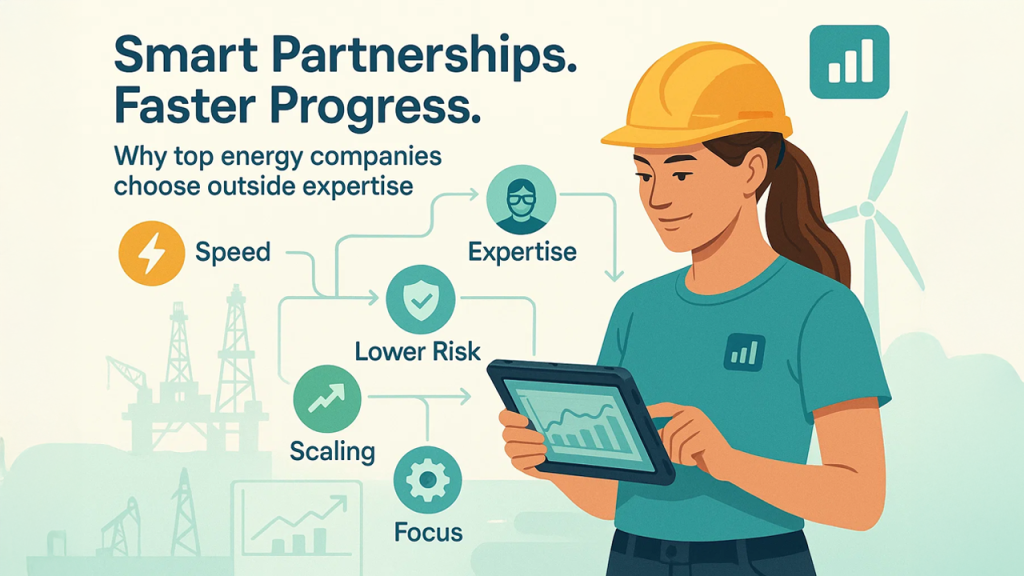
It may seem like firms like Shell or ExxonMobil could build predictive analytics on their own, but partnering with outside teams is often faster and smarter.
- Speed: Vendors have working components, whereas in-house development of a full system can take years. Deployment thus happens much faster.
- Expertise: Providers have experience across many clients and know which models truly work-and which mistakes to avoid.
- Focus: Oil and gas companies want to drill and produce, not run software teams. Outsourcing keeps their attention on core operations.
- Lower risks: Large IT projects often go off track. Working with a seasoned vendor shifts part of the risk to them through contracts and guarantees.
- Easy scaling: As companies expand to new fields or projects, external platforms scale much more easily than internal tools.
Industry challenges add to this. There’s a talent shortage, aging equipment that’s hard to integrate with new tech, and rising environmental pressure. Predictive analytics helps with all of that — from spotting leaks early to optimizing processes — but setting it up correctly requires skills many companies don’t have internally.
And with renewables becoming stronger competitors, oil and gas companies increasingly seek out partners that understand both traditional and green energy.
What's Next: Looking Ahead
Predictive analytics in oil and gas industry is still early in its evolution, even though it already prevents failures and saves companies millions. In the coming years, systems will move toward real autonomy — not just warning about issues but adjusting equipment on their own, from drilling parameters to pipeline pressure.
Supply-chain transparency will also grow. Blockchain could give every oil batch a “digital passport,” while analytics uses that data to optimize routes and logistics.
Quantum computing may still seem like the stuff of science fiction, but it could dramatically accelerate reservoir modeling, well planning, and market forecasting. In concert, the cloud will remain a superior choice to on-premise systems due to easier scaling and lower costs.
And at the center of all this tech, it is still people. Analytics will support decisions, but engineers and managers will still have to make them. Those companies will get most value that combine data insights with experience and intuition.
The predictive analytics market will continue to grow, as there are more and more entrants, and specialists dive deeper. Predictive analytics isn't a buzzword; rather, it's a practical answer for aging assets, market volatility, and rising environmental demands. These tools don't just help companies survive; they help them find opportunities where they once saw only problems.