






Artificial intelligence (AI) is no longer a step away from a competitive benefit; it’s now a fundamental requirement in modern software. By 2026, most SaaS products will claim to be “AI-powered,” yet buyers and product teams are still evaluating these tools to mitigate costly mismatches. However, understanding which AI tool is most suitable for business and whether it truly aligns with their workflow requirements is crucial.
This is why proper product classification acts as a primary safeguard. Rather than analyzing tools based on standard marketing claims, businesses should use a structured approach to access AI SaaS products. Whether they aim to build SaaS products or to choose the right tools for their needs, it has become a go-to solution. AI SaaS product classification criteria are essential in such cases—providing a framework to evaluate products by capability, maturity, governance, and business impact.
Industry insights demonstrate that global AI-driven SaaS are projected to spend over $300 billion by 2025. This transforms poorly aligned AI investments into more than a technical vulnerability; instead, they become a critical financial risk. This blog demonstrates clear, functional, and current AI SaaS product classification criteria built for 2026. By implementing structured criteria, businesses can make several strategic decisions, like
- Vendor comparison and evaluation using predefined criteria.
- Scalability analysis with sustained business goals.
- Clear identification of core business problems.
- AI alignment, cost optimization, and ROI justification.
- Risk assessment and data management control.
- Compliance and regulatory requirements, like GDPR or HIPAA.
Consequently, it fosters confidence, mitigates procurement challenges, and aligns technology investments with quantifiable outcomes.
The Role of AI SaaS Product Classification Criteria
In previous years, businesses often experimented with AI tools without expecting immediate results. But now that exploratory phase has ended. With Budgets tightening, expectations rising, leaders are focused on measurable outcomes and long-term values. Based on the recent buyer research, it indicates that 38% of B2B buyers postpone or cancel AI SaaS purchases due to lack of clarity about the actual functionalities, data management, and long-term scalability. These are the issues that a well-defined AI SaaS classification directly tackles.
By 2026, the AI SaaS market is no longer guided by curiosity alone. Instead, it is transformed by focused expertise, transparency, and business resilience. However, the main challenge is the rise of native AI SaaS products that look impressive yet often lack integration, accountability, and compliance with regulatory requirements. Therefore, regulatory evaluation has increased, with data privacy protocols, audit obligations, and ethical AI standards shaping purchasing decisions as much as performance metrics.
Consequently, classification now fully depends on how extensively AI is integrated into operations, data pipelines, and decision-making processes.Here are why businesses rapidly prioritize AI tools that address specific challenges within well-defined domains rather than broad, standard platforms. Clear, well-defined AI SaaS product classification criteria help them prevent these challenges by establishing lifelike expectations early.
The 7 Key AI SaaS Product Classification Criteria in 2026
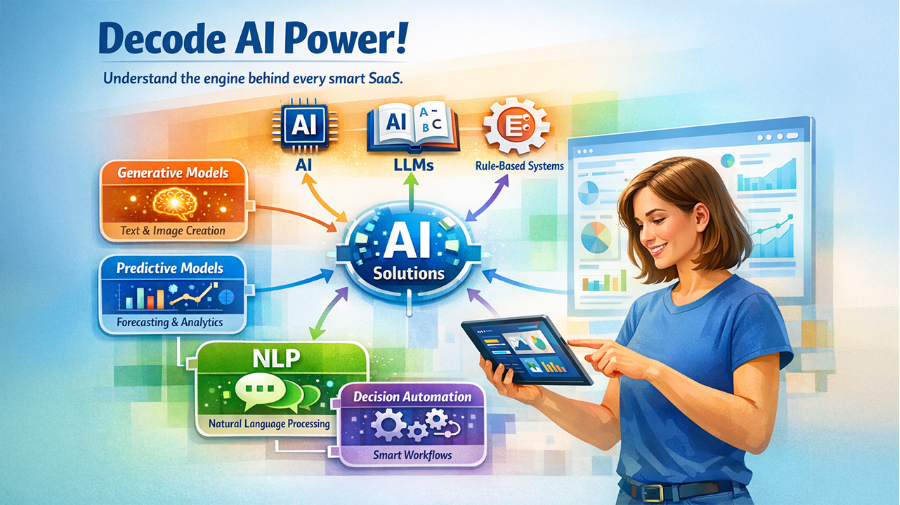
Primary AI Functionality
This is one of the most basic and straightforward criteria that demonstrates the actual functioning of AI inside the product. This feature-based classification tells users what type of problems the platform solves. Numerous tools brand themselves “AI-powered,” though underlying capabilities differ significantly.
Some products are built around typical generative models, predictive models, machine learning, natural language processing, and decision automation systems. The AI SaaS classification layer classifies and labels the product based on the type of AI powering it. This provides real-time insights on pricing, market changes, customer preferences, and the current investment guidelines of B2B SaaS AI products.
A proper, accurate AI SaaS product classification criteria help you understand whether the product is powered by artificial intelligence, a large language model, or a rule-based system. This clarity mitigates the likelihood of errors that occurred from basic automation tools.
Business Applications and Vertical Alignment
AI SaaS products can be extensively categorized as horizontal or vertical.
- Horizontal Alignment: These tools are designed for a wide range of industries (general-purpose chatbots) with scalable use cases.
- Vertical Alignment: These tools are built specifically for industries such as healthcare, finance, legal, or eCommerce.
In 2026, vertical alignment is expected to be widely adopted, as domain-trained models typically perform comparatively better, easily comply with regulations, and need less customization. This classification technique categorizes AI SaaS products based on the alignment and the specific market they serve, like healthcare, finance, and manufacturing. Here are some industry-driven SaaS product categories:
- Healthcare AI SaaS: Tools that provide smart solutions for patient care, diagnostics, and imaging assessment in the healthcare domain.
- E-commerce AI SaaS: Platforms improve the retail industry with inventory forecasting, personalized recommendations, and streamlined customer engagement.
- Fintech AI SaaS: AI-driven tools for risk management, fraud detection, personalized financial decision-making, and smart wealth management.
3. Compliance Requirement and Data Governance Layer
The quality of data AI systems consume decides how efficiently they work. This AI SaaS product classification criteria analyzes how a product manages and controls data throughout its lifecycle. In compliance-driven industries, data location and regulatory compliance are equally important for AI SaaS products. This classifies products that comply with frameworks like HIPAA, GDPR, and AI ethics.
A strong criteria help establish trust, increase enterprise adoption, mitigate risk, boost ROI, and make your product enterprise ready. Without this transparent approach, organizations often struggle between compliance and security vulnerabilities.
Deployment Model and Scalability Framework
The AI SaaS products are classified based on models they are hosted on and also their scalability, latency, and multi-tenant performance. This deployment flexibility frequently determines whether an AI SaaS product remains a trial or becomes an essential operational system. Let's explore some product categories based on deployment models.
- Cloud Native/Public Cloud: The standard powered by public cloud platforms offers maximum scalability, quick execution, and automatic updates.
- Edge AI SaaS: Process data at the network edge, fostering faster, real‑time deployment close to devices and sensors.
- Single Tenant/Private Cloud: Provide dedicated infrastructure for each client, empowering enterprises with enhanced customization, security, and compliance.
- Multi-Tenant AI SaaS: Offer a shared, collaborative environment for multiple clients, balancing cost efficiency with logical separation.
- BYOC (Bring your own cloud) and Hybrid Model: Enable customers to run AI SaaS on their preferred cloud provider and hybrid models, offering greater control over data and deployment.
Integration Ecosystem
This AI SaaS product classification criteria classifies how a product runs and integrates with existing systems, like CRM, ERP, and internal data systems. Some products are hosted on the cloud, while some support hybrid models and API-first architecture. Robust integration support reduces migration cost, enhances customer loyalty, provides early visibility into API updates, and ensures seamless integration with AI solutions. An AI SaaS product with smooth integration is more likely to be adopted, unlock upsell opportunities, drive long-term revenue growth, and offer you a competitive edge across top industries.
Pricing and Monetization
Classifying SaaS products by pricing model is the key dimension of AI SaaS product classification criteria. These products come with various pricing structures, like freemium, Pay per use, subscription, and industry-grade plans. A robust pricing classification is crucial to measure adoptability to meet B2B SaaS startup investment budgets or large-scale enterprise requirements. It strengthens your product classification approach, reduces adoption overhead, and links monetization for sustainable growth—essential for securing revenue and investor confidence.
Key pricing models in AI SaaS classification are explained below:
- Free Accessibility: Offer basic feature access at no cost with a few limitations to drive adoption.
- Subscription: Premium monthly or annual plans are required to access advanced functionalities, increasing the likelihood of customer retention.
- Pay-per-Usage: Allows you to pay as you use the platform, making it perfect for both startups and enterprises seeking cost flexibility.
- Enterprise-Grade Plans: A pricing plan specially designed for regulated or large-scale organizations, tailoring the system to meet compliance and scalability requirements.
Automation Level Classification
Not all automated systems are designed equally. This AI SaaS product classification criteria focuses on the latest technologies and directly impacts a platform’s key strengths, limitations, and required expertise. Some products rely heavily on hybrid AI models that integrate various cutting-edge technologies, like Artificial Intelligence and Natural Language Processing, for measurable outcomes. By identifying customer demand early and providing personalized recommendations, these tools can become more robust and scalable solutions. It classifies AI SaaS products based on the relevancy of these products to AI and the degree of human oversight required. Some are the following:
- Solutions that would not exist without AI at their foundation.
- A classic software application enhanced with AI-powered features to improve performance and efficiency.
- Product that includes AI functionality but is not essential to their primary use cases.
- System integrated with AI, yet all final decisions are made by humans.
- Platform operated completely by AI and capable of making automated decisions independently.
How to Implement the Framework: A Step-by-Step Guide
After comprehending AI SaaS product classification criteria, the major concern is how to actually implement them when analyzing real products. Here is the detailed guide demonstrating the essential steps to select the right AI SaaS products.
Step 1: Define Use Cases and Analysis Weights
- Precisely define the business challenges that the AI SaaS product can resolve and the results that drive success.
- Turn objectives into quantifiable KPIs such as quality refinement, speed improvement, cost optimization, or workflow effectiveness.
- Allocate weights to every classification criterion based on business requirements, regulatory vulnerabilities, and risk endurance.
- Set up basic compliance benchmarks for critical dimensions like data policy management or interpretability.
Step 2: Collect Standardized Vendor Inputs and Evidence
- To obtain technical data, security, and commercial information, use a standardized Questionnaire for Supporting AI Vendors.
- Request solid evidence from vendors in the form of security certifications, architecture diagrams, data handling policies, and model documentation.
- Ensure every vendor answers the same set of questions to ensure a fair evaluation of vendor proposals.
Step 3: Apply the Scoring Rubric Across All Classification Dimensions:
- Each vendor must be assessed on a 0-5 scale within every AI SaaS product classification criteria in accordance with pre-established scoring parameters.
- For each score assigned, there must be a narrative explanation detailing the context, the assumptions made in assigning that score, and any associated risks.
- Any dimension where the vendor receives a score less than the minimum acceptable score should be identified as a potential deal-breaker.
Step 4: Shortlist Vendors and Validate Through a Focused POC
- Determine the best vendors based on the relative weight of the scores assigned to them and whether they have any types of risk flags.
- Build a short proof-of-concept that achieves results in alignment with the company's business key performance indicators (KPIs) and integration requirements.
- Re-evaluate the vendor scoring(s) based on the performance the vendor has delivered on the project rather than stated capabilities.
Step 5: Aggregate Scores, Assess Risk, and Make the Decision
- Generate aggregate scores using weightage assigned and normalized results for drawing comparisons that are clear and accurate.
- Review how sensitivity scenarios affect rankings based on priorities that differ from person to person.
- Combine scores with risk indicators to facilitate a more informed and balanced selection process.
Step 6: Operationalize, Monitor, and Re-Evaluate Periodically
- Transform evaluation results into contracts, SLAs, and Governance clauses.
- Monitor AI performance, compliance, and data usage during production.
- Reapply the scoring matrix periodically to reflect updates to the models, changes to the data, or business needs.
Conclusion:
Acquiring AI SaaS product classification criteria in 2026 goes beyond innovation. It helps vendors, buyers, and product teams in choosing products based on where they fit in the organization's governance structure. Also, it ensures measuring the return on investment (ROI) precisely through analytics that demonstrate real results. Organizations should use a structured AI SaaS product classification criteria framework to decipher the marketing hype, reduce risks, and find tools that foster growth in the long term.
AI SaaS Classification is no longer an optional exercise for buyers and product teams; it's a strategic necessity moving forward.