







The article explores what a Student CRM is, how it works, and how AI is making student management easier.
Managing students is not limited to maintaining attendance registers, storing academic records, or sending occasional emails. Educational institutions must handle a huge amount of information, from student inquiries and admissions to communication, enrollment, engagement, academic progress, and retention.
With so much data moving between departments, managing everything can become complicated and time-consuming. This is where a Student CRM can make a significant difference.
A student at CRM helps schools, colleges, universities, coaching institutes, and other educational organizations organize student information, automate repetitive tasks, improve communication, and build stronger relationships with students.
The growing demand and evolution of artificial intelligence are taking this step further. An AI CRM for education can analyze information, automate workflows, offer useful insights, and help education teams make faster and smarter decisions.
What is a Student CRM?
A Student CRM (or Customer Relationship Management) system is software that is especially designed to help schools, colleges, universities, coaching institutes, and other educational organizations manage their interactions and relationships with students and prospective students.
Unlike any traditional CRM that is used by businesses to manage customers, a Student CRM is specifically tailored for the educational sector. The platform helps institutions manage the complete student journey, from first inquiry and admission application to enrollment, communication, engagement, support, and retention.
The CRM platform for students brings all the relevant information together in a centralized system, instead of being scattered across spreadsheets, emails, messaging apps, and paper records. A Student CRM helps institutions manage student inquiries, leads, admissions, applications, student communication, follow-ups, parent communication, student engagement, support requests, and retention.
Why Do Educational Institutions Need a Student CRM?
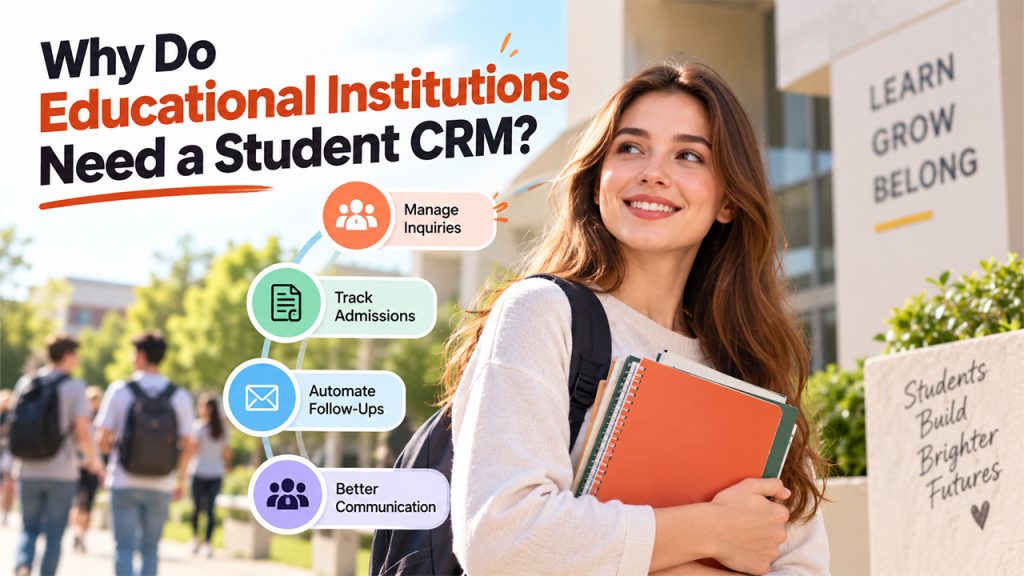
An educational institute generally manages a large amount of student information every single day. From admission inquiries to communication, enrollment, and student support, keeping every piece of information organized can become challenging when the team relies on spreadsheets, emails, and manual processes.
A Student CRM helps bring all these activities together in a centralized platform, making student management more organized, efficient, and personalized.
- Centralizes Student Information
Student data is often spread across different departments and systems. A student CRM system helps bring all the important information into one centralized location, allowing authorized staff to quickly access student profiles, inquiries, applications, communication history, and other relevant details.
- Improves Admission Management
Managing all prospective students is also a major responsibility for educational institutions. A Student CRM can easily track every stage of the admission journey, from the initial inquiry to application and enrollment.
- Prevents Missed Follow-Ups
Generally, manual follow-ups can easily be forgotten, especially when counselors are handling hundreds of inquiries. CRM platform automate workflows can notify staff when an action is required.
- Makes Communication More Efficient
Students and parents expect quick and consistent responses. A Student CRM helps institutions organize communication and maintain a record of previous interactions.
Key Features of Student CRM
A Student CRM is especially designed to simplify the way educational institutions manage student information, admissions, communication, and engagement. Some of the key features of a Student CRM are as follows:
- Student Data Management: A Student CRM can keep important student and prospect information in one centralized location. With the platform, staff can manage contact details, course preferences, enrollment information, interaction history, and other relevant records.
- Lead and Admission Management: Managing prospective students is among the most crucial functions of a Student CRM. It allows institutions to easily track leads from their initial inquiry through counseling, application, document verification, and enrollment.
- Communication Management: A Student CRM helps institutions efficiently organize communication with students and prospects through supported channels, such as emails, SMS, notifications, and messaging platforms.
- Automated Follow-Ups: A missed follow-up can result in lost admissions or disengaged students. A Student CRM can automate reminders, notifications, and follow-up tasks, based on predefined workflows.
How is AI Changing Student Management?
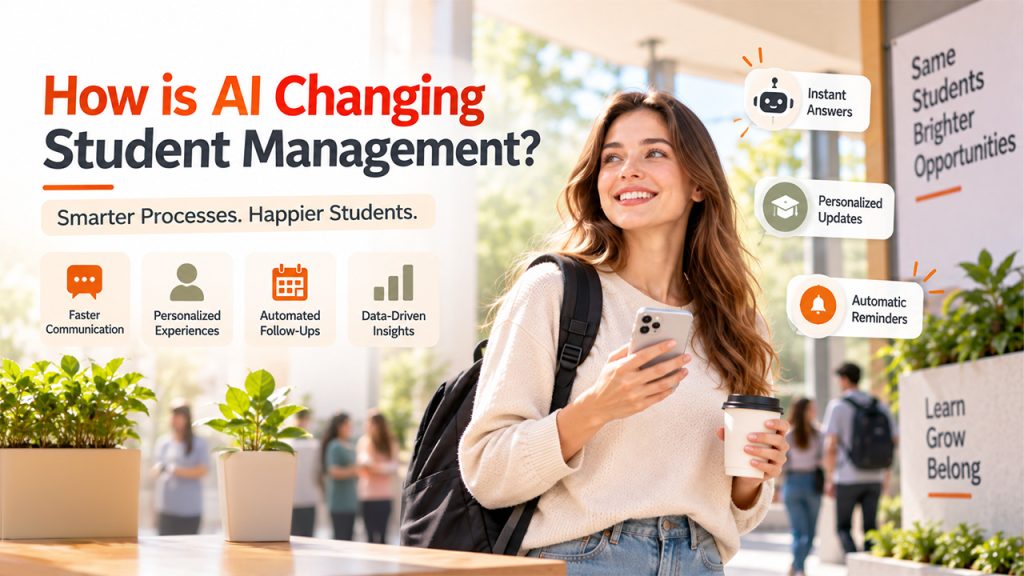
Artificial intelligence has transformed how educational institutions manage students, simply by making everyday processes faster, more personalized, and data-driven. When AI capabilities are integrated into a Student CRM, institutions can easily move beyond simply storing student information and use the data to automate tasks, understand student needs, and improve communication.
- Faster and Smarter Student Communication
The AI-powered chatbots and virtual assistants can answer various common questions instantly, reducing the workload on administrative teams. With AI CRM for Education, students could receive an automated response immediately, instead of waiting for an admissions counselor to respond to basic questions.
- Personalized Student Experiences
The AI tool can easily analyze relevant information stored in a Student CRM and can also help institutions personalize communication. With an AI CRM, students interested in a particular course can receive relevant updates, while prospective students who haven't completed their applications can receive appropriate reminders.
- Automated Follow-Ups
The AI-powered CRM workflows can help identify prospects who need attention and automate suitable reminders or communications. This helps reduce missed opportunities and keeps the admission process moving.
- Better Analysis of Student Data
The AI CRM for Education can help educational institutions to understand various trends, such as which courses attract the most inquiries, which communication channels generate engagement, where prospective students leave the admission process, and which students have declining engagement.
Choosing the Right CRM Expertise for Education
While evaluating Student CRM or AI-powered CRM solutions, educational institutions need to consider not only the features of the platform but also the expertise behind its implementation and customization. OutRight Store brings experience in SuiteCRM and SugarCRM development, CRM customization, integrations, workflow automation, and ready-to-use CRM extensions. Its solutions also include AI-powered CRM capabilities designed to modernize workflows and reduce repetitive tasks. This type of CRM expertise can be valuable for organizations looking to adapt CRM workflows to their specific operational requirements rather than relying solely on a one-size-fits-all system.
Student CRM vs Traditional Student Management
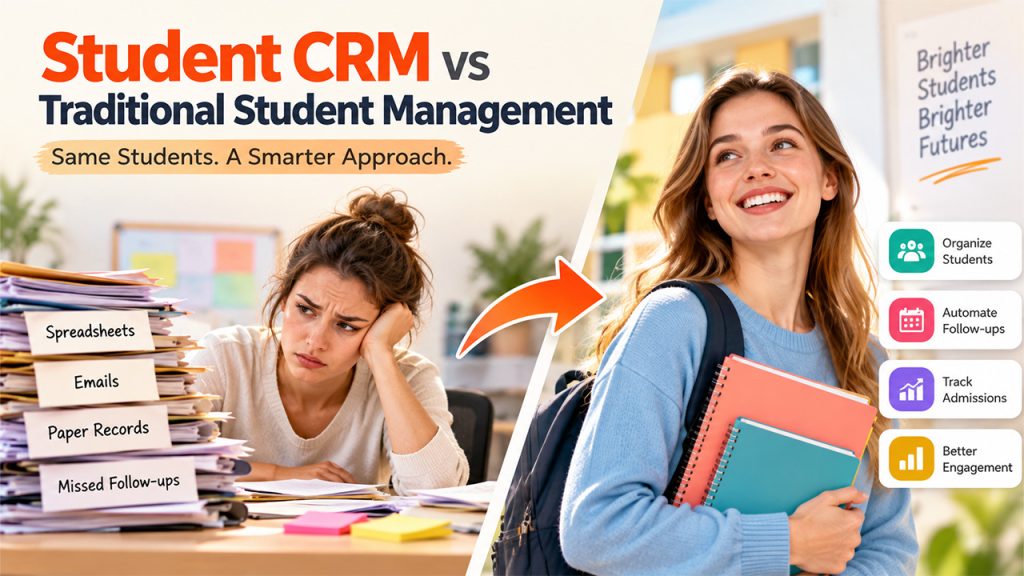
Educational institutions have traditionally managed student information using spreadsheets, paper records, emails, and separate software systems. While these methods can work for smaller organizations, they end up becoming difficult to manage as the number of students, inquiries, and administrative activities grows.
The Student CRM offers a more centralized and automated approach. It helps institutions manage the entire student relationship, instead of simply storing student records.
- Traditional Student Management
Traditional student management generally involves multiple disconnected processes. This approach can create multiple challenges, such as student information being scattered across different platforms, staff needing to enter the same information multiple times, follow-ups being forgotten or delayed, and communication history being difficult to track.
- Student CRM
A Student CRM brings student-related information and activity into a centralized platform. The CRM platform also reminds staff members about pending actions, organizes communication, and provides reports on admission pipelines.
A quick comparison between Traditional Student Management and Student CRM are as follows:
| Traditional Student Management | Student CRM |
| Information may be stored in multiple places. | Information is centralized. |
| Heavy reliance on manual processes. | Greater workflow automation. |
| Follow-ups may be manually tracked. | Automated reminders and follow-ups. |
| Limited communication history. | Centralized interaction history |
| Manual reporting. | Dashboards and automated reports. |
| Primary record focused. | Relationships and engagement focused. |
How Tools Like MagicSchool AI Benefit Educational Sectors
Artificial intelligence is becoming an increasingly useful part of the education system. Platforms such as MagicSchool AI help educators use AI for everyday teaching and administrative tasks.
Although tools like Magic School AI are not a replacement for a Student CRM, they demonstrate how AI can reduce repetitive work and offer education professionals more time to focus on students.
Some of the key benefits of MagicSchool AI are as follows:
- Saves Teachers Time
Teachers spend significant time creating lesson plans, assignments, activities, worksheets, and other classroom materials.
- Supports Personalized Learning
AI helps educators adapt educational materials for different learning levels, as students have different learning abilities, interests, and requirements.
- Help Create Educational Content
AI tools can assist teachers with creating lesson plans, quizzes, discussion questions, writing prompts, rubrics, and study materials.
Conclusion
A Student CRM is a platform designed to help educational institutions move beyond manual student management by centralizing information, automating routine tasks, improving communication, and strengthening student engagement. The integration of AI-powered capabilities into CRM for education can make these processes more efficient through intelligent automation, personalized communication, and data-driven insights. Solutions available through Store OutrightCRM can support institutions looking to adopt modern CRM technologies and improve how they manage student-related activities. As the education sector continues to become more digital, combining CRM and AI can help institutions create a more organized, responsive, and student-focused experience. By bringing student data, communication, and workflows together, educational organizations can improve operational efficiency while delivering more personalized interactions throughout the student journey.
Frequently Asked Questions
1. What is a Student CRM?
A Student CRM manages student information, admissions, communication, engagement, follow-ups, and other activities throughout the student lifecycle. It is designed specifically for educational institutions.
2. How does a Student CRM work?
A Student CRM centralizes student and prospective student information in a centralized location. It can help institutions track inquiries, applications, communications, follow-ups, enrollment, and engagement while automating repetitive workflows.
3. How does AI improve Student CRM?
AI can improve Student CRM as it can make the system more intelligent by helping automate repetitive tasks, analyze student data, personalize communication, summarize interactions, and provide useful insights.
4. Can AI automate student communication?
Yes, AI can automate student communication. Depending on the platform and its configuration, AI can assist with frequently asked questions, automated responses, email drafting, reminders, and other routine communications.