





Quick Answer: Which AI Voice Agent Is Best for Your Business?
- CloudTalk: Best for small and mid-sized sales and support teams that need a complete AI-powered phone system and a native AI voice agent on one shared infrastructure – inbound routing, outbound dialing, CRM sync, and human agent operations in one platform.
- Retell AI: Best for technical and operations teams that want managed production phone agents, the lowest verified per-minute cost, and self-service HIPAA compliance without an enterprise contract.
- Synthflow: Best for non-technical teams and agencies that need a working AI voice agent live in under 30 minutes with a no-code visual builder.
- Bland AI: Best for developer-led teams running high-volume outbound campaigns where consolidated per-minute billing simplifies cost forecasting.
- ElevenLabs Conversational AI: Best when voice naturalness is the primary differentiator – premium services, multilingual deployments, and brands where the AI voice is part of the experience.
- Telnyx: Best for developer and enterprise teams that want carrier-owned infrastructure with the lowest all-in bundled rate, sub-200ms round-trip time, and a complete enterprise compliance stack.
- Vapi: Best for engineering teams that need maximum component flexibility – choosing every LLM, TTS, STT, and telephony provider independently.
- Aircall: Best for teams already running on Aircall's phone system that want to add AI voice automation without switching vendors.
- Dialpad: Best for organizations that want AI transcription, real-time coaching, and autonomous voice agents at every plan tier in a unified UCaaS platform.
How a Business AI Voice Agent Actually Works: The Four-Stage Pipeline
Strip away the marketing and every AI voice agent for businesses runs the same pipeline, dozens of times per conversation:
Telephony – Speech-to-Text (STT) – Large Language Model (LLM) – Text-to-Speech (TTS) – back to Telephony
Stage 1: Telephony: A call arrives on a number connected to the platform – typically provisioned through Twilio or Telnyx under the hood, or directly on the provider's own carrier infrastructure. This layer handles ringing, transfers, call recording, and hangup detection. The best platforms let you buy a local number in one click for roughly $2–5 per month, or bring your own via SIP trunking.
Stage 2: Speech-to-Text: The caller's audio stream is transcribed continuously by a streaming STT model – Deepgram is the most common engine in this category. Streaming matters: the transcriber emits partial results while the caller is still talking, so the system knows what is being said before the sentence ends. It also runs endpoint detection – deciding that the caller has finished their turn – which is one of the hardest engineering problems in voice AI.
Stage 3: The LLM: The transcript, conversation history, and system prompt go to a language model that decides what to say next. In voice, the LLM must produce output fast enough to speak within a second, and it can emit tool calls mid-conversation that trigger real actions in connected systems.
Stage 4: Text-to-Speech: The LLM's response is synthesized into audio and streamed back to the caller. Streaming synthesis starts on the first sentence while the LLM is still generating the rest, which is how well-configured agents begin speaking in under a second.
What you are actually paying a platform for is the orchestration layer wrapped around this pipeline: turn-taking, barge-in handling, filler behavior during tool calls, voicemail detection, and call transfer logic. Any team can chain three APIs together. Making the result feel like a competent person on the phone is the actual product.
The Latency Budget: Why 800ms Is the Production Benchmark
Under 800ms from the caller finishing to the agent's first audio: the conversation feels smooth and most callers do not consciously register a delay. 800 to 1,200ms: acceptable for business calls, noticeable if you are listening for it. Above 1,500ms: the pause is obvious, callers start repeating themselves or talking over the agent.
Where does the time go? A realistic budget for one conversational turn:
| Pipeline stage | Typical range | What drives it |
| Endpoint detection (deciding caller stopped) | 200–400ms | Deliberate wait to avoid cutting people off |
| STT finalization | 50–150ms | Streaming model, mostly already done |
| LLM time-to-first-token | 200–500ms | Model choice – the biggest lever you control |
| TTS time-to-first-audio | 100–200ms | Streaming synthesis engine |
| Network and telephony round trips | 30–80ms | Provider region placement |
Use a fast model class for the live conversation loop. Keep your system prompt short – a 3,000-token prompt slows every single turn. Configure spoken filler phrases during tool calls so the line is never silent.
Advertised vs. Real All-In Cost: What You Actually Pay
| Platform | Advertised | Realistic all-in | What adds up |
| CloudTalk (AI Receptionist) | From $99/month (200 min bundle) | ~$0.50/min on PAYG; bundled rates lower at volume | Phone plan separate from AI agent; custom rates at 10k+ min |
| Retell AI | $0.07–0.08/min voice engine | ~$0.10–0.17/min | Add LLM ~$0.006/min and telephony ~$0.015/min |
| Synthflow | $0.09/min voice engine | ~$0.13–0.20/min | LLM and telephony billed separately |
| Bland AI | $0.14/min (no plan) | $0.11–0.14/min + subscription | Plan fee ($299–499/month) stacks on top of per-minute usage |
| ElevenLabs Conversational AI | $0.08/min beyond plan | ~$0.10–0.15/min | LLM and telephony separate |
| Telnyx | $0.05/min (STT + native TTS included) | ~$0.07–0.12/min | LLM billed separately; lowest bundled rate in this comparison |
| Vapi | $0.05/min platform fee | $0.13–0.31/min | STT, LLM, TTS, and telephony all billed separately |
| Aircall AI Voice Agent | $0.49/min | $0.49/min + phone plan | No hidden layers, but the highest base rate in this comparison |
| Dialpad AI Agents | Credit-based | Quote required | No public per-conversation rate |
How We Evaluated These AI Voice Agent Platforms
Nine platforms were evaluated against seven criteria:
| Criterion | Weight | What it measures |
| Conversation quality and latency | 20% | End-to-end response time; barge-in handling; naturalness |
| Real all-in cost transparency | 18% | Actual production cost vs. advertised rate |
| CRM and telephony integration | 18% | Native bidirectional sync; warm transfer capability |
| Setup speed and no-code accessibility | 16% | Time to first live call without developer support |
| Compliance and security | 14% | HIPAA, SOC 2, TCPA support; data residency |
| Scalability and concurrent capacity | 8% | Maximum simultaneous calls; uptime |
| G2 reviews and independent evidence | 6% | Verified production reliability |
AI Voice Agent Comparison Table
| Platform | Best for | Real all-in rate | G2 rating | No-code | HIPAA |
| CloudTalk (CeTe) | SMB sales and support: full phone system + AI voice agent | Bundled from $99/mo; $0.50/min PAYG | 4.4/5 (1,702+) | Yes | Yes |
| Retell AI | Production agents; lowest per-minute cost | ~$0.10–$0.17/min | 4.8/5 (1,400+) | Basic | Yes (self-serve) |
| Synthflow | No-code; agencies | ~$0.13–$0.20/min | 4.5/5 (815) | Yes | Yes (enterprise) |
| Bland AI | High-volume outbound; plan-based billing | $0.11–$0.14/min + subscription | ~3.3/5 (limited) | Partial | Yes |
| ElevenLabs Conversational AI | Voice quality; multilingual | ~$0.10–$0.15/min | Growing | Partial | Limited |
| Telnyx | Carrier-owned infrastructure; lowest bundled rate | ~$0.07–$0.12/min | Not listed for voice | No | Yes |
| Vapi | Developer; maximum flexibility | $0.13–$0.31/min all-in | ~3.8/5 | No | $1,000 add-on |
| Aircall | Existing Aircall teams | $0.49/min + phone plan | 4.4/5 (~1,547) | Yes | Yes |
| Dialpad | UCaaS + AI at all plan tiers | Quote required | 4.4/5 (~4,700) | Yes | Yes |
The 9 Best AI Voice Agents for Businesses in 2026
What is CloudTalk – and how does its AI voice agent work?
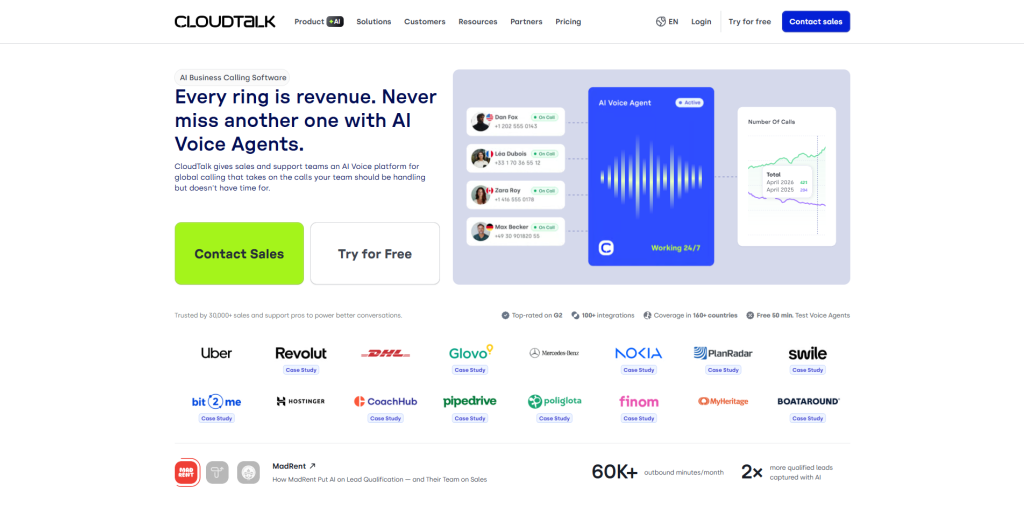
CloudTalk is an AI-powered business phone system and AI voice agent platform built for small and mid-sized sales and support teams. It runs full cloud telephony – including phone numbers, call routing, IVR, and call recording – then layers two products on top of that stack: a phone system your human team calls from, and an AI Voice Agent that handles calls on its own.
The business calling platform and AI Voice Agent are separate products that work together as a single integrated setup. Because both share the same telephony infrastructure – call routing, phone numbers, and CRM sync – a call the AI Voice Agent answers and later hands to a human shows up in your CRM as one continuous record, with the AI's notes and recording attached. There is no re-explaining required, and no fragmented data across two separate systems.
The AI Voice Agent comes in two tiers with distinct job roles.
AI Virtual Receptionist handles inbound calls 24/7 to answer questions, not execute tasks. It screens spam, answers FAQs using a connected knowledge base, identifies callers, logs details, and transfers to a live agent when needed – all without touching your internal systems. A non-technical user can build and launch a Receptionist agent in under ten minutes using pre-built role templates for lead qualification, appointment scheduling, healthcare intake, and recruitment screening.
AI Specialist goes a step further by actually resolving issues. It authenticates callers, updates live CRM records, processes payments and invoices, schedules calendar appointments, and completes complex workflows end to end. While it handles inbound requests, Specialist is also built for outbound work – powering instant lead qualification, follow-up campaigns, win-backs, and automated feedback surveys.
Choose Receptionist to answer and route incoming calls. Choose Specialist to resolve calls automatically or reach out to customers proactively.
Key features
The AI Voice Agent responds with sub-800ms latency across 60+ languages and accents using neural voices built to sound natural on the line. Native CRM write-back connects to HubSpot, Salesforce, Pipedrive, Zoho CRM, Zendesk, and Intercom directly – no middleware required. For all other tools in CloudTalk's 100+ native integration suite, AI Voice Agent call data routes automatically through CloudTalk's open API, webhooks, or Zapier. A visual call flow designer lets non-technical users configure routing logic, business hours rules, and escalation paths. The AI Voice Agent plugs into CloudTalk's Power Dialer and Parallel Dialer for human outbound teams on the same platform. AI Conversation Intelligence – available as an add-on at $9/user/month – produces transcripts and AI summaries that flow through the same system.
What do real customer results show?
Trevo reached 20x more customers per outbound campaign by deploying an AI Voice Agent on their dormant lead list at a scale no human team could match. Oxford Royale Academy replaced four seasonal temporary hires with one AI agent serving prospective students in 176 countries, qualifying inquiries and following up fast enough that interest didn't go cold. Autenti set an internal target of 10% fewer calls reaching live agents – the AI delivered 30%, and pickup rates rose 7% because queue lengths shortened.
Strengths and limitations
Strengths: AI Voice Agent and human phone system share one telephony infrastructure, routing layer, and CRM integration – no vendor fragmentation. Native write-back to six CRM and helpdesk platforms without middleware. Non-technical deployment in under ten minutes using pre-built templates. AI Specialist handles outbound campaigns, instant lead qualification, and end-to-end task resolution alongside AI Receptionist inbound – both on the same account. G2 4.4/5 from 1,702+ reviews; Trustpilot 4.1/5 Great; G2 Small Business Leader 2026. 99.999% uptime SLA. First 50 minutes free in the first month; 14-day trial included.
Limitations: AI Voice Agent and phone system are priced and billed separately – total cost requires modeling both. AI Specialist starts at $349/month, a meaningful step up for teams that only need basic inbound FAQ handling.
What does CloudTalk actually cost?
AI Business Phone System from $25/user/month (annual billing). AI Voice Agent is priced on usage, not seats:
| Tier | Starting price | Included minutes | Built for |
| AI Receptionist | $99/month | 200 minutes/month | 24/7 answering, triage, and routing |
| AI Specialist | $349/month | 1,000 minutes/month | End-to-end task resolution and outbound campaigns |
| Custom | From $0.15/minute | 10,000+ minutes/month | High-volume teams needing bespoke automation |
Receptionist bundle steps: $99 (200 min), $199 (500 min), $299 (1,000 min), $699 (2,500 min). Specialist bundle steps: $349 (1,000 min), $749 (2,500 min), $1,249 (5,000 min). Pay-as-you-go: $0.50/minute.
Retell AI: Best for Technical Teams That Want the Best Latency at the Lowest Verified Per-Minute Cost
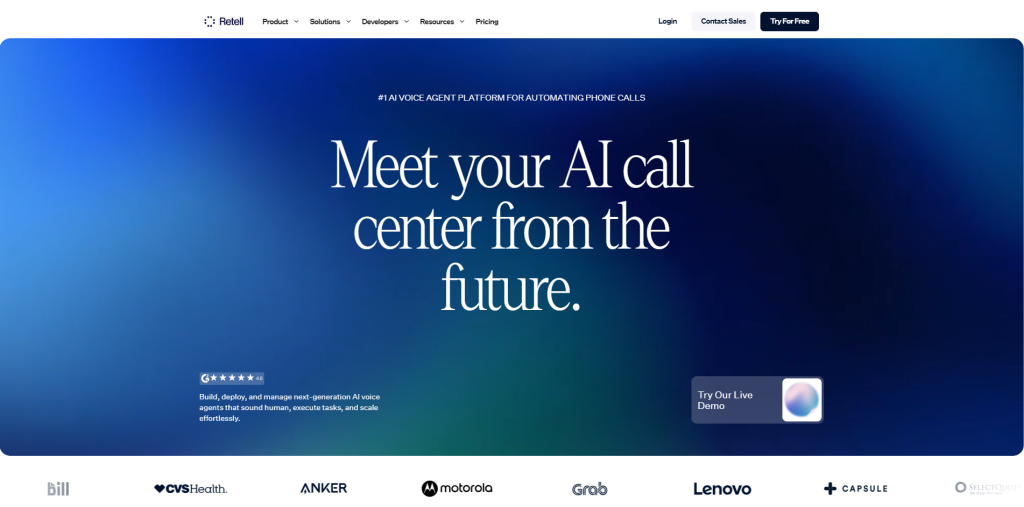
Retell AI is cited for three specific reasons. First, its per-minute economics: at $0.07–0.08/min for the voice engine, with LLM and telephony adding approximately $0.03–0.09/min more, real all-in costs of $0.10–0.17/minute are consistently lower than Vapi's $0.13–0.31/min and Bland AI's subscription-plus-usage model at comparable volumes. Second, its sub-600ms end-to-end latency – independently measured at approximately 600–750ms in benchmark testing – puts it in the fastest tier of managed platforms. Third, its self-service HIPAA BAA portal requires no enterprise contract.
Retell AI processed 30M+ calls per month as of early 2026, earned G2's Best Agentic AI Software Products 2026 award, and holds a 4.8/5 rating from 1,400+ reviews – the highest rating of any platform in this comparison. It provides both a no-code flow builder and a full developer API on the same platform, meaning non-technical teams can configure standard inbound reception while developer teams build arbitrarily complex pipelines.
Strengths and limitations
Strengths: Highest G2 rating in this comparison (4.8/5, 1,400+ reviews). Sub-600ms latency with proprietary barge-in handling. Self-service HIPAA BAA on paid plans without enterprise contract. SOC 2 Type II, GDPR, PII redaction, on-premise deployment available. Both no-code and full developer API on the same platform. No platform fee – $0.07/min with $10 in free credits and no minimum commitment.
Limitations: No native outbound power dialer for human agents – teams needing both AI inbound and outbound dialing with human operations should evaluate CloudTalk. Optimal configuration with custom LLM and premium voice providers requires 1–2 days of tuning.
What does Retell AI cost?
$0.07–0.08/min voice engine; no platform fee; no minimum. All-in: $0.10–$0.17/min in typical configurations. At 500 calls/month (4-minute average = 2,000 minutes): approximately $200–$340/month.
What makes Synthflow the leading no-code choice?
Synthflow solves the specific structural problem most other platforms in this comparison present to non-technical teams: Vapi requires developer comfort, Retell's full power requires API work, Bland AI's Pathways builder has real limitations for non-coders. Synthflow's drag-and-drop visual builder deploys standard inbound and outbound phone workflows in under 30 minutes from signup to first live call – independently verified at approximately 11 minutes, earning G2's Fastest Implementation badge.
At 65 million+ calls processed per month across 30+ countries, Synthflow has the production scale to back the claim. Its white-label agency dashboard with unlimited client sub-accounts is the most complete agency offering in this comparison. 200+ native integrations include HubSpot, Salesforce, GoHighLevel, Google Calendar, and Zapier. SOC 2 and HIPAA (enterprise tier) compliance are available. G2 Spring 2026 Best Estimated ROI in AI Agents award alongside Fastest Implementation.
Strengths and limitations
Strengths: Fastest setup of any platform in this comparison – genuinely no-code. Best white-label agency capability. 200+ native integrations; 50+ language support.
Limitations: Higher effective per-minute cost than Retell AI at comparable volumes. Off-script conversation handling weaker than developer platforms. No native phone numbers outside US, Canada, and Australia.
What does Synthflow cost?
Voice engine at $0.09/min; LLM adds $0.02–$0.05/min; telephony adds $0.02/min. Effective all-in: $0.13–$0.20/min. Enterprise plans (10,000+ minutes/month) require a custom quote.
What does Bland AI's billing model actually mean for outbound teams?
Bland AI's primary argument is pricing legibility for high-volume outbound. Where Vapi's billing fragments across five or six separate vendor invoices, Bland AI's plan-based model consolidates most components into one per-minute rate on top of a subscription base. For teams that have validated their outbound use case and want predictable billing at volume, the Build plan ($299/month + $0.12/min) and Scale plan ($499/month + $0.11/min) offer cleaner cost forecasting than Vapi's component-by-component model.
One billing mechanic to know before committing: 61-second calls are billed as two minutes, and each failed outbound attempt incurs a $0.015 charge. Model these against your expected call patterns before comparing Bland AI's effective rate to competitors.
Strengths and limitations
Strengths: Consolidated billing simplifies cost forecasting at committed outbound volume. Up to 1 million concurrent calls on enterprise configurations. SOC 2, HIPAA (Build/Scale tiers), GDPR, PCI DSS v4.0.
Limitations: G2 approximately 3.3/5 from a limited review base. No no-code builder for non-technical teams. The subscription stacks on per-minute usage, making it expensive for low-volume experimentation. 61-second billing minimum and $0.015/outbound attempt add to effective cost.
What does Bland AI cost?
Start: $0.14/min, no platform fee. Build: $299/month + $0.12/min. Scale: $499/month + $0.11/min. Enterprise: custom.
What makes ElevenLabs the voice quality leader?
ElevenLabs built the voice synthesis engine that set the category standard for naturalness and expressiveness. Its Conversational AI product applies that synthesis capability to interactive phone conversations. The measured latency difference – approximately 900ms median versus Vapi's 750ms and Retell's 800ms in independent benchmark testing under identical conditions – reflects the extra processing that produces the audio quality difference. For deployments where voice realism measurably affects caller trust – premium healthcare, luxury services, multilingual customer support across 29+ languages – this trade-off is frequently worth making.
One documented production pattern from agencies shipping voice AI at scale: use ElevenLabs for the voice layer and build a custom orchestration layer for maximum flexibility, treating ElevenLabs as the voice infrastructure rather than the full agent platform. ElevenLabs can also function as the TTS voice layer inside other platforms – Vapi, Retell, and CloudTalk all support it as a provider – for teams that want ElevenLabs voice quality within a different orchestration environment.
Strengths and limitations
Strengths: Category-leading voice quality and emotional expressiveness. 29+ languages with native-quality voices. Voice cloning for brand-consistent AI agents. Flexible use as standalone agent or TTS layer inside other platforms.
Limitations: Highest latency of the three leading developer platforms (~900ms versus ~600–750ms). Conversational agent function-calling and conditional workflow logic less mature than dedicated voice agent infrastructure platforms. Lighter HIPAA compliance posture than enterprise-focused platforms. Not a telephony provider – separate phone number layer required.
What does ElevenLabs Conversational AI cost?
From $0.08/min beyond plan minutes. All-in with LLM and telephony: approximately $0.10–0.15/min. At 10,000 minutes/month: approximately $1,500–2,200/month including LLM and telephony.
What makes Telnyx structurally unique in this comparison?
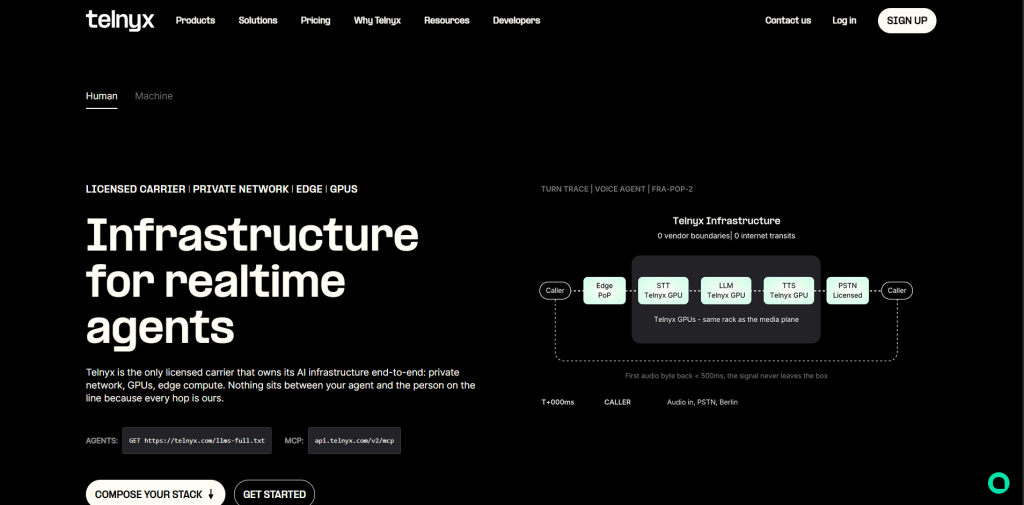
Every other platform in this comparison routes calls over Twilio or a third-party carrier. Telnyx owns its own carrier infrastructure – it is a licensed Tier 1 carrier network – and routes calls over its own backbone. The practical consequence: sub-200ms round-trip time, which is significantly faster than any platform using third-party carrier routing, and a direct impact on the latency budget for every conversational turn.
At $0.05/minute for orchestration with STT and Telnyx-native TTS included in the base rate, Telnyx offers the lowest all-in bundled rate of any platform that includes both speech-to-text and voice synthesis at baseline. LLM cost is additive, bringing the real all-in to approximately $0.07–0.12/min depending on model choice – still lower than Retell AI's $0.10–0.17/min when TTS is factored in. Teams that want premium voice quality (ElevenLabs or equivalent) can bring their own at additional cost. Telnyx also brings the most complete enterprise compliance stack in this comparison: SOC 2 Type II, ISO 27001, PCI DSS, HIPAA, and GDPR – all included. Phone number coverage spans 150+ countries.
Strengths and limitations
Strengths: Carrier-owned infrastructure with sub-200ms RTT – the fastest in this comparison. $0.05/min with STT and native TTS included – the lowest all-in bundled rate. SOC 2 Type II, ISO 27001, PCI DSS, HIPAA, and GDPR – the most complete compliance stack in this comparison. Bring-your-own LLM at any tier. 150+ country number coverage.
Limitations: Developer configuration required – no no-code interface for non-technical users. Fewer independent G2 reviews specific to the voice AI product than larger consumer-facing platforms. Native TTS quality at the base rate is functional but does not match ElevenLabs – premium voice providers add cost on top.
What does Telnyx cost?
$0.05/minute for Conversational AI orchestration, with STT and Telnyx-native TTS included. LLM billed separately at cost. Real all-in: approximately $0.07–$0.12/min in typical configurations. Volume-based pricing plans available. Phone number costs from $1–2/month depending on country.
When does Vapi's component architecture make sense?
Vapi is an AI voice orchestration framework designed for engineering teams building custom voice AI pipelines. Every layer is independently selectable: STT provider (Deepgram, AssemblyAI), LLM (GPT-4, Claude, Gemini, or custom), TTS (ElevenLabs, Cartesia, PlayHT), and telephony (Twilio or Vapi-managed numbers). The $0.05/minute platform fee covers only the orchestration layer – a fact that independent testing consistently validates: real production deployments land at $0.13–0.31/minute all-in, depending on provider choices.
Vapi benchmarks at approximately 750ms median latency with GPT-4o, making it one of the faster options when optimally configured with matching provider regions. The Squads feature chains multiple specialized agents within one call for complex multi-department routing. The developer community consistently rates Vapi's API as the cleanest in the voice AI category for teams building custom voice products rather than deploying a finished agent.
Strengths and limitations
Strengths: Maximum component flexibility – swap any LLM, TTS, STT, or telephony provider. Cleanest developer API in the category. Squads feature for multi-agent chaining. Potentially cheapest at scale when every layer is individually optimized with custom provider keys.
Limitations: Real all-in cost ($0.13–$0.31/min) is 2.6–6.2x the advertised $0.05/min headline rate. No no-code builder – non-technical teams cannot use Vapi without developer support. HIPAA compliance is a $1,000 separate paid add-on; enterprise pricing runs $40,000–$70,000/year. Call history retained only 14 days on standard plans. Troubleshooting spans four to six vendors simultaneously.
What does Vapi cost?
$0.05/min platform fee plus LLM, STT, TTS, and telephony billed separately. Real all-in: $0.13–$0.31/min. HIPAA add-on: $1,000. Enterprise: $40,000–$70,000/year.
When does Aircall make sense as an AI voice agent platform?
Aircall is a cloud-based business phone platform with 22,000+ customers across 110 countries. Its AI Voice Agent – added in 2026 – is a usage-priced add-on for teams already on Aircall's core phone system. The specific case where Aircall wins: teams with working CRM integrations, tested phone infrastructure, and trained agents who want to add AI inbound handling without migrating a phone number, rebuilding a CRM connector, or introducing a new vendor.
At $0.49/minute, Aircall's AI Voice Agent rate is the highest in this comparison – 7x Retell AI's $0.07/min and nearly 10x Telnyx's $0.05/min base rate. For teams not already on Aircall, the economics of switching in for voice AI alone don't hold up. For existing Aircall teams, the integration continuity often outweighs the per-minute premium at moderate call volumes. The 3-user minimum excludes solo operators and small teams.
Strengths and limitations
Strengths: Seamless add-on for existing Aircall customers – no migration, no number porting. 200+ native integrations – the widest marketplace in this comparison. Second-by-second billing (no charge on calls under 15 seconds).
Limitations: $0.49/min AI Voice Agent rate is the highest in this comparison. 3-user minimum. G2 reviewers document recurring connection issues (71 mentions) and call quality problems (58 mentions).
What does Aircall cost?
Phone system: Essentials $30/user/month, Professional $50/user/month (3-user minimum, annual billing). AI Voice Agent: 50 free minutes/month; $0.49/minute above that; $0.015/outbound origination fee per attempt.
What makes Dialpad structurally different from the rest of this comparison?
Dialpad is built on DialpadGPT, trained on eight billion minutes of business conversations. Its defining architectural decision: real-time transcription, post-call summaries, and sentiment analysis are included at every plan tier – including the $15/user/month Connect Standard entry point. On every other platform in this comparison, comparable AI analytics are add-ons. For teams where AI Agents for Customer Support and AI-assisted human calling (coaching, transcription, CRM logging) are as important as autonomous AI call handling, this baseline inclusion fundamentally changes the economics.
Dialpad's AI Agents (autonomous voice agents) use credit-based pricing with no published per-conversation rate – budgeting requires a direct sales conversation. For teams evaluating Dialpad specifically for transparent per-minute autonomous AI pricing, it is not the right fit. For teams evaluating it for AI-enhanced human calling with autonomous agents as a secondary layer, it is the most cost-effective option in this comparison at the analytics tier.
Strengths and limitations
Strengths: AI transcription, summaries, and sentiment at every plan tier – no add-on required. G2 4.4/5 from 4,700+ reviews – the largest review base in this comparison. SOC 2, ISO 27001, HIPAA, GDPR. 100% uptime SLA for qualifying enterprise plans.
Limitations: AI Agents use credit-based pricing with no public per-conversation rate. CRM integrations (HubSpot, Salesforce) gated to the Pro plan at $25/user/month. Full CCaaS capability starts at $80/user/month.
What does Dialpad cost?
Connect Standard $15/user/month; Connect Pro $25/user/month; Dialpad Support (CCaaS) from $80/user/month; Dialpad Sell (outbound AI) from $39/user/month. AI Agents: credit-based, quote required.
What the Right Choice Looks Like by Business Type
- You need AI voice and a full phone system on one platform: CloudTalk. AI Voice Agent and human phone operations share the same telephony infrastructure, CRM integrations, and routing rules – with AI Receptionist for inbound and AI Specialist for outbound campaigns, both on the same account.
- You want the best latency and lowest verified per-minute cost: Retell AI. Sub-600ms independently benchmarked; most transparent all-in pricing in the category.
- You need a working agent live today without a developer: Synthflow. 11-minute setup verified; no-code throughout; best agency white-label capability.
- You’re running committed high-volume outbound: Bland AI. It’s a strong choice for AI Voice Agents for Outbound Calling, with consolidated plan-based billing that makes sense at volume; however, the subscription model can penalize low-volume experimentation.
- Voice quality is the brand differentiator: ElevenLabs Conversational AI. Measurably better voice naturalness and multilingual quality across 29+ languages.
- You need carrier-owned infrastructure at the lowest bundled rate: Telnyx. Sub-200ms RTT on Tier 1 carrier infrastructure; STT and TTS included at $0.05/min; most complete compliance stack in this comparison.
- Your team needs maximum infrastructure control: Vapi. Cleanest developer API; every component independently selectable; plan for real all-in cost of $0.13–0.31/min.
- You're already on Aircall: Stay and add the AI Voice Agent. Migration cost exceeds the per-minute premium at moderate call volumes.
- You want AI analytics at every plan tier: Dialpad. Transcription, summaries, and sentiment at $15/user/month – no add-on required.
What It Actually Costs: A Worked Example
500 inbound calls per month, 4-minute average call duration, 2,000 connected minutes:
| Platform | Monthly estimate | Per-call cost | Notes |
| Telnyx | ~$140–$240 | $0.28–$0.48 | STT + TTS bundled; LLM additive |
| Retell AI | ~$200–$340 | $0.40–$0.68 | Most cost-effective managed platform |
| ElevenLabs | ~$200–$300 | $0.40–$0.60 | Plus LLM and telephony |
| Synthflow | ~$260–$400 | $0.52–$0.80 | Effective rate on subscription tier |
| CloudTalk AI Receptionist | ~$299–$799 | $0.60–$1.60 | Includes telephony; bundle determines cost |
| Vapi | ~$260–$620 | $0.52–$1.24 | Depends on provider optimization |
| Bland AI Build | ~$539–$739 | $1.08–$1.48 | $299 subscription + $0.12/min x 2,000 min |
| Aircall AI Voice Agent | ~$980–$1,180 | $1.96–$2.36 | $0.49/min + phone plan |
A part-time human receptionist covering the same hours costs $1,500–2,500/month. A traditional human answering service runs $1–2 per call with no booking capability. If even five of those 500 calls are new customers who would otherwise have reached voicemail and called a competitor, most platforms in this comparison pay for themselves within the first week.
TCPA and US Compliance for AI Voice Agents
Inbound is low-risk. When a customer calls you, they initiated contact. TCPA restrictions on artificial voices apply to calls you make. Deploy an inbound AI voice agent with disclosure ("You're speaking with an AI assistant") and a recording notice and you are operating in a low-compliance-burden environment.
Outbound requires explicit consent. In February 2024, the FCC confirmed that AI-generated voices are "artificial or prerecorded voice" under the TCPA. Outbound AI calls require prior express consent from the recipient. For marketing or sales calls to mobile phones, that means prior express written consent – obtained before the first dial. Statutory damages run $500–$1,500 per call, per violation, without any need to prove actual harm.
Safe outbound use cases: transactional calls to your own customers who have previously consented – appointment confirmations, delivery notifications, requested callbacks.
Call recording: Roughly a dozen US states – including California, Florida, Washington, Pennsylvania, Illinois, and Massachusetts – require all-party consent for recording. Standard practice is universal disclosure in the greeting.
Compressed to a rule: inbound with AI disclosure and a recording notice is low-risk; outbound requires documented consent per recipient; outbound marketing to mobile phones requires written consent.
Common Deployment Failures – and What Causes Them
Chat prompts ported directly to voice. The agent gives 90-second monologues with list structure. Voice prompts need explicit brevity rules, spoken-number handling, and one-question-at-a-time discipline. Rewrite from scratch; do not adapt a chat prompt.
Latency ignored until launch. The team builds with a flagship reasoning model, demos feel acceptable, then real callers encounter two-second pauses and start interrupting. Set a latency budget on day one and use the fastest model class for the live conversation loop.
No tool timeout design. A webhook that takes six seconds means six seconds of silence on a live call. Keep the synchronous path under two to three seconds, defer everything else, and configure a spoken filler phrase during every tool execution.
Hallucinated availability. The agent offers Tuesday at 3pm without checking the calendar. Every fact the agent states must come from a connected tool result or the prompt itself. The prompt must explicitly state: "Never offer times or details not returned by a tool call."
No escalation path at launch. Build the human transfer path before the first live call. A healthy escalation rate for a booking or reception agent is 5–15% of calls. Near zero means the agent is refusing to transfer people who should be transferred. Above 25% means the agent is failing at its core tasks.
Transcript review skipped post-launch. Review transcripts weekly for the first month, tag failure categories, and feed fixes back into the prompt and tool configuration. Teams that run this iteration loop consistently reach 80–90% autonomous resolution rates. Teams that skip it plateau at 50%.
Frequently Asked Questions
The best depends on your primary constraint. For a complete phone system plus AI voice on one platform: CloudTalk, with AI Receptionist for inbound and AI Specialist for outbound. For the best latency at the lowest verified per-minute cost: Retell AI. For no-code deployment without a developer: Synthflow. For carrier-owned infrastructure at the lowest bundled rate: Telnyx. For maximum infrastructure flexibility: Vapi. For voice quality as the primary differentiator: ElevenLabs Conversational AI.
Anywhere from $0.28 to $2.36 per handled call depending on platform and call duration at 4-minute average length. Telnyx at $0.28–0.48/call is the lowest in this comparison for developer-configured deployments. Retell AI at $0.40–0.68/call is the most cost-effective managed platform. Aircall at $0.49/minute puts a 4-minute call at approximately $1.96. Always model the full call – platform, LLM, STT, TTS, and telephony – not just the headline rate.
Sub-800ms from when the caller finishes speaking to when the agent begins responding is the production quality threshold. Independent benchmark testing places Vapi at approximately 750ms median, Retell at approximately 800ms, and ElevenLabs at approximately 900ms. Telnyx's carrier-owned infrastructure produces sub-200ms round-trip time on the telephony layer, bringing total end-to-end latency lower when paired with fast STT and LLM choices. The biggest driver of latency is LLM model choice, not platform selection.
Only with explicit consent. The FCC confirmed in February 2024 that AI-generated voices are "artificial voices" under the TCPA, meaning outbound AI calls require prior express consent. Marketing calls to mobile phones require prior express written consent. Violations carry $500–$1,500 per call in statutory damages. Inbound agents answering customer-initiated calls face no TCPA restrictions – start inbound.
CloudTalk provides native bidirectional write-back to HubSpot, Salesforce, Pipedrive, Zoho CRM, Zendesk, and Intercom without middleware – covering both the AI Voice Agent and the human phone system on the same infrastructure. Aircall has 200+ native integrations. Retell AI integrates natively with HubSpot; other CRMs connect via webhook or Zapier. Telnyx, Vapi, and ElevenLabs connect to CRMs through webhooks and automation tools.
For specific, well-defined call types – appointment booking, FAQ handling, lead qualification, payment reminders – yes, reliably at scale. Complex calls involving disputes, emotionally sensitive situations, or multi-step judgment still benefit from human handling. CloudTalk's architecture specifically supports the hybrid model: AI and human calls share one CRM record with no data fragmentation between the two.