






Suppose you filled a bucket with water, and you didn’t notice the small hole near the bottom. You keep pouring water in from the top, and for a while, it looks like the bucket is filling up. However, the hole never stops leaking. So, you pour faster. And still, the water level barely moves. You're so busy filling it up that you never stop to think or ask why it’s draining in the first place.
That's exactly what running a business without a customer retention plan feels like. Marketing teams work hard to find quality leads and bring in new customers, sales teams close the deals, and after that, a good number of those customers quietly walk away within months before you realize. Nobody is paying attention to the leak because everyone is busy with their respective tasks. But when you fix the hole, all effort at the top starts to actually count for something.
What Is Customer Retention?
Customer retention refers to the company’s ability to keep its existing customers coming back, making them buy again, and sticking around instead of running away to a competitor. It's not a single action. Rather, it’s an outcome, built from the first interaction a customer has with your brand after their first purchase.
It includes how fast you respond to complaints, how well your product actually works, and whether your customer feels valued instead of just a name on an invoice. To put it simply, it’s the exact opposite of churn. If churn is the water leaking out of the bucket, retention is the patch that stops it. Most businesses track customer retention, work to improve the strategies, and build entire teams around it because it is a lot cheaper to keep existing customers than finding a new one every few months.
Why Is Customer Retention Important for Businesses?
Most businesses underestimate how much a small improvement in retention boosts profit. The reason is that repeat customers already trust your brand. You don’t have to convince them over and over again. They spend more over time and often refer to others without being asked. Acquiring a new customer, on the other hand, involves ad spend, sales calls, onboarding, and a good amount of guesswork about whether they’ll even hang around.
Retention is more than just a “customer happiness” metric; it’s a financial one. Tracking a customer's touchpoints from first contact to loyalty through customer journey mapping makes retention efforts far more targeted. Chasing new leads every month to replace the ones who left takes a toll on your team’s sanity, is exhaustive, and expensive. It affects your revenue predictability and marketing budget.
Top Benefits of Customer Retention

Let’s explore the key benefits of customer retention and how they can support long-term business growth.
Lower Customer Acquisition Costs: Every dollar spent keeping an existing customer goes further than a dollar spent chasing a new one. With existing customers, you don’t have to spend on ads, cold outreach or go through the long trust-building phase, because they already trust you, so there’s no need to keep convincing them to stay with you.
Increase Customer Lifetime Value: Customers who choose to stay with your brand tend to keep spending more over time. Additionally, they upgrade their plans, try new products you launch, and recommend your products to their friends and family. This is simply because they already believe in what you offer.
Build Stronger Brand Advocacy: Happy, long-term customers talk. They leave reviews, refer friends, and defend your brand when someone else criticizes it online. That kind of word-of-mouth marketing can't really be bought.
Generate More Predictable Revenue: When you know a solid percentage of your customers will renew or repurchase, forecasting revenue becomes far less of a guessing game. This kind of stability makes it easier to plan everything else.
Gain Valuable Customer Feedback: Long-term customers have used your products long enough to know exactly what works, what doesn’t, and what’s trending. This honest feedback is hard to get from someone who just signed up last week and might leave anytime.
Key Customer Retention Metrics
If you don’t measure it, you simply won’t know what needs to be improved. These are the numbers most teams track to understand how well they're actually holding on to customers. Reviewing your broader CRM metrics alongside these numbers gives a fuller picture of customer health.
| Metric | What It Measures | Why It Matters |
| Customer Retention Rate (CRR) | The percentage of customers a business keeps over a given period | Gives a direct, high-level view of how "sticky" your customer base is |
| Churn Rate | The percentage of customers who stop doing business with you | The flip side of retention. A rising churn rate is an early warning sign |
| Customer Lifetime Value (CLV) | The total revenue you can expect from one customer over the entire relationship | Helps you understand how much you can afford to spend to keep someone happy |
| Repeat Purchase Rate | How often existing customers buy from you again | A strong indicator of satisfaction and habit-forming loyalty |
| Net Promoter Score (NPS) | How likely customers are to recommend you to others | Reflects emotional loyalty, not just transactional behavior |
These metrics give businesses a clearer view of customer loyalty and highlight where retention efforts need improvement.
Best Customer Retention Tools
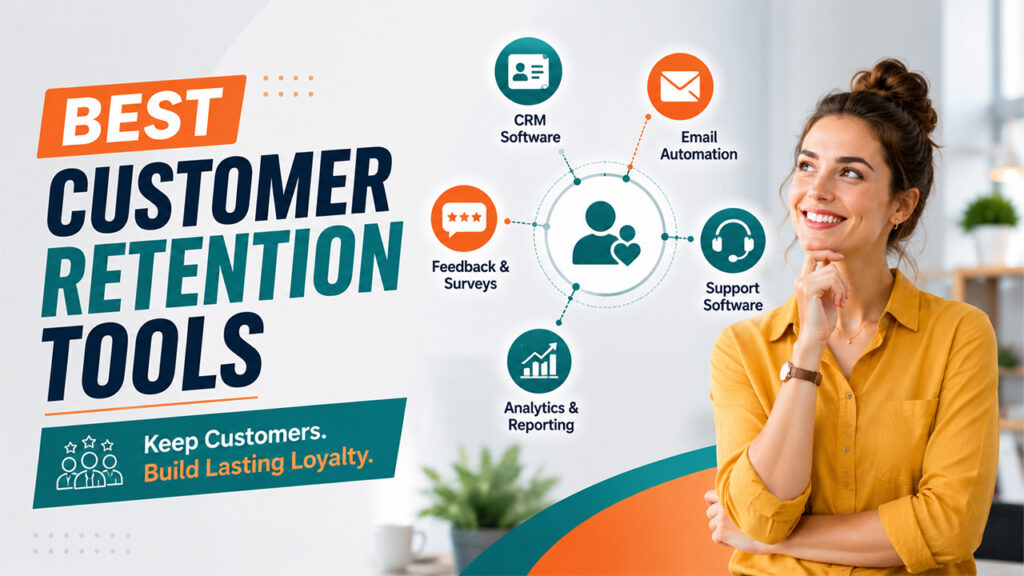
Let’s explore the tools that can help businesses manage customer relationships and strengthen retention efforts.
There are several tools built specifically to make retention far easier. So, there is no need to guess what your customers want or keep records on your desk to remember who needs a follow-up email or call. Each tool works on one simple principle: keep every piece of customer information organized in one place, so nothing slips through the cracks.
CRM Software: A CRM system stores every detail of a customer, such as names, contact details, purchase history, support tickets, and past conversations in one centralized place. So, every team member can pick up where the last one left off instead of juggling spreadsheets or making the customer repeat themselves.
Customer Feedback and Survey Tools: These tools are used to collect reviews or opinions directly, whether through post-purchase surveys or quick NPS check-ins. They help you figure out what is frustrating customers before they quietly abandon you.
Email Marketing Automation Platforms: With these, you can send personalized follow-ups, renewal reminders, welcome messages, or “we miss you” emails automatically instead of blasting the same generic emails to everyone. This works by analyzing how a customer has been behaving, without someone manually tracking every account.
Customer Support and Helpdesk Software: Fast and organized support makes a huge difference to whether someone sticks around. These tools track tickets, response times, and recurring issues, so problems get solved in time instead of being repeated.
Customer Retention Analytics and Reporting Tools: They show important metrics like churn rates and repeat purchase rates in one view to give you a full picture. So, you don’t have to dig through multiple spreadsheets to understand whether your retention strategies are actually working or not.
Most of these tools work best when they talk to each other. A CRM that connects with your support desk and your email platform gives you one full picture of the customer, rather than scattered pieces that nobody has time to stitch together manually.
5 Best Customer Retention Strategies

With the right foundation in place, these five customer retention strategies can turn one-time buyers into long-term customers.
Personalize the Customer Experience: Everybody wants to stand out from the noise. Use customer data like their past purchases, preferences, and support history to send personalized emails, offers, and recommendations that make people feel you care about them. This is where customer retention in CRM tools becomes genuinely useful, since a good CRM pulls all this history into one place, so your team isn't left guessing.
Build a Customer Loyalty or Rewards Program: Give customers a reason to keep choosing you over a competitor, even when a rival offers a slightly lower price. Points, exclusive discounts, or early access to new products all work because they turn a one-time purchase into an ongoing relationship, and people genuinely enjoy feeling rewarded for their loyalty. This is a win-win situation for both you and your customers.
Act Quickly on Customer Feedback: When someone takes the time to complain or suggest an improvement, it means they actually value your brand and give you a second chance. Responding quickly, fixing the issue, and following up shows customers that their voice actually changes something, which builds trust far faster than any marketing campaign ever could.
Invest in Proactive Customer Support: Don't wait for a customer to come to you aggressively before you listen to them and help them. Reach out to them before renewal dates, check in after onboarding, or spot usage drops before they turn into cancellations. It shows customers that you are paying attention rather than ghosting them and coming back again when you want a sale.
Track and Act on Customer Retention Metrics: Strategy without measurement is just guesswork. Review your churn rate, CLV, and NPS regularly to actually adjust your approach based on what those numbers tell you. This way, you can turn customer retention strategies from a one-time initiative into a habit your whole company builds around.
Conclusion
Customer retention is not something that you can check once a year. It’s an ongoing commitment that significantly shapes how a business scales. Companies that fix the hole in their bucket earn more, spend less, and build relationships that last longer and compound over time instead of starting from scratch for every sale.
It doesn't require a massive budget or a complete overhaul either. Often, it starts with something as simple as listening better, responding faster, and using the data you already have more wisely. The businesses that treat their existing customers as their most valuable asset, not just their most convenient one, are the ones that end up winning long after the marketing budget runs dry.
Frequently Asked Questions (FAQs)
Acquisition brings in new customers; retention keeps existing ones engaged and buying, which is generally far more cost-effective in the long term.
A CRM centralizes customer data, purchase history, and interactions, helping teams personalize outreach and spot at-risk customers before they leave.
It varies by industry, but generally, anything above 85% is considered strong for most subscription-based or service businesses.
Absolutely. Even simple steps, like personalized follow-ups or loyalty perks, work well and often cost far less than acquiring new customers.
Common reasons include poor service, lack of personalization, better competitor offers, or simply feeling ignored after their first purchase.