





Nobody calls a business between 9 and 5 anymore. They call at midnight because that's when they finally sat down to deal with the refund, or at 7 AM before work. After all, the delivery still hasn't shown up. And if they're put on hold, most of them just hang up and complain on Twitter instead. That's the actual reason AI voice agents stopped being a "someday" project for customer service teams and became something people are rolling out right now, in 2026.
If you've spent even an hour looking into this space, you already know it's a mess to navigate. Half the tools calling themselves "voice AI" are really just chatbots with a text-to-speech layer bolted on; they sound fine for ten seconds and then fall apart the moment a caller says something unexpected. A smaller group actually holds a conversation, picks up on intent, and closes the loop without a human touching it. This piece walks through five Indian companies building the second kind what each one is actually good at, who it's built for, and what it tends to cost so you're not starting from zero.
Doesn't matter if you're running support for a scrappy D2C brand or managing a BFSI contact center with compliance breathing down your neck, the goal here is the same: give you something useful to work from, not a sales pitch dressed up as a listicle.
TL; DR: Top AI Voice Agents for Customer Service Teams Overview
If you're skimming, here's the short version:
- Rootle AI: Builds conversations backward from business KPIs instead of just tracking call volume. A good fit if you're in BFSI, Healthcare, Telecom, or eCommerce and actually want to see resolution and conversion numbers move.
- Gnani.ai: Bengaluru-based, and unusual in that they've trained their own speech models on real telephony audio instead of adapting a general-purpose model. Known for voice biometrics and BFSI-grade security.
- Haptik (Jio Haptik): One of the oldest names in Indian conversational AI, now under Reliance Jio. Handles massive enterprise deployments across voice, WhatsApp, and web without breaking a sweat.
- Yellow.ai: A broader omnichannel platform where voice is one piece of a bigger puzzle. Wide language coverage, multiple underlying models, built for enterprises that don't want five separate vendors.
- SquadStack: Trained its voice agents on hundreds of millions of real calls, and it shows the conversations feel less scripted than most.
They're not interchangeable. Some are built around outcomes, some around scale, some around raw voice quality. Here's the fuller picture.
The 5 Top AI Voice Agents for Customer Service Teams Overview 2026
1. Rootle AI
Year Founded: 2023
Headquarters: India
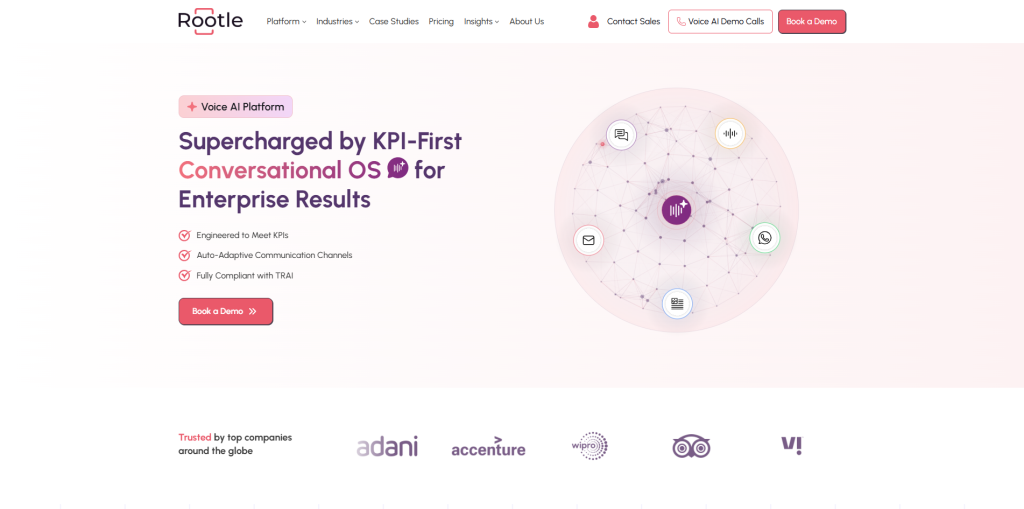
Rootle is a Voice AI Platform that starts from a different question than most tools in this category. Instead of "how do we automate this call," it asks "what's the business actually trying to achieve here" and then designs the conversation flow backward from that. Across voice, WhatsApp, RCS, and email, it treats interactions as one connected journey rather than a pile of disconnected touchpoints. It keeps track of intent and context as a customer moves between channels, and it adjusts the conversation path on the fly depending on what the person actually needs. Whether that's resolving a complaint, finishing a task, or nudging someone toward a purchase, every step is pointed at the goal that was set up front.
What's genuinely different here is the scorecard. Most systems in this space still lean on volume calls handled, minutes logged. Rootle doesn't. It optimizes for impact instead: completion rates, how good the resolution actually was, whether it converted, and it keeps refining conversations based on those numbers rather than raw throughput. For a support leader who's sick of reporting "we handled 40,000 calls" without being able to say whether any of them actually solved the customer's problem, that distinction matters more than it sounds. Among the newer names building Voice AI Agents with Indian compliance baked in from day one, Rootle is one to watch.
Key Features
- KPI-first conversation design that maps every dialogue path back to a defined business goal
- Cross-channel orchestration across voice, WhatsApp, RCS, and email with maintained context
- Dynamic conversation adaptation based on real-time customer behavior and intent
- Continuous learning loop focused on completion rates and resolution quality, not just call volume
- Enterprise-grade compliance: TRAI-aligned, DPDPA-compliant, Indian data residency, ISO certification-aligned
Industries Served by Rootle AI
Rootle is built to flex across industries rather than lock into one:
- Recruitment
- BFSI
- Education
- Ecommerce
- Hospitality
- Telecom
- Utilities
- Healthcare
- Logistics
It's designed for conversations for all of these.
Rootle AI Plans & Pricing
There's no flat rate card here. Rootle runs on custom, enterprise-scoped pricing, which makes sense given how much the setup depends on which channels you're using, how much volume you're pushing, and how complex the customer journeys are. Expect a conversation with sales rather than a self-serve checkout; pricing gets scoped to your actual use case, not a generic tier.
Rootle AI Use Cases
- Lead qualification and onboarding for BFSI and eCommerce
- Customer support and query resolution across multiple channels
- Collections and payment reminders with compliance-safe scripting
- Bookings, appointment scheduling, and service reminders
- Retention and win-back campaigns tied to measurable conversion goals
Rootle isn't locked into a set of predefined flows; it flexes based on the business goal, the customer's behavior, and the context of the conversation. That makes it just as workable for high-volume, repetitive support queues as it is for messier, multi-step workflows where the "right" path isn't obvious until the conversation is already underway.
2. Gnani.ai
Year Founded: 2016
Headquarters: Bengaluru, Karnataka, India
Intro
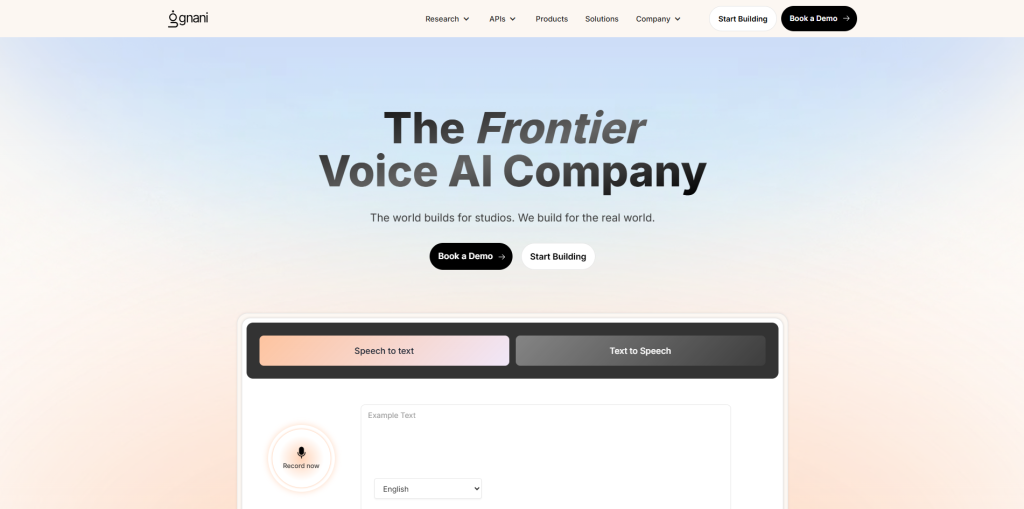
Most voice AI companies take a general-purpose language model and try to make it work over the phone. Gnani.ai did the opposite; they built their own speech-to-text, text-to-speech, and language models from the ground up, trained specifically on telephonic audio. Not clean studio recordings, but the real thing: bad network, background noise, people switching between Hindi and English mid-sentence. That focus shows up in how the system handles calls that would trip up a lot of competitors, especially on poor connections or in heavy regional accents.
Where Gnani has really built its name is in regulated industries, particularly banking. Voice biometrics and on-premise deployment aren't afterthoughts for them; they're a core part of the pitch, because that's what BFSI compliance teams actually ask for.
Key Features
- In-house STT, TTS, and language models trained on tens of millions of hours of real telephonic audio
- Strong performance across multiple Indian languages, including noisy, low-bandwidth call conditions.
- Voice biometrics for identity verification and fraud prevention
- Agent-assist tools offering real-time coaching, note-taking, and suggested responses for human agents
- On-premise deployment options for strict data residency and BFSI compliance needs
Industries Served by Gnani.ai
- Mostly Banking & Financial Services
- Telecom
- E-Commerce
- Insurance
- Healthcare
The kind of sectors where a security slip-up isn't just embarrassing; it's a compliance problem.
Gnani.ai Plans & Pricing
No public pricing page. It's a custom, enterprise-quote model, generally shaped around call volume, which languages you need, and whether you're going cloud or on-premises.
Gnani.ai Use Cases
- High-security voice verification for banking transactions
- Multilingual customer support across regional Indian languages
- Real-time agent assistance in large contact centers
- Fraud detection through voice biometrics
- Speech analytics for compliance monitoring in regulated industries
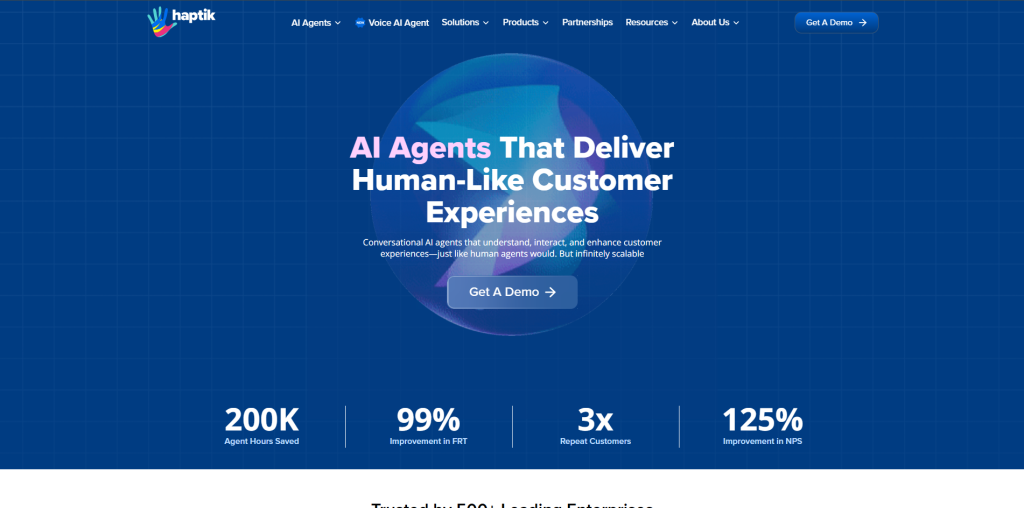
3. Haptik (Jio Haptik)
Year Founded: 2013
Headquarters: Mumbai, Maharashtra, India
Intro
Haptik's been around long enough to remember when "chatbot" was still a novelty word. It was one of the first companies in India to build a large-scale conversational AI platform, well before this space got crowded, and Reliance Jio Platforms acquired it in 2019. That gave Haptik something most competitors don't have: the backing and reach of one of the country's biggest telecom players. Today it's grown into a full CX platform, with a dedicated Voice AI Agent sitting alongside its chat and WhatsApp automation tools.
Scale is really the story here. Haptik has been running in production with hundreds of enterprise clients for years, which means it's had a lot more real-world call data to learn from than a newer entrant would.
Key Features
- Dedicated Voice AI Agent for inbound and outbound calls alongside chat and WhatsApp bots
- Six distinct autonomous AI agent types, including support, sales, booking, and lead qualification agents
- Deep omnichannel integration across voice, WhatsApp, and web from a single platform
- Backed by Reliance Jio's telecom infrastructure and enterprise reach
- Long production history with large, well-known enterprise brands
Industries Served by Haptik
- Large Enterprises in Retail
- Quick-Service Restaurants
- Media And Entertainment
- Telecom
- BFSI
- Travel
Haptik Plans & Pricing
Enterprise-only and entirely custom-quoted; there's no self-serve plan you can just sign up for. It usually starts with a sales call and a demo, and pricing scales with conversation volume plus per-seat costs if you're using the live-agent tools. Voice minutes tend to get billed separately on top of the base platform fee.
Haptik Use Cases
- Large-scale customer support automation for retail and QSR brands
- Voice ordering and store-locator style queries
- Lead qualification and sales assistance for enterprise sales funnels
- Appointment booking and reservation management
- Omnichannel customer engagement combining voice, WhatsApp, and web chat
4. Yellow.ai
Year Founded: 2016
Headquarters: Bengaluru, Karnataka, India (with global offices)
Intro
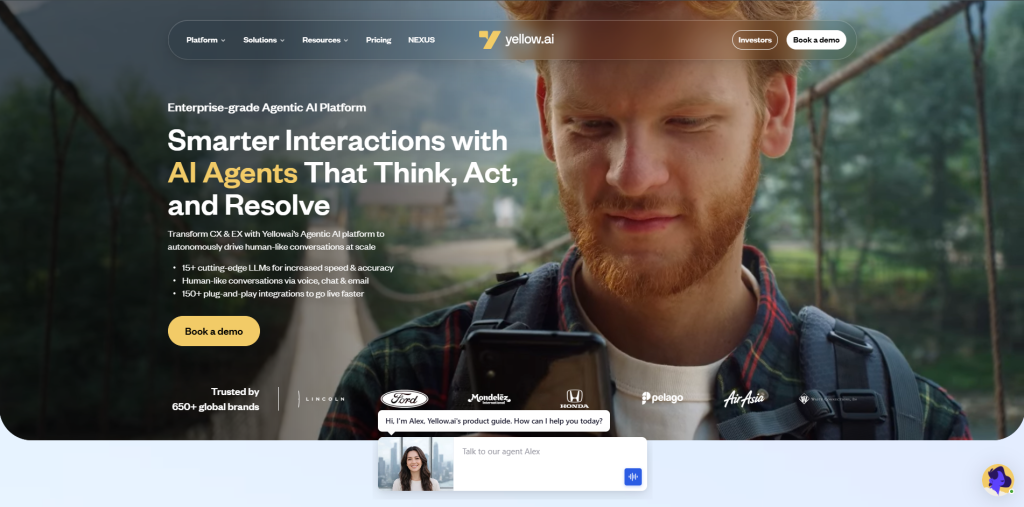
Yellow.ai isn't really a "voice company" first; it's an omnichannel customer service automation platform where voice happens to be one strong piece of a larger offering. That includes a voice cloning feature called Nexus Vox. The pitch works for enterprises that would rather deal with one vendor across voice, chat, and messaging than stitch together three separate tools and hope the handoffs don't break.
The platform doesn't lock itself into a single underlying model either; it runs a multi-LLM setup, and it covers a wide spread of Indian and international languages, which is a big part of why large, multi-region businesses tend to end up here.
Key Features
- Voice cloning and synthesis technology supporting a large number of languages.
- Multi-LLM architecture rather than reliance on a single model provider
- Support for around 20 Indian languages plus numerous international languages
- Extensive third-party integrations across CRMs, helpdesks, and enterprise systems
- Sales-led enterprise implementation with dedicated onboarding support
Industries Served by Yellow.ai
- BFSI
- Retail
- Healthcare
- Travel
- Telecom
Mostly among businesses with a wide regional or global footprint.
Yellow.ai Plans & Pricing
Same story as most enterprise players on this list: no public pricing. It's sales-led and custom-quoted, generally built around usage volume, language requirements, and how many channels you're deploying.
Yellow.ai Use Cases
- Multilingual voice support for enterprises with pan-India or global operations
- Omnichannel customer engagement spanning voice, chat, and messaging
- Voice-based order tracking and account queries
- Large-scale outbound campaigns for renewals and reminders
- Enterprise helpdesk automation integrated with existing CRM systems
5. SquadStack
Year Founded: 2016 Headquarters: Gurugram, Haryana, India
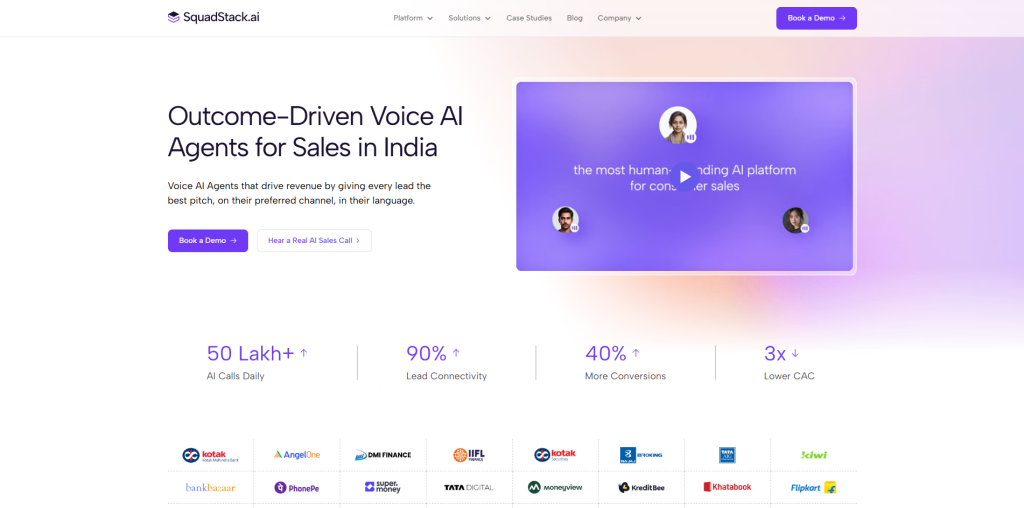
SquadStack's whole approach rests on one bet: the more real conversations you train on, the less robotic the AI sounds. Their voice agents have been trained on hundreds of millions of actual recorded calls, which the company says is why they're better at picking up on tone and sentiment instead of just following a script line by line.
That's also why teams that have already tried a voice bot and found it stiff or repetitive tend to gravitate here; the conversational quality is genuinely the selling point, not an afterthought.
Key Features
- Voice agents trained on a massive dataset of real, recorded calls
- Sentiment and tone detection for more natural, context-aware responses
- End-to-end conversation management without heavy reliance on rigid scripts
- Support for both inbound customer support and outbound engagement calls
- Analytics and reporting to track resolution quality over time
Industries Served by SquadStack
- BFSI
- Real Estate
- Ed-tech
- Healthcare
- D2C
- E-Commerce
Basically, anywhere the tone of the call matters as much as the content.
SquadStack Plans & Pricing
Generally usage-based, tied to call minutes or volume, with custom enterprise pricing for bigger deployments. You'll usually need a scoping conversation before you get an actual number.
SquadStack Use Cases
- Natural-sounding customer support calls for D2C and e-commerce brands
- Outbound lead engagement and qualification for real estate and ed-tech
- Appointment reminders and follow-up calls for healthcare providers
- Collections and payment follow-up calls with a human-like tone
- Customer satisfaction and feedback call post-resolution
How to Choose the Right AI Voice Agent for Your Customer Service Team
Five decent options, and you still have to pick one. Here's roughly how to think it through:
1. Figure out what you're actually optimizing for before you look at tools.
Cutting resolution time? Lowering cost per call? Getting more conversions on outbound calls? Better CSAT? Your answer changes the shortlist. If outbound calling is a major part of your customer service strategy, look for AI Voice Agents for Outbound Calling that can handle follow-ups, reminders, lead qualification, surveys, and other proactive customer conversations. A KPI-first platform suits teams chasing outcomes; a scale-first platform suits teams drowning in standardized, repetitive queries.
2. Test language coverage against your real customers, not the vendor's demo reel.
A vendor claiming "20 languages" doesn't tell you much. Ask how the thing performs on an actual noisy phone call in the specific dialects your customers use — demo audio recorded in a quiet studio proves almost nothing.
3. Get compliance in writing before you get attached to a tool.
If you're in BFSI, healthcare, or any regulated space, ask for TRAI, DPDPA, and data residency documentation up front. Don't take a sales rep's word for it.
4. Be honest about whether you actually need omnichannel.
If your customers bounce between WhatsApp, email, and voice, a platform that holds context across all three will beat a voice-only tool that sounds slightly better in isolation. If they mostly just call, don't overpay for channels you won't use.
5. Ask how pricing actually adds up, not just the headline number.
Per-minute charges, per-seat fees, platform licensing these stack in ways that surprise people three months in. Get the full breakdown before you sign anything.
6. Run an actual pilot.
Nearly every vendor here will let you test with real call data first. Do it. Two weeks of real calls will tell you more than any sales deck ever will.
7. Check what the vendor considers "success."
Some report on call volume. Others report on resolution and conversion. The second kind is usually a better match for what customer service leaders are actually judged on.
AI Voice Agents vs. Traditional Call Centers
| Category | AI Voice Agents | Traditional Call Centers |
| Availability | Operate 24/7 without breaks, shifts, or holidays | Limited to staffed hours, with gaps during nights and holidays |
| Scalability | Can handle thousands of simultaneous calls instantly | Requires hiring, training, and staffing more agents to scale |
| Cost Structure | Pay per minute or per conversation; costs shrink with volume | High fixed costs from salaries, infrastructure, and attrition |
| Consistency | Delivers the same quality and compliance-safe script every time | Quality varies by agent experience, mood, and training |
| Ramp-Up Time | Can be deployed or updated in days to weeks | New agent hiring and training can take weeks to months |
| Handling Complexity | Excellent for structured, high-volume queries; improving on nuance | Better suited for highly emotional or ambiguous edge cases |
| Data & Insights | Every call is automatically logged, transcribed, and analyzed | Requires manual QA or separate analytics tools for insights |
| Multilingual Support | Can switch languages instantly across a large customer base | Requires hiring agents fluent in each specific language |
In practice, most decent customer service teams in 2026 aren't picking a side. They're using AI voice agents to soak up the high-volume, repetitive stuff and freeing up their human agents for the calls that actually need a person: the angry ones, the confusing ones, the ones where a script just isn't going to cut it.
Conclusion
India's AI voice agent space has grown up fast, and by 2026 most customer service teams have stopped asking "should we even do this" and moved on to "which one actually fits us." Each platform here brings something different: Gnani's telephony-trained models, Haptik's sheer scale, Yellow.ai's omnichannel spread, SquadStack's natural-sounding calls.
Rootle AI is worth a closer look if you want your AI Voice Agents tied directly to business outcomes instead of just call-handling stats. The KPI-first approach matters more now that support teams are being asked to prove actual ROI, not just show activity numbers. Whichever one you end up going with, the point is the same either way: faster resolutions, customers who aren't stuck on hold, and a support team that isn't buried under repetitive calls all day.