




Well-implemented RAG chatbots can deflect 40 to 50 percent of routine support tickets, cut Average Handle Time by up to 40 percent, and reduce operational costs by up to 30 percent, according to the Wonderchat 2025 RAG in Customer Support Benchmark Report. The catch: those numbers only appear when the pipeline is built properly. Most are not.
Base LLMs hallucinate in 15 to 25 percent of responses without grounding data. At scale, that can mean hundreds of misleading customer support answers each day. RAG reduces this risk by grounding responses in verified company knowledge, cutting hallucination rates below 5 percent when implemented well.
The market is growing at pace. According to MarketsandMarkets via GlobeNewswire, the RAG market is projected to grow from USD 1.94 billion in 2025 to USD 9.86 billion by 2030 at a 38.4 percent CAGR. That growth is pulling in every services firm that can spell "vector database" onto the buying committee radar.
This article compares five custom RAG development companies for customer support automation, highlighting the trade-offs and ideal buyer profile for each. It also covers what effective RAG builds require, how the firms were evaluated, how to assess deflection claims, and the buyer mistakes that derail pilots.
What Is RAG for Customer Support, and Why Is It Different From a Chatbot?
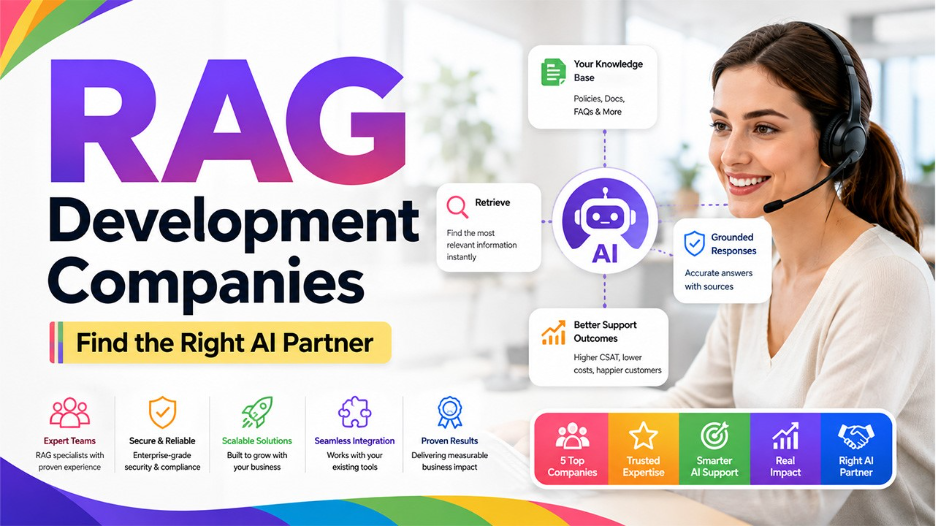
Retrieval-Augmented Generation is not another chatbot pattern. It is an architecture that grounds an LLM's response in a live knowledge base at query time, turning static AI into a system that answers from your actual policies, product docs, and ticket history.
The architectural distinction matters. A static LLM chatbot answers from what the model learned during training. It hallucinates on proprietary company data because that data was not in the training set. A RAG-powered support system retrieves relevant passages from a vector-indexed knowledge base, forces the model to generate answers from them, and cites the source alongside the response.
The concept traces back to a 2020 paper from Meta AI researchers led by Patrick Lewis. Adoption exploded post-2023 once ChatGPT proved how useful, and how unreliable, base LLMs could be, as documented in this Medium overview by Reenbit.
The hallucination reduction claim is real, but distribution matters. Base LLMs hallucinate at 15 to 25 percent. Well-built RAG reduces this to under 5 percent in enterprise deployments. Field studies record hallucination reductions between 70 and 90 percent when RAG pipelines are introduced, per Mordor Intelligence citing the Makebot AI Research Team.
There is a CSAT benefit that often gets overlooked. IrisAgent's Q1 2026 customer survey documented an 8 to 12 percent CSAT lift on tickets where the AI cited its sources, even without any change to underlying accuracy. Citations raise trust.
Counterargument to address head-on: "Isn't RAG just search plus an LLM?" Technically, yes. But that framing hides where the real engineering work sits. Chunking strategy, embedding model selection, reranking, confidence thresholding, escalation guardrails, and knowledge base freshness monitoring are the five layers that separate a working RAG system from a fragile demo. Firms offering custom RAG development services who cannot describe their approach to all five are selling a proof of concept at production pricing.
What Belongs in Custom RAG Development Services That Actually Ship
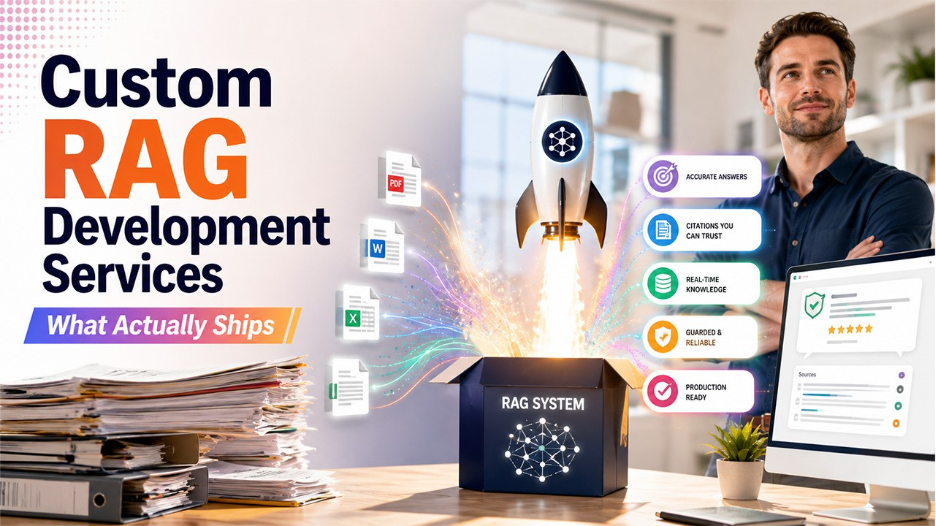
The market shorthand collapses everything into "we build RAG." The reality is that custom RAG development services span five distinct capability areas, and a firm that ships production RAG has depth in all of them.
- Data ingestion and knowledge base structuring. Layout-aware parsing that preserves headers, tables, code blocks, and version metadata. Not template-based OCR. This applies to product docs, policies, ticket history, resolved-case corpora, and change logs.
- Vector database selection and configuration. Pinecone, Weaviate, Qdrant, pgvector, Chroma, Milvus. The choice is not neutral. Latency, cost, ecosystem, hybrid-search support (dense plus sparse), and metadata filtering all differ. A serious firm has explicit benchmarking data and defensible reasons for choosing one over the others.
- Retrieval pipeline engineering. Chunking strategy (fixed-length, semantic, hierarchical), embedding model selection (OpenAI text-embedding-3, Cohere, sentence-transformers, domain-fine-tuned), query rewriting, reranking with Cohere rerank or cross-encoders, and retrieval evaluation harnesses. Reranking alone typically improves retrieval precision by 20 to 40 percent over dense-only retrieval.
- Generation layer and guardrails. LLM choice (GPT-5, Claude, Gemini, LLaMA, Mistral, open-weights), prompt engineering, citation forcing, confidence scoring, escalation thresholds, and hallucination detection.
- Production monitoring and KB freshness. Drift detection, retrieval quality metrics, feedback loops, automated KB re-indexing when source docs change, and alerting when confidence drops below thresholds. According to Zendesk 2025 data via IrisAgent, 30 percent of a typical enterprise help center contains articles over 12 months old. Even a perfectly grounded RAG will hallucinate against a stale KB. KB curation alone reduces grounded-but-wrong answers by 20 to 30 percent.
If a firm's marketing page leads with "we use Pinecone" without addressing chunking, reranking, monitoring, and KB curation, they are selling a demo. Not a system.
How We Compared These 5 RAG Development Firms
The five firms below were evaluated on six axes weighted toward what actually matters for a customer support RAG deployment.
- Production track record. Named client deployments with quantified outcomes, not portfolio decoration.
- Explicit RAG capability disclosure. Named vector databases, chunking strategies, and reranking approach, not marketing generality.
- Compliance posture. SOC 2, ISO 27001, ISO 42001, and HIPAA readiness, third-party validated rather than marketing copy.
- Verified third-party reviews. Clutch or G2 ratings above 4.5, cross-referenced with named deployments.
- Customer-support-specific integration depth. Native connectors for Zendesk, Salesforce Service Cloud, ServiceNow, HubSpot Service Hub, and Intercom.
- Delivery model and time-zone overlap. Fixed-price PoC to production timeline, availability of dedicated teams versus staff augmentation, and iteration cycle latency.
Counterargument to address: "Aren't these signals all gameable?" Any individual signal, whether Clutch score, SOC 2 report, or named client, can be gamed in isolation. The methodology here requires firms to satisfy multiple independent signals simultaneously, which is materially harder to manufacture in aggregate. A firm can buy reviews. It cannot buy reviews and a SOC 2 report and a named client willing to go on record and published production telemetry from its own systems.
The 5 Top RAG Development Companies for Customer Support Automation
With criteria set, here are the five firms, presented in intentional order to signal that the list is heterogeneous rather than strictly ranked. LeewayHertz opens because its ZBrain platform gives it the strongest published integration story on this list. Codazz closes because it is the newest firm with the ISO 42001 signal. Azumo appears mid-list with an extended profile because its production track record on its own RAG-powered systems is one of the clearest independently verifiable signals a buyer of custom RAG development services can evaluate.
1. LeewayHertz
Best for enterprise buyers who want a platform-plus-services model with 200+ prebuilt SaaS connectors already available on day one.
LeewayHertz sells services on top of its proprietary ZBrain platform. Model-agnostic architecture supports GPT-5.2, Claude, Gemini, LLaMA 4, Grok 3, and Mistral. Their 200+ prebuilt data connectors are a real integration moat for customer support use cases that need to reach Zendesk, ServiceNow, Salesforce, HubSpot, or internal databases without greenfield API work.
Founded in 2007 and recently acquired by The Hackett Group, LeewayHertz was named a representative vendor in Gartner's 2024 Hype Cycle Report for Generative AI. Their Fortune 500 client base includes 3+ named references.
The ZBrain platform has three components relevant to customer support RAG:
- ZBrain AI XPLR identifies AI opportunities, designs solution blueprints, and prioritizes initiatives.
- ZBrain Builder is an agentic AI orchestration platform to design, deploy, and manage RAG-powered agents on proprietary data.
- Agent Crew handles multi-agent orchestration for coordinated workflows.
The platform supports the Google ADK framework, A2A protocol, MCP, and Agent Context Protocol. Guardrails, runtime monitoring, and feedback loops are named platform components, which is exactly what a production customer-support RAG needs.
Trade-off: LeewayHertz's ZBrain gives them the strongest published integration story on this list. Weakness: only 9 Clutch reviews. Social proof is thinner than the marketing depth suggests. The Hackett Group acquisition adds enterprise depth but also creates procurement complexity. Buyers now negotiate with a larger consulting firm, not a boutique. Best fit for mid-market to enterprise buyers who want to lean on platform IP rather than build a bespoke RAG stack from scratch. Not the right answer for a lean startup engagement.
2. InData Labs
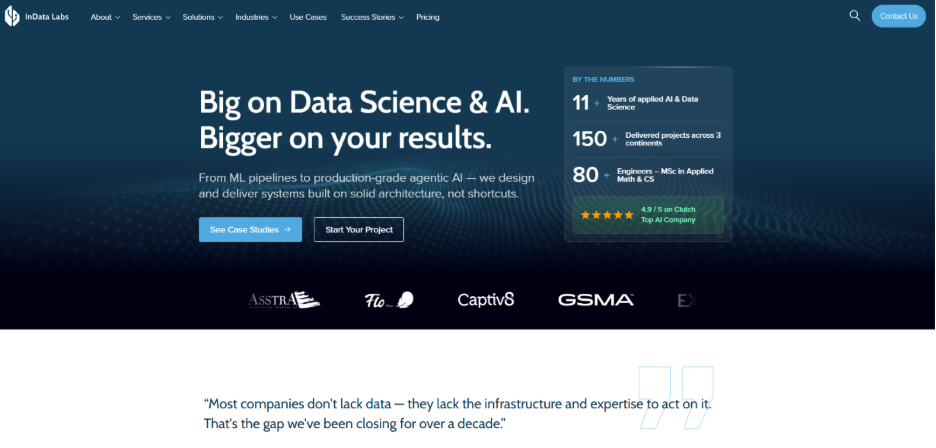
Best for buyers who want custom RAG development services built inside a broader data-engineering and machine-learning practice, not as an isolated support chatbot.
InData Labs has been building production AI systems for 10+ years, well before the ChatGPT wave. Their RAG capability sits inside a full-stack data science firm. The differentiator is that the same team that builds the RAG also builds the data engineering that keeps the knowledge base fresh.
Founded in 2014 by Marat Karpeko (Co-Founder and Chairman, a video gaming industry veteran per InData Labs), the firm operates as a certified AWS cloud development partner. Their US headquarters, per CB Insights, anchors an international engineering team. They carry 20 Clutch reviews with a minimum project size of $10,000.
Their named RAG stack, per the InData Labs AI Chatbot Development page, includes Pinecone, Qdrant, and pgvector; embedding pipelines; and LLM fine-tuning on historical conversations, support tickets, or domain-specific corpora. Post-launch support is explicitly scoped on their site: performance monitoring (response accuracy, fallback rates, CSAT scores), scheduled model retraining as the KB evolves, and conversational flow refinement based on real user interaction data.
Their named RAG-specific case study is a rehab platform. A GPT-4o-powered assistant with a RAG-based knowledge base lets clinics design tailored rehab programs and keep patients engaged beyond the clinic. It is currently in Phase 2 expansion, adding email notifications, an AI-powered exercise library, patient-provider messaging with text-to-speech, and a patient iOS app. Adjacent case studies include an anti-fraud solution, freight rate prediction, ML audience segmentation on AWS, an e-commerce platform with a 25 percent revenue boost from inventory optimization, and debt collection scoring across 3.5 million accounts monthly.
Trade-off: InData Labs is best for buyers who see RAG as part of a broader data platform build. Weakness: smaller Clutch review base than LeewayHertz on the deep-services end, and less named RAG-specific customer support case telemetry than Azumo. Best fit for organizations that need RAG combined with data engineering, MLOps, or predictive analytics. Not for a standalone off-the-shelf support chatbot build.
3. Azumo
Azumo is the only firm on this list that runs its own RAG-powered customer support systems in production against auditable telemetry. It is best for buyers who want custom RAG development services built with SOC 2 discipline, US time-zone alignment, and an independently verifiable production track record. Charli, their production chatbot, lives on Azumo's own website. The AI Receptionist answers Azumo's own phone line.
Azumo has been building production AI since 2016, before the ChatGPT wave. The RAG-specific benchmark is public: the Azumo AI development team integrates knowledge bases with LLMs to reduce hallucination rates from 15 to 20 percent (with the base LLM) to under 5 percent across most enterprise use cases.
The track record is measurable:
- 300+ successful production deployments; 100+ production AI systems
- 4.9 verified client rating on Clutch, DesignRush, and The Manifest
- 150 percent net retention rate; 3.2+ year average client engagement
- 100+ customers from startups to Fortune 100, including Meta, Twitter/X, Discovery, Omnicom, NCsoft, Zynga, Angle Health, and Stovell AI
- SOC 2 certification, GDPR/CCPA compliant, HIPAA-ready with BAA support, AES-256 encryption
- Member of the Anthropic Claude Partner Network
Proprietary customer-support-relevant AI products as production proof:
- AI Receptionist is production voice AI running Azumo's own phone line. Built on Twilio, Deepgram, Anthropic Claude, ElevenLabs, and proprietary orchestration. Verified telemetry: 1.7-second median response time, 76 percent of turns under 2 seconds, 512 measured conversation turns, zero downtime.
- Charli is an LLM-powered conversational AI chatbot trained on internal data via RAG. It runs live on Azumo's customer support page. Visitors can talk to it before signing.
- Valkyrie is an AI infrastructure platform providing a unified REST API to any LLM.
Named RAG stack: LLMs across OpenAI, Anthropic Claude, LLaMA, Mistral, Qwen, DeepSeek, and Cohere. Agentic frameworks include LangChain, LangGraph, LlamaIndex, CrewAI, and Microsoft AutoGen. Vector databases include Pinecone, Weaviate, and Chroma. Cloud deployment covers AWS Bedrock, Azure OpenAI, and Google Vertex AI. Enterprise integrations reach Salesforce, HubSpot, SAP, Oracle, NetSuite, ServiceNow, Slack, Microsoft Teams, and Zendesk.
The Azumo customer support AI catalog covers 10 named agent types across three tiers. Self-Service includes Intelligent Chatbot, RAG-grounded Knowledge Base Search, and Guided Troubleshooting. Agent Augmentation adds Agent Assist (RAG-grounded real-time knowledge surfacing), Ticket Summarization, and Auto-Response Drafting. Support Intelligence layers in Sentiment Analysis, Ticket Classification and Routing, Voice of Customer Analytics, and an Escalation Predictor.
The most directly relevant customer-support RAG case is the Angle Health case study. Angle Health, an insurance SaaS, needed LLM-powered RFP-to-quote automation. The pipeline uses GPT to extract key parameters from unstructured Zendesk threads and 30+ page attachments. The team went from 45 minutes per RFP to 5 minutes per RFP: a 90 percent cycle time reduction and 9x process efficiency gain. Human-in-the-loop verification remains in the pattern.
Delivery model: POC and MVP RAG chatbots ship in days. Production-ready RAG systems with enterprise integrations ship in 2 to 6 months. Fixed-price projects, dedicated AI teams, or staff augmentation. Nearshore delivery from Latin America runs approximately 30 to 50 percent below equivalent US-based teams.
Trade-off: Azumo is best for buyers who want custom RAG development services built with a verifiable production track record and SOC 2 compliance posture. Not the right fit for buyers who want a self-serve platform to license. There is no proprietary RAG "product" the way ZBrain is licensed. Also not the right fit for a 50-country SAP-integrated rollout requiring GSI-scale change management.
Azumo is the answer when the engagement is a focused RAG build with a measurable KPI, a fixed timeline, and integration depth that off-the-shelf products cannot cover.
4. Markovate
Best for early-stage SaaS startups or mid-market SaaS teams that need a RAG-powered support agent PoC priced for pre-Series-B budgets.
Markovate positions itself between a traditional dev shop and an AI product studio. Their PoC pricing sits at $25,000 to $40,000, materially below the larger firms on this list. Case telemetry on SaaS-embedded agents is real, if narrower.
Founded in 2014 with a US and India hybrid team of 300+, Markovate is led by Co-Founder and CEO Rajeev Sharma (18+ years of AI and cloud experience, previously at AT&T and IBM, per the Markovate SaaS AI Agents blog). They run an explicit SaaS AI Development practice. They carry 12 Clutch reviews, a smaller review base than others on this list. Named agent tooling includes CrewAI and LLM-powered assistants.
The Groovy Web 2026 assessment reads: "positions between traditional dev shop and AI product studio... strong at agents-inside-a-product, less proven on multi-agent enterprise orchestration with hundreds of tools."
Named customer-support-relevant case studies include a chatbot deployment for a SaaS client that produced a 50 percent reduction in response times and a 30 percent reduction in operational costs within 6 months. A media and entertainment SaaS platform's AI-powered quotation engine improved quote generation time by more than 70 percent. NVMS, an inspection SaaS, reported that "inspection accuracy has skyrocketed, significantly reducing our operational costs and improving customer satisfaction."
Trade-off: Markovate is the sharpest fit on this list for early-stage SaaS startups who need a PoC-priced RAG support agent build inside their existing product. Weakness: thinner Clutch review base than others on this list, less depth on multi-system enterprise orchestration, and no proprietary RAG platform to license. For a Series-C+ SaaS with a complex integration surface, the larger firms above are the better answer.
5. Codazz
Best for buyers who value ISO 42001 AI governance certification and fast delivery, and are willing to trade named-client social proof for lower cost and geo-flexibility.
Codazz lists RAG Development as a named service alongside AI Agent Development, LLM Integration, and Generative AI. Their ISO 42001 certification is a legitimately differentiating signal. It is the newer ISO standard for AI Management Systems, and few boutiques carry it. The weakness is that no specific named clients or case telemetry appear on their public site.
Headquartered in Edmonton, Canada and Chandigarh, India, per Codazz Berlin, Codazz operates additional offices in New York and Dubai. Location-specific service pages exist for London, Atlanta, Vancouver, Kigali, Berlin, and more. That is an SEO-heavy geographic footprint. They report 500+ projects delivered.
Their named RAG capability from the Codazz USA AI page: "We build RAG pipelines, fine-tune models on your proprietary data, engineer production-grade prompts and deploy at scale with guardrails." A fintech-specific claim on the Codazz Berlin AI page covers PCI-DSS compliance and SOC 2 certification for fintech clients. Delivery timeline, per Codazz Vancouver: "From idea to live product in 8 weeks."
Trade-off: Codazz is the smallest, newest firm on this list in terms of published production track record. Their ISO 42001 certification is a real differentiator, directly addressing AI governance concerns that regulated buyers care about. Weakness: no specific named clients, no verifiable case study outcome numbers, and no published production telemetry on their public site.
Their footprint is heavier on SEO-oriented city-specific landing pages than on demonstrated deployments. Best fit for buyers who need a fast, geo-flexible team, are willing to trade named-client social proof for cost, and value ISO 42001 as a compliance signal.
How to Read Vendor Deflection Claims Honestly
Vendor-published deflection rates for RAG customer support are among the least reliable metrics in enterprise AI. Reading them well is the difference between an accurate business case and a stalled project.
The 30 to 40 percentage-point gap between vendor claims and independent benchmarks is real. Vendor claims cluster in the 70 to 80 percent deflection range. Wonderchat says up to 70 percent deflection is possible when RAG is combined with agentic action-taking. Independent benchmarks tell a different story. Alhena's analysis shows that pure-RAG-answer-only containment plateaus at 30 to 40 percent. Zendesk's enterprise median deflection across all CX programs is 41.2 percent.
The gap is structural, not fraudulent. Vendor numbers draw from best-performing deployments in specific ticket categories where RAG is a natural fit. Independent aggregates include median and bottom-quartile deployments that never appear in case studies.
What to actually measure before buying:
- Deflection rate on your top five ticket categories, not the vendor's showcase examples
- Hallucination rate on domain-specific edge cases, measured directly by your team
- Cost per resolution versus the human agent baseline
- CSAT delta before and after deployment
- Confidence-based escalation rate. A healthy signal is that low-confidence extractions route to humans rather than get fabricated
Counterargument to address: "Can't I just ask the vendor for numbers?" You can. Firms with real production track records will provide them. Firms that answer with generic percentages ("we typically see 70 to 80 percent") without specifying ticket categories, deployment context, or measurement methodology are giving you a sales quote, not evidence.
The Buyer Mistakes That Kill RAG Customer Support Pilots
Even the right firm on this list will fail for the wrong buyer. The buyer's job is to avoid the five failure patterns that kill most RAG customer support pilots before they scale.
- Vague problem definition. "We need RAG in our support" is not a brief. "Reduce Average Handle Time on top 5 repetitive ticket categories by 30 percent in 6 months" is a brief.
- Weak knowledge base foundations. The Zendesk 2025 KB health report via IrisAgent found that 30 percent of enterprise help center articles are over 12 months old. RAG accuracy drifts as products and policies change. Top-quartile deployments update their KBs weekly.
- Integration as an afterthought. RAG chatbots that live outside the support workflow, as a parallel channel or separate app, get single-digit adoption. Agents embedded inside Zendesk, ServiceNow, or the existing help desk get 40 to 60 percent.
- No monitoring plan. Drift detection, retrieval quality metrics, and confidence-threshold escalation belong in the SOW, not the retro.
- Missing escalation guardrails. Without a confidence threshold, the model will guess when unsure. Guesses delivered with the cadence of authority are how most customer-facing errors reach customers.
Counterargument to address: "Shouldn't the RAG development firm own most of this?" Partially. Firms with production experience will flag weak briefs, data gaps, and missing integration plans in discovery. That pushback is itself a selection signal. But the buyer owns the business case, the KB, the workflow, and internal ownership of monitoring. The firm can flag. Only the buyer can fix.
The Next Step
The five firms above are not interchangeable. Each fits a specific buyer profile, and RAG customer support automation is a real opportunity when the pipeline is built right.
The cheapest filter you will apply in vendor evaluation is a scoped 4-week paid discovery against a single measurable KPI. Pick one: deflection rate on your top ticket category, or hallucination rate on domain-specific edge cases. Use your real knowledge base and your real tickets. Some firms on this list, including Azumo and LeewayHertz, run production RAG on their own systems. That lets buyers verify quality directly before signing. It is the strongest single evaluation signal available.
Whichever firm you evaluate, insist on production telemetry from a comparable deployment, an explicit KB freshness plan, and a monitoring clause in the SOW. Without those three, you are buying a pilot that will not scale.