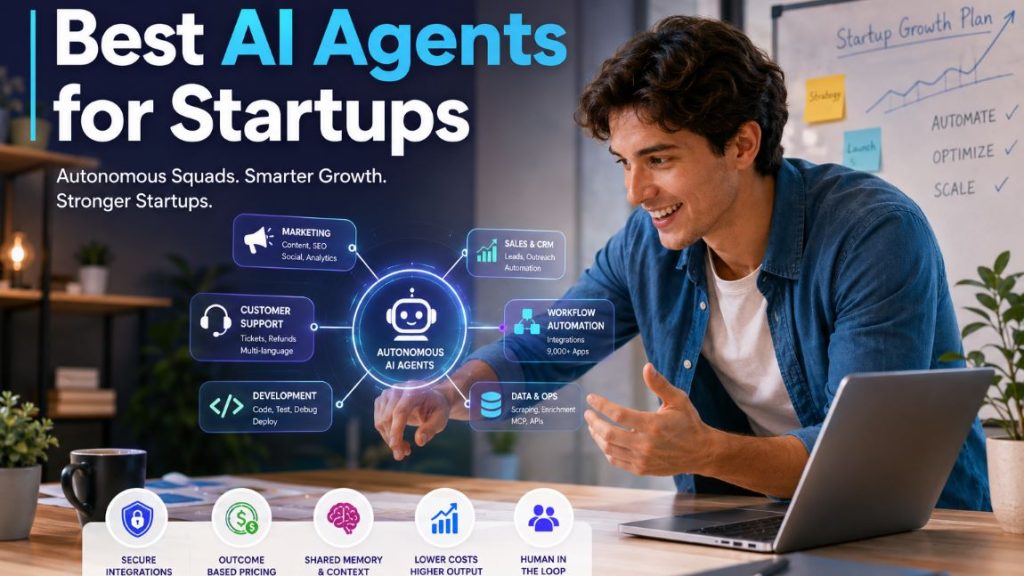






The year 2026 has marked a fundamental shift in how early-stage companies scale. Startups are increasingly replacing large teams and fragmented software stacks with autonomous AI agents capable of executing complex workflows with minimal oversight. Rather than acting as simple assistants, these agents collaborate, execute tasks, and continuously improve, allowing startups to achieve enterprise-level leverage with lean teams.
Key Takeaways
- The Rise of Autonomous Squads: Startups are adopting multi-agent systems that share memory and collaborate on business goals.
- Outcome-Based Pricing Dominance: Many AI agents now charge based on results such as resolved tickets or qualified leads.
- Massive Cost Reductions: Specialized AI agents can reduce operational overhead by more than 80% while increasing output.
- Standardized Agentic Frameworks: MCP and agentic commerce APIs allow agents to securely connect to databases and financial systems.
The Shift to Autonomous AI Agents in 2026
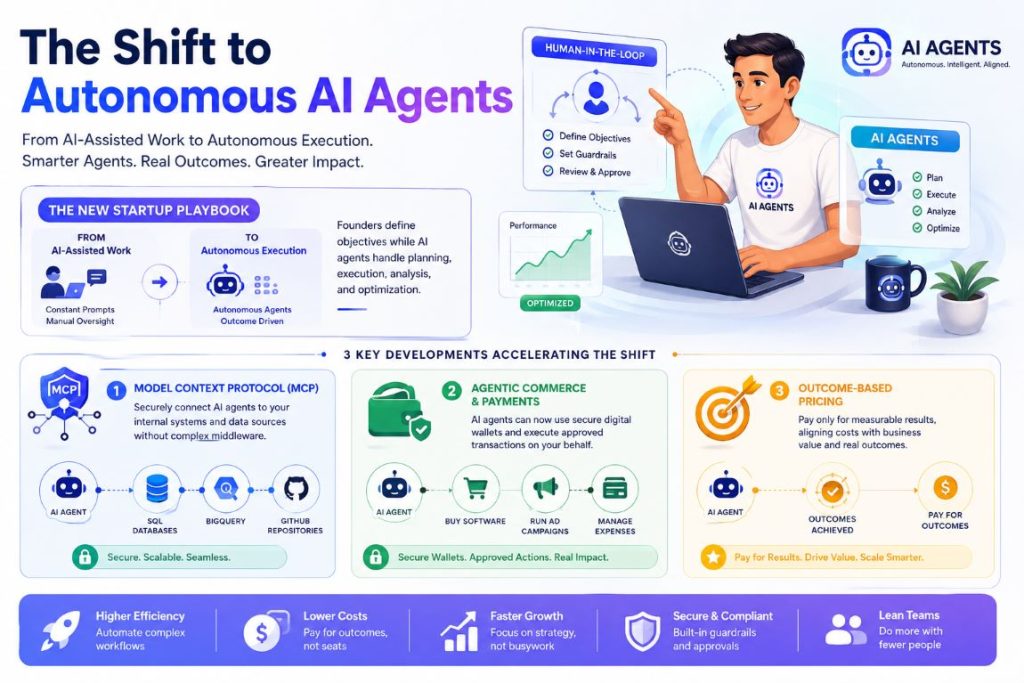
The startup playbook has evolved from AI-assisted work to autonomous execution. Instead of requiring constant prompting, modern agentic systems operate under a human-in-the-loop model. Founders define objectives while AI agents handle planning, execution, analysis, and optimization. Before autonomous AI agents became mainstream, many startups adopted AI builders to create websites, MVPs, and applications with minimal coding. If you're exploring that evolution, read our guide on AI builders for startup development.
Three developments have accelerated this shift:
- Model Context Protocol (MCP): MCP enables AI agents to securely connect with internal systems such as SQL databases, BigQuery, and GitHub repositories without complex middleware.
- Agentic Commerce & Payments: AI agents can now use secure digital wallets and execute approved transactions, including purchasing software, running ad campaigns, or handling operational expenses.
- Outcome-Based Pricing: Rather than paying per user seat, companies increasingly pay only when measurable outcomes are achieved, aligning costs with business value.
How to Choose the Right AI Agents for Your Startup
Founders should evaluate AI agents based on three factors:
- Task Autonomy vs. Human Oversight: The best agents operate independently while still allowing human approval for sensitive actions.
- Shared Memory & Brand Alignment: Agents should access centralized knowledge and brand guidelines to maintain consistent messaging across departments.
- Integration & Ecosystem Fit: Effective agents integrate with tools such as HubSpot, Slack, Discord, GitHub, and MCP-compatible systems.
The Best AI Agents for Startups in 2026
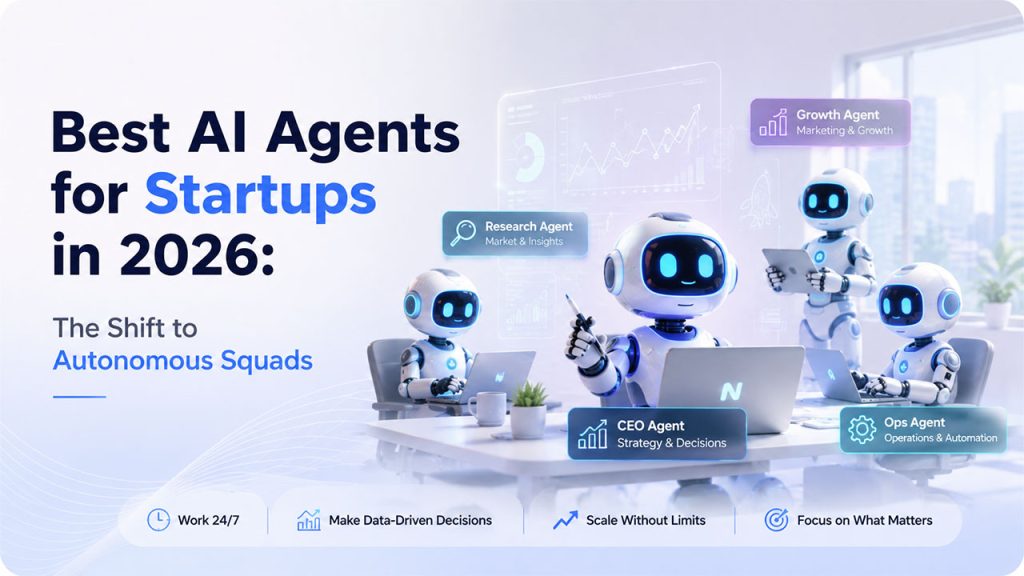
The following list represents the top-performing autonomous AI agents in 2026, categorized by their business function and evaluated based on real-world performance, features, and pricing.
1. NoimosAI — The Autonomous AI Marketing Team
NoimosAI is an autonomous AI marketing team designed to solve the common startup challenges of limited time, budget, and marketing expertise. Instead of functioning as a single tool, it operates as a coordinated team of AI agents that handle competitive research, SEO/GEO optimization, content creation, social media management, PR, and analytics.
Users connect their website and business information, while the platform continuously develops strategies, creates content, analyzes results, and reports progress through channels such as email, chat, and Slack.
- Best For: Startups, small businesses, creators, and freelancers.
- Key Features: Research, strategy, SEO/GEO optimization, content creation, social media management, PR, analytics, and continuous learning.
2. Intercom Fin — The Autonomous Customer Support Agent
Intercom Fin is a customer support agent capable of handling complex support workflows beyond simple chatbot interactions. It can verify accounts, process refunds, and manage subscriptions through direct API integrations.
- Best For: SaaS and e-commerce startups.
- Key Features: Multi-step procedures, CRM integrations, multilingual support, and human handoff capabilities.
3. HubSpot Breeze — The Native CRM & Sales/Marketing Agent
HubSpot Breeze consists of AI teammates embedded within the HubSpot ecosystem. It automates prospecting, lead qualification, outreach personalization, and content repurposing.
- Best For: Startups already using HubSpot.
- Key Features: Native CRM integration, automated prospecting, lead qualification, and content transformation.
4. Anthropic Claude Code — The Autonomous Developer Agent
Claude Code is a command-line development agent that works directly inside a codebase. It can plan, write, test, and debug software while maintaining strong safety controls.
- Best For: Technical founders and lean engineering teams.
- Key Features: Deep codebase understanding, autonomous testing, bug fixing, and pull request generation.
5. Devin by Cognition Labs — The Autonomous Software Engineer
Devin is designed to complete end-to-end software engineering tasks independently. It can research documentation, configure environments, write code, debug issues, and deploy applications.
- Best For: Rapid prototyping and backend development.
- Key Features: Autonomous research, debugging, development environments, and deployment workflows.
6. Gumloop — The No-Code AI Workflow & Web Scraping Agent
Gumloop provides a visual workflow builder for AI-powered automation. It enables teams to create data pipelines for web scraping, lead enrichment, PDF analysis, and competitor research.
- Best For: Non-technical growth and operations teams.
- Key Features: No-code builder, web scraping, PDF parsing, and MCP support.
7. Zapier Central — The Natural Language Workflow Automation Agent
Zapier Central adds AI reasoning to Zapier’s ecosystem of integrations. Users can define workflows in natural language instead of building traditional automation rules.
- Best For: Businesses using multiple SaaS applications.
- Key Features: 9,000+ integrations, natural language instructions, approval workflows, and security controls.
8. Workfx AI — The Organic Growth & Visibility Agent
Workfx AI focuses on organic growth through social listening, competitor analysis, and community engagement. It helps startups build visibility without relying heavily on paid advertising.
- Best For: Bootstrapped startups.
- Key Features: Social monitoring, keyword tracking, influencer coordination, and content distribution.
Comparison of the Top AI Agents for Startups
| Tool Name | Primary Business Function | Key Differentiator | Pricing Model | Best For |
| NoimosAI | Marketing & Visibility | All-in-one autonomous marketing team | Subscription (Starts at $99/mo) | research, strategy, content creation, SEO/GEO optimization, social media management |
| Intercom Fin | Customer Support | Multi-step Procedures & API integrations | Outcome-based ($0.99/resolution) | SaaS & e-commerce support scaling |
| HubSpot Breeze | Sales & Marketing CRM | Deep, native integration with HubSpot CRM | Pay-per-outcome / Hub bundle | Sales prospecting & automated campaigns |
| Claude Code | Software Engineering | High-reasoning command-line developer agent | Pay-as-you-go (Token-based) | Code maintenance & rapid feature building |
| Devin | Software Engineering | Fully autonomous, self-contained developer environment | Subscription (Starts at ~$500/mo) | Prototype building & backend microservices |
| Gumloop | Operations & Data | Visual no-code builder for complex batch processing | Credit-based (Starts at $37/mo) | Web scraping & lead enrichment pipelines |
| Zapier Central | Workflow Automation | Natural language reasoning across 9,000+ apps | Task-based (Starts at $19.99/mo) | Connecting traditional SaaS stacks |
| Workfx AI | Organic Growth | Automated social listening and community outreach | Subscription (Starts at $49/mo) | Bootstrapping organic visibility & lead gen |
Conclusion
Autonomous AI agents have become a practical necessity for startups seeking to scale efficiently in 2026. By deploying specialized agents across marketing, customer support, engineering, and operations, companies can reduce costs, increase productivity, and accelerate growth.
For many startups, marketing remains the most accessible starting point. Platforms such as NoimosAI provide a complete AI-powered marketing operation that handles research, content creation, SEO/GEO optimization, social media management, PR, and analytics, enabling founders to focus on product development and business growth.
FAQ
What is the difference between an AI copilot and an autonomous AI agent?
An AI copilot assists users through prompts and guidance, while an autonomous AI agent independently plans and executes multi-step workflows to achieve a defined objective.
How do autonomous AI agents ensure brand consistency?
They use centralized knowledge bases and shared memory systems that allow multiple agents to access the same brand guidelines, historical performance data, and content standards.
What is outcome-based pricing in AI agents?
Outcome-based pricing means businesses pay only when specific results are achieved, such as a resolved support ticket or a qualified sales lead.
How can businesses maintain consistent marketing activities without hiring a large marketing team?
Platforms such as NoimosAI provide an autonomous AI marketing team that continuously manages research, SEO/GEO optimization, content creation, social media management, PR, and performance analysis while requiring minimal oversight.