





The best AI voice agent for outbound calling in 2026 is the one that matches your call volume, your compliance exposure, and the systems your sales team already runs on. An AI voice agent for outbound calling is autonomous software that dials a list of contacts, holds a natural spoken conversation, qualifies leads, handles common objections, and books meetings or logs outcomes to your CRM, all without a human on the line. The category has moved from experimental to mainstream, and the gap between a glorified auto-dialer and a genuinely conversational agent is now wide.
This comparison ranks seven platforms that have proven themselves on real outbound campaigns. Each was assessed on the dimensions that decide outbound success: conversation quality, CRM integration, compliance support, language coverage, scalability, and how quickly a team can get a campaign live. Pricing is reported for every tool but is not used as the ranking factor, because outbound pricing models (per minute, per seat, per agent, credit-based) vary too much to compare on price alone.
TL;DR: the best AI voice agents for outbound calling at a glance
- CloudTalk — best AI voice agent for outbound calling built into a complete business phone system
- Bland AI — best for high-volume, large-scale outbound dialing
- Retell AI — best for developer teams building custom outbound agents
- Vapi — best for a model-agnostic voice orchestration layer
- Synthflow — best for no-code outbound workflow building and agencies
- ElevenLabs — best for ultra-realistic outbound voice quality
- Thoughtly — best for automated outbound follow-up on inbound leads
AI voice agent for outbound calling comparison table
| Tool | Best for | Entry pricing | Languages | Outbound strength |
| CloudTalk | Outbound calling inside a phone system | Plans from €25/user/mo; AI agent add-on from ~€350/mo (1,000 min) | 60+ (AI agent) | Power and parallel dialers plus a conversational AI agent |
| Bland AI | High-volume large-scale dialing | ~$0.09/connected min; subscriptions from ~$299/mo | English-primary | Up to ~1M concurrent calls |
| Retell AI | Developer-built custom agents | ~$0.07/min, ~$0.05/min at scale | Many (configurable) | Low-latency real-time calling |
| Vapi | Model-agnostic orchestration | ~$0.05/min orchestration + provider costs | Many (configurable) | Bring-your-own STT/LLM/TTS |
| Ecosmob | Custom AI voice agent for outbound calling | Custom pricing based on the AI voice agent features | Many (configurable) | Multilingual voice support with customizable STT and TTS engines |
| Synthflow | No-code workflows and agencies | Plans from $29/mo (~$0.08–0.13/min) | 50+ | Visual builder, multi-tenant |
| ElevenLabs | Outbound voice quality | Credit-based; Starter from $5/mo | 30+ | Best-in-class TTS and voice cloning |
| Thoughtly | Outbound follow-up on inbound leads | Custom pricing | Multiple | Voice + SMS + email cadence, native CRM |
The 7 best AI voice agents for outbound calling in 2026
1. CloudTalk: best AI voice agent for outbound calling overall
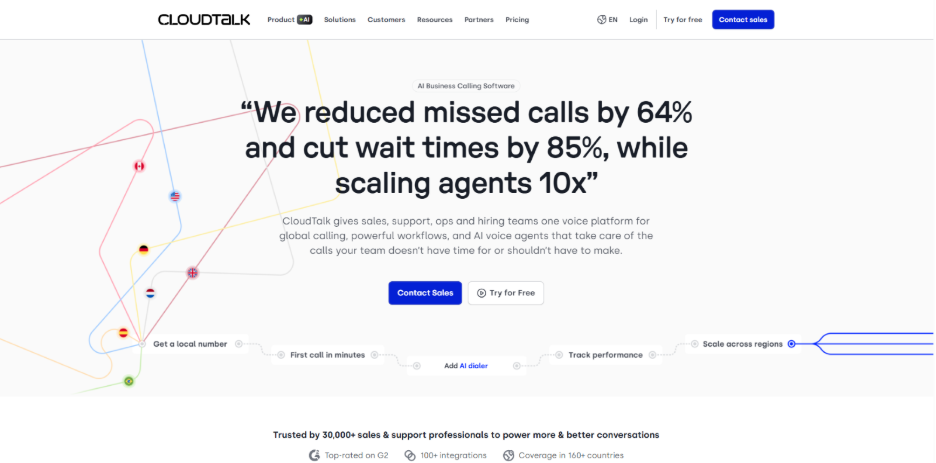
CloudTalk is the best AI voice agent for outbound calling for businesses that want conversational call automation built directly into a complete business phone system, rather than a standalone bot bolted on later. The AI voice agent handles outbound tasks such as lead qualification, appointment scheduling, payment reminders, and "we miss you" reactivation calls in 60+ languages and accents, then hands warm prospects to a live rep inside the same platform your team already uses.
What separates CloudTalk from pure voice-AI startups is the surrounding stack. The AI agent sits alongside a Power Dialer, a parallel dialer, two-way CRM sync, and Conversation Intelligence, so a sales team can blend automated outreach with human calling and keep every recording, transcript, and outcome in one place. CloudTalk is trusted by more than 4,000 companies and provides number and routing coverage across 160+ countries.
What Are CloudTalk's Key Outbound Features?
- Conversational AI voice agent for outbound qualification, reminders, and follow-up in 60+ languages
- Power Dialer for high-volume sequenced human outbound calling
- Parallel (smart) dialer that calls multiple numbers and connects reps to the first live answer
- Call flow designer for branching outbound scripts and routing
- Real-time analytics and Conversation Intelligence on every call
- International numbers and local caller ID across 160+ countries
What Are CloudTalk's Best Integrations?
CloudTalk connects to HubSpot, Salesforce, and Pipedrive with two-way sync, alongside helpdesk tools such as Zendesk, Intercom, and Freshdesk. Zapier and an open API cover everything else, and in total CloudTalk offers 35+ business-tool integrations across CRM and helpdesk platforms, so call outcomes and contact records stay aligned without manual entry.
What Are CloudTalk's Outbound Use Cases?
- Outbound sales prospecting and lead qualification
- Appointment and demo booking
- Overdue invoice and payment reminder calls
- Lead reactivation and renewal outreach
What Are CloudTalk's Industries?
- SaaS and technology: high-velocity sales teams use the AI agent and dialers to qualify and follow up on trial signups at scale.
- Financial services: outbound reminders and renewals run with the call recording and compliance controls regulated teams need.
- E-commerce and retail: abandoned-cart, win-back, and order-related outbound calls reactivate customers across busy seasonal peaks.
- BPO and customer support teams: blended inbound and outbound calling across many clients is centralized in one phone system.
What Are the Pros & Cons of CloudTalk?
| Pros | Cons |
| All-in-one phone system: The AI agent, dialers, and CRM sync live in one platform instead of separate tools. | AI agent is a separate add-on: Conversational calling is priced on top of the per-user plans. |
| Native AI, not bolted on: Conversation Intelligence and the AI voice agent are built into the product. | Expert tier seat minimum: The plan with smart and power dialers requires at least three licenses. |
| Broad country coverage: Local numbers and caller ID span 160+ countries for global outbound. | AI minutes add up at volume: Per-minute agent pricing can climb on large outbound campaigns. |
What Are CloudTalk's Plans & Pricing?
- Starter: from €25 per user per month (billed annually)
- Essential: from €29 per user per month
- Expert: from €49 per user per month (minimum three licenses)
- Custom: tailored pricing for larger deployments
- AI voice agent: separate add-on from roughly €350 per month for 1,000 minutes, with volume discounts
2. Bland AI: best for high-volume outbound dialing at scale
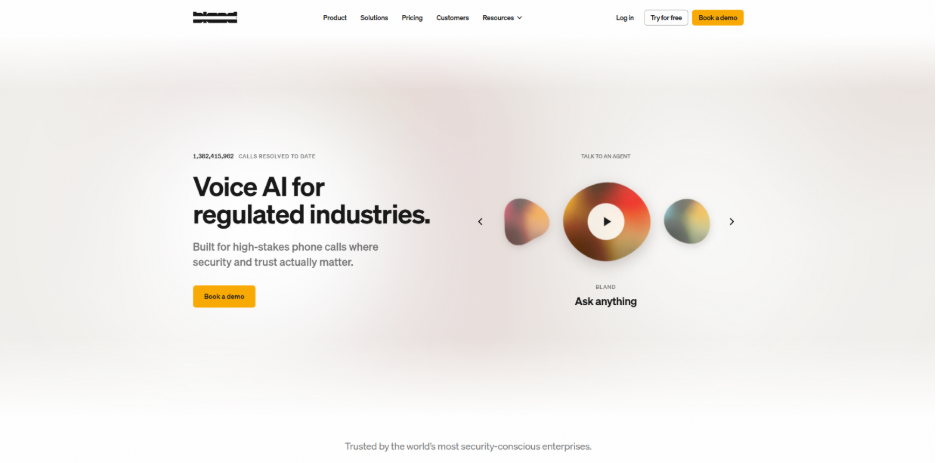
Bland AI is the strongest fit for organizations that need to run enormous outbound volumes without quality degradation. The platform is engineered for scale, with the company citing support for up to roughly one million concurrent calls, and it runs its own speech and reasoning models for tighter control over latency and reliability.
Bland positions itself for enterprise outbound and transactional calling, with granular conversational pathways that mix scripted and generative responses. Compliance is supported through multi-region data processing, but TCPA configuration and consent handling remain the user's responsibility.
What Are Bland AI's Key Outbound Features?
- Scales to very high concurrent outbound call volumes
- Conversational Pathways for controlled, branching scripts
- Proprietary in-house voice and reasoning model stack
- Multi-region data processing for privacy requirements
- Omnichannel voice and SMS from one platform
- Strong English-language conversation quality for sales
What Are Bland AI's Best Integrations?
Bland AI follows an API-first integration model, connecting to CRMs and data systems through webhooks and custom infrastructure connections. Telephony runs via supported carriers, which keeps the platform flexible for engineering teams wiring it into bespoke outbound stacks rather than relying on prebuilt connectors.
What Are Bland AI's Outbound Use Cases?
- Large-scale appointment setting and lead qualification
- Notifications and transactional outbound calls
- Reactivation and follow-up campaigns
- Enterprise telemarketing programs
What Are Bland AI's Industries?
- Enterprise sales organizations: massive concurrent dialing supports nationwide campaigns that smaller platforms cannot sustain.
- Healthcare and finance (with configuration): multi-region data processing helps meet privacy requirements in regulated sectors.
- Logistics and operations: high-volume notification and status calls keep customers updated automatically.
- High-volume contact centers: the platform's scale-first architecture absorbs spikes without quality degradation.
What Are the Pros & Cons of Bland AI?
| Pros | Cons |
| Extreme scalability: Engineered for up to roughly one million concurrent calls for the largest campaigns. | Engineering-heavy setup: Meaningful customization typically needs developer involvement. |
| Proprietary model stack: In-house voice and reasoning models give tighter control over latency. | Shallow native CRM depth: Integration is API and webhook-first rather than prebuilt connectors. |
| Transparent per-minute base: You are billed for active talk time at a clear connected-minute rate. | English-first: Broader language support requires custom enterprise arrangements. |
What Are Bland AI's Plans & Pricing?
- Roughly $0.09 per connected minute
- Tiered subscriptions (Start, Build, Scale) from around $299 per month
- Lower outbound-attempt charges for short calls
- Custom enterprise pricing at volume
3. Retell AI: best for developer teams building custom outbound agents
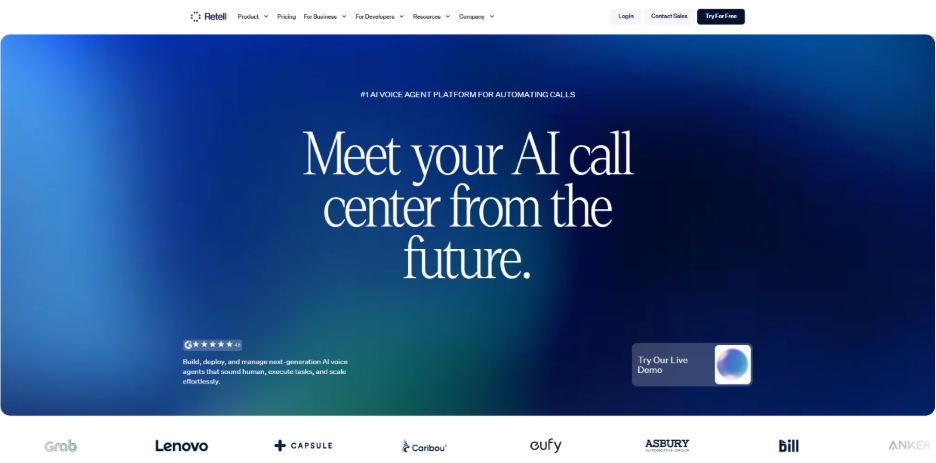
Retell AI is the best choice for teams with developers who want full control over an outbound agent's behavior, voice, and logic. It provides a developer-first environment with a drag-and-drop builder plus APIs for call management, real-time streaming, and function calling, so you can wire outbound calling into an existing sales stack rather than adopt an opinionated platform.
Retell is known for sub-second latency and transparent usage-based pricing. Understanding the Retell AI Bot Testing Cost can also help teams estimate expenses before scaling outbound campaigns. It pairs cleanly with leading LLM and premium voice providers. Every call is transcribed, summarized, and scored, which makes iterating on outbound scripts straightforward.
What Are Retell AI's Key Outbound Features?
- Low-latency, real-time outbound voice with natural turn-taking
- Drag-and-drop agent builder plus full APIs
- Function calling for CRM lookups and calendar booking mid-call
- Choice of LLMs and premium voices (ElevenLabs, Play.ht)
- Automatic transcription, summaries, and sentiment scoring
- Pre-built templates for qualification and appointment setting
What Are Retell AI's Best Integrations?
Retell AI integrates with Twilio and SIP telephony for call delivery and connects to Salesforce and HubSpot for CRM sync. It supports leading LLM providers such as OpenAI and Anthropic, and its well-documented API allows custom integrations into any existing system, which is the point for developer teams building their own outbound stack.
What Are Retell AI's Outbound Use Cases?
- Custom outbound qualification agents
- Appointment scheduling and routing
- Call-handling pilots and automation experiments
- Outbound flows embedded in proprietary apps
What Are Retell AI's Industries?
- Software and product teams: developers embed outbound calling directly into their own applications and workflows.
- Outbound sales groups: predictable per-minute pricing and fast iteration suit teams testing call scripts continuously.
- Call centers: low-latency, real-time voice handles high outbound volumes without awkward pauses.
- Regulated sectors (SOC 2, HIPAA, GDPR supported): built-in certifications make it viable for healthcare and finance outbound.
What Are the Pros & Cons of Retell AI?
| Pros | Cons |
| Full developer control: You own the voice, conversation logic, and model choices end to end. | Requires technical skill: There is no turnkey interface; you build and maintain the agent. |
| Transparent usage pricing: Pay-as-you-go from a low per-connected-minute rate. | You own compliance: TCPA and GDPR handling are your responsibility to implement. |
| Strong real-time performance: Sub-second latency keeps outbound conversations natural. | LLM costs stack on top: Total cost includes separate language-model usage. |
What Are Retell AI's Plans & Pricing?
- Usage-based from around $0.07 per connected minute
- Roughly $0.05 per minute with enterprise discounts
- Local numbers from $2 per month, toll-free from $5 per month
- $10 testing credit for early pilots
4. Vapi: best for a model-agnostic outbound voice orchestration layer
Vapi is best for developers who want a flexible orchestration layer and the freedom to bring their own speech-to-text, LLM, and text-to-speech providers for outbound calling. Rather than locking you into a fixed model stack, Vapi coordinates the components you choose, which appeals to teams optimizing latency and cost across providers.
The trade-off is that the advertised orchestration fee is only part of the bill, since the third-party STT, LLM, and TTS services you plug in add to the all-in per-minute cost. For technical teams that want maximum control, that flexibility is the point.
What Are Vapi's Key Outbound Features?
- Model-agnostic orchestration for outbound calls
- Bring-your-own STT, LLM, and TTS providers
- Real-time, low-latency call handling
- Programmable call logic and function calling
- Concurrent outbound calling support
- Detailed call logs and analytics
What Are Vapi's Best Integrations?
Vapi connects to Twilio and SIP telephony and is deliberately open to major LLM and voice providers so teams can mix and match the best components. CRMs connect through the API and webhooks, and custom backend connections let engineering teams orchestrate outbound calls exactly how their stack requires.
What Are Vapi's Outbound Use Cases?
- Developer-built outbound qualification agents
- Cost- and latency-optimized calling stacks
- Appointment booking and reminders
- Experimental multi-provider deployments
What Are Vapi's Industries?
- Software and engineering teams: full control over the model stack appeals to teams optimizing latency and cost.
- Startups building voice products: the orchestration layer accelerates shipping outbound voice features without reinventing infrastructure.
- Agencies with technical resources: client-specific outbound agents can be assembled from preferred providers.
- Outbound sales tooling builders: Vapi serves as the calling backbone inside larger sales applications.
What Are the Pros & Cons of Vapi?
| Pros | Cons |
| Model-agnostic flexibility: Bring your own STT, LLM, and TTS providers for full control of the stack. | Hidden all-in costs: Third-party provider fees push the real per-minute cost much higher. |
| Low headline orchestration fee: The base per-minute orchestration cost is competitive. | Developer required: It is not usable without engineering resources. |
| Programmable call logic: Ideal for embedding outbound calling inside custom applications. | DIY guardrails: Compliance and analytics are largely build-your-own. |
What Are Vapi's Plans & Pricing?
- Around $0.05 per minute orchestration fee
- Plus the cost of your chosen STT, LLM, and TTS providers
- All-in costs commonly reach roughly $0.30 per minute
- Free tier and pay-as-you-go scaling
5. Ecosmob: Best custom AI voice agent for outbound calling
Ecosmob is the best fit for businesses that need an AI voice agent built around their existing call center, PBX, CRM, or communication workflows rather than adopting another standalone calling platform. Its custom AI voicebot solutions can automate outbound lead follow-ups, appointment booking, reminders, customer reactivation, surveys, and other voice workflows while integrating with existing telephony infrastructure.
What separates Ecosmob from off-the-shelf voice AI platforms is the level of customization. The AI voice agent can connect with SIP-based telephony, IP PBX systems, CRMs, calendars, and other business applications. Ecosmob also offers a custom Voicebot Connector that supports real-time audio streaming, outbound and inbound calls, dynamic routing, and seamless escalation to human agents without requiring changes to the existing dial plan.
What are Ecosmob's Key Outbound Features?
- Custom AI voice agents for lead qualification, follow-ups, reminders, and appointment booking
- Outbound calling integrated with existing IP PBX and telephony systems
- Real-time two-way audio streaming between telephony infrastructure and the AI engine
- Dynamic call routing based on AI responses and caller intent
- Human-agent escalation when a conversation requires live assistance
- Multilingual voice support with customizable STT and TTS engines
- Flexible AI model integration based on cost, language, latency, and business requirements
What are Ecosmob's Best Integrations?
Ecosmob can integrate AI voice agents with CRMs, PBX and SIP platforms, calendars, analytics systems, and other business applications. Its voicebot connector uses SIP, RTP, WebSocket, and webhook-based communication to connect the AI layer with existing telephony infrastructure. The connector is also voicebot-agnostic, allowing businesses to connect compatible third-party AI voice engines without rebuilding their telephony stack.
What are Ecosmob's Outbound Use Cases?
- Lead qualification and sales follow-ups
- Appointment and demo scheduling
- Payment and overdue invoice reminders
- Customer reactivation and renewal campaigns
- Automated surveys and feedback calls
- Promotional and notification campaigns
What are Ecosmob's Industries?
- SaaS and technology: qualify leads, follow up with prospects, and schedule demos without adding more manual calling capacity.
- Financial services: automate reminders, follow-ups, and customer notifications while routing complex conversations to human agents.
- Healthcare: handle appointment reminders, confirmations, and routine outbound communication through voice.
- E-commerce and retail: automate order-related notifications, customer reactivation, and promotional outreach.
- BPO and contact centers: deploy customized AI calling workflows across existing telephony infrastructure and client campaigns.
What Are the Pros & Cons of Ecosmob?
| Pros | Cons |
| Highly customizable: Voice agents can be designed around specific business workflows, call logic, and integrations. | Custom implementation: Businesses looking for a ready-to-use, self-service voice agent may need an implementation process. |
| Works with existing telephony: The Voicebot Connector can bridge AI voicebots with IP PBX and SIP infrastructure without changing the existing dial plan. | Pricing is not fixed: Cost depends on the required features, integrations, call flows, and level of customization. |
| Flexible AI stack: Supports different STT, TTS, and AI engines based on business requirements. | More suited to tailored deployments: Simple use cases may not need the level of customization Ecosmob provides. |
What Are Ecosmob's Plans & Pricing?
- Custom pricing based on the AI voice agent features and integrations required
- Cost varies with call center integration, call flows, CRM, SIP, PBX, and other third-party systems
- Pricing also depends on AI models, STT/TTS engines, call volume, and deployment requirements
- Enterprise pricing available for larger, complex, or high-volume deployments
6. Synthflow: best for no-code outbound workflow building
Synthflow is the best AI voice agent for outbound calling teams and agencies that want to build sophisticated workflows without writing code. Its visual conversation designer lets you map branching outbound dialogue, configure API calls mid-conversation, and run multi-tenant setups, which makes it especially attractive for agencies managing several clients.
Voice quality is strong with custom voice options and support for 50+ languages, and pricing is transparent and plan-based. The flexibility means more setup time than a turnkey tool, but far less than a code-first platform.
What Are Synthflow's Key Outbound Features?
- No-code visual builder for outbound conversation flows
- Branching logic and mid-call API actions
- 50+ languages with voice cloning options
- Sub-500ms target response times
- Multi-tenant support for agencies
- Bring-your-own-carrier telephony
What Are Synthflow's Best Integrations?
Synthflow works with Twilio and SIP trunks and integrates with HubSpot, Salesforce, and other CRMs out of the box. A bring-your-own-carrier option lets teams keep their existing phone systems, while webhooks and mid-call API actions trigger external systems during a conversation without writing code.
What Are Synthflow's Outbound Use Cases?
- Outbound appointment setting
- Lead qualification and routing
- Agency-run client campaigns
- Reminder and follow-up calls
What Are Synthflow's Industries?
- Marketing agencies: multi-tenant setups let one team run separate outbound agents for many clients.
- SMB sales teams: the no-code builder makes outbound automation accessible without engineering support.
- Healthcare (HIPAA support): compliant configurations cover appointment reminders and patient outreach.
- Multi-client service providers: a single visual builder scales across varied outbound campaigns and accounts.
What Are the Pros & Cons of Synthflow?
| Pros | Cons |
| No-code visual builder: Branching outbound flows are built without writing code. | Setup time for complex flows: The flexibility means more configuration up front. |
| Transparent plan pricing: Clear monthly tiers come with included minutes. | Usage fees on top of plans: Workflow and concurrency usage can add to the bill. |
| Multi-tenant for agencies: Separate agents run per client from a single account. | Shorter track record: It is newer than established enterprise providers. |
What Are Synthflow's Plans & Pricing?
- Starter: $29 per month for 5,000 minutes and 1 agent
- Growth: $99 per month for 20,000 minutes and unlimited agents
- Scale: $249 per month for 60,000 minutes
- Custom enterprise pricing for higher volumes
7. ElevenLabs: best for ultra-realistic outbound voice quality
ElevenLabs is the best option when outbound voice quality and brand voice matter more than anything else. Best known for industry-leading text-to-speech and voice cloning, ElevenLabs has expanded into conversational agents, producing some of the most natural-sounding synthetic voices available for outbound calls.
It is not a full telephony stack on its own, so most teams pair it with a calling platform for routing and call flows. For brands with an audio-first identity, the voice realism is the differentiator.
What Are ElevenLabs' Key Outbound Features?
- Highly realistic, human-like voice synthesis
- Advanced voice cloning from small samples
- Conversational AI agents layered on premium TTS
- Multilingual support across 30+ languages
- Fine-grained voice design controls
- Grounding agents in your own data
What Are ElevenLabs' Best Integrations?
ElevenLabs operates as an API-first voice engine rather than a full telephony stack, so it pairs with calling platforms that handle routing and call flows. It connects to LLMs for conversation logic and slots into custom applications, which makes it the voice layer many other outbound tools rely on for realism.
What Are ElevenLabs' Outbound Use Cases?
- Brand-consistent outbound voice experiences
- Localized multilingual outreach
- Voice layer for other calling platforms
- Personalized outbound messaging
What Are ElevenLabs' Industries?
- Consumer and D2C brands: a distinctive cloned brand voice keeps outbound calls on-brand and recognizable.
- Media and voice-first products: best-in-class realism suits audio-led experiences and outreach.
- Marketing teams: expressive, natural voices lift engagement on personalized outbound campaigns.
- Global outreach programs: 30+ language support enables localized outbound calls across markets.
What Are the Pros & Cons of ElevenLabs?
| Pros | Cons |
| Best-in-class voice realism: Industry-leading text-to-speech and voice cloning. | Not a full telephony stack: It must be paired with a calling platform for routing. |
| Strong multilingual range: Natural-sounding voices across 30+ languages. | Credit pricing is hard to forecast: Costs vary with usage at scale. |
| Low entry price: Credit-based plans start very cheap for early testing. | Limited compliance posture: Less built-in than purpose-built outbound tools. |
What Are ElevenLabs' Plans & Pricing?
- Credit-based pricing model
- Free tier with 10,000 credits per month
- Starter from $5 per month for 30,000 credits
- Higher creator, pro, business, and enterprise tiers
8. Thoughtly: best for automated outbound follow-up on inbound leads
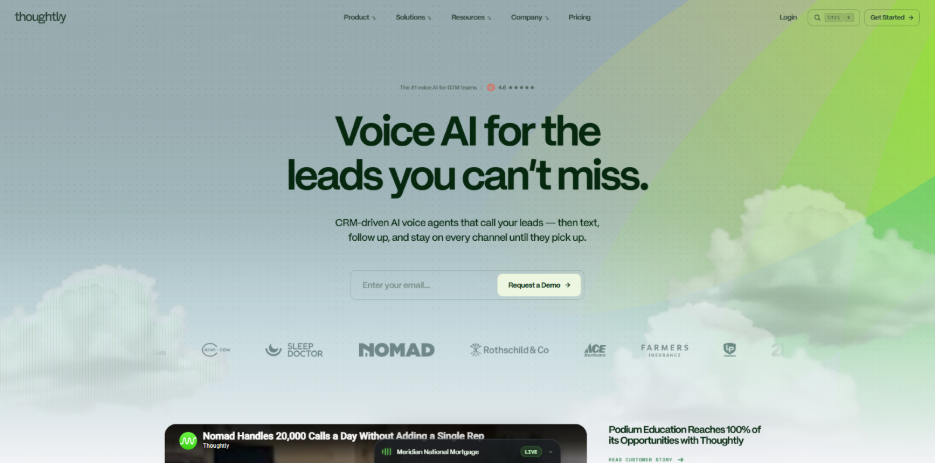
Thoughtly is the best AI voice agent for outbound calling when the outbound motion starts with an inbound signal. A lead fills out a form, requests a quote, or misses an inbound call, and Thoughtly's agent calls back within seconds, qualifies against a custom script, books a meeting, and then follows up by SMS and email if the prospect does not convert on the first call. One agent runs the full cross-channel cadence and writes every outcome back to the CRM.
What sets Thoughtly apart from developer-focused voice infrastructure is that RevOps and go-to-market teams own the agent, not engineering. Qualification logic, follow-up cadences, and escalation rules are configured in a visual workflow builder, with consent, DNC scrubbing, and calling-hour rules enforced automatically.
What Are Thoughtly's Key Outbound Features?
- Sub-60-second speed-to-lead callbacks triggered by webhook events
- Same agent across voice, SMS, and email in one cadence
- Visual workflow builder for qualification and follow-up (no code)
- Voicemail detection and drop handling
- Structured CRM write-back (qualified, callback, DNQ, booked)
- Built-in consent, DNC, and calling-hour compliance
What Are Thoughtly's Best Integrations?
Thoughtly offers native, bidirectional integrations with HubSpot and Salesforce, plus GoHighLevel, Pipedrive, and Zoho, and more than 20 additional CRM and business-tool connectors. Webhooks and an API trigger outbound calls from custom events, so structured outcomes write straight back to contact records and pipeline stages without middleware.
What Are Thoughtly's Outbound Use Cases?
- Speed-to-lead follow-up on form fills and quote requests
- Missed inbound-call callbacks
- Aged-pipeline re-engagement
- Appointment confirmation and rescheduling
What Are Thoughtly's Industries?
- Insurance and mortgage: expensive leads get an instant qualifying callback before they go cold.
- Real estate and automotive: fast follow-up on inquiries books showings and test drives automatically.
- Legal and education: intake and enrollment leads are qualified and routed to the right human quickly.
- Healthcare and home services: appointment confirmations and reschedules run across voice, SMS, and email.
What Are the Pros & Cons of Thoughtly?
| Pros | Cons |
| Sub-60-second speed-to-lead: The agent calls leads back before they leave the page. | Needs a defined lead process: Qualification and cadence rules must be set up first. |
| Omnichannel in one agent: Voice, SMS, and email run on a single follow-up cadence. | Volume threshold: Best suited to teams generating 500+ inbound leads per month. |
| RevOps-owned, no code: Go-to-market teams configure the agent without engineering. | Custom pricing only: There is no public rate card for quick comparison. |
What Are Thoughtly's Plans & Pricing?
- Custom pricing based on volume and channels
- Quote provided on request
- Best suited to teams generating 500+ inbound leads per month
- Voice, SMS, and email included in the agent workflow
How to choose the best AI voice agent for outbound calling
Choosing the best AI voice agent for outbound calling means matching the platform to how your sales team actually runs outbound, not to the longest feature list. These are the factors that consistently decide whether a deployment delivers results.
Phone system vs. standalone agent: Decide whether outbound calling should live inside a full business phone system or run as a separate bot. If it sits alongside human dialing, live transfers, and CRM sync, CloudTalk keeps the AI agent and dialers in one stack. If you only need a standalone calling layer, Bland AI, Retell AI, or Vapi fit better.
Outbound call volume: The larger the outreach, the more automation pays off, since an AI agent can run many conversations at once without adding SDR headcount. For extreme concurrency across thousands of simultaneous calls, Bland AI is built for scale; CloudTalk covers high-volume blended human and AI outbound.
Technical resources: Match the build model to your team. Developer-heavy teams that want full control gravitate to Retell AI or Vapi, while no-code teams and agencies move faster on Synthflow or Thoughtly. CloudTalk gives non-technical sales teams a turnkey setup.
Integration depth: The platform must sync contacts and outcomes bidirectionally with your CRM so reps pick up qualified leads with full context. CloudTalk, Thoughtly, Retell AI, and Synthflow connect natively to HubSpot and Salesforce; API-first tools like Bland AI and Vapi expect you to wire integrations yourself.
Compliance needs: Verify TCPA (US) and GDPR (EU) support before launching, including consent capture, DNC scrubbing, and AI disclosure. CloudTalk and Thoughtly build compliance controls in; developer platforms leave most of it to you.
Pricing model: Usage-based per-minute pricing (Retell AI, Bland AI, Vapi) suits variable volumes but can get unpredictable at scale, while plan-based pricing (Synthflow, CloudTalk) is easier to forecast. Map projected call volume to each model before committing.
Key takeaway: match the platform to your team's technical resources, phone-system needs, and CRM first, then compare features. For most teams that want outbound automation inside a real phone system, CloudTalk is the safest starting point.
AI voice agents vs. traditional auto-dialers for outbound calling
AI voice agents and traditional auto-dialers both automate outbound calling, but they solve different problems. The difference is what happens once a prospect answers: an auto-dialer places calls and connects a live human rep (or plays a recording) with no understanding of the conversation, while an AI voice agent listens, responds dynamically, handles objections, and can book a meeting or update a CRM with no human on the line.
| Category | AI voice agents | Traditional auto-dialers |
| Primary purpose | Conduct outbound conversations automatically | Connect human reps with more live prospects |
| Human involvement | Can be fully automated for many calls | Requires available human agents |
| Interaction quality | Dynamic and conversational from the first second | Limited or none until a human joins |
| Lead qualification | Asks questions and qualifies leads on its own | Handled by the human rep |
| Appointment booking | Often books directly during the call | Human rep typically books |
| Scalability | Thousands of simultaneous conversations | Capped by the number of available reps |
| Cost structure | AI usage plus telephony costs | Agent labor plus software seats |
| Complex conversations | Improving fast, but not perfect | Humans still handle nuance better |
| Compliance | Needs careful AI disclosure and consent | Regulated, with more established workflows |
| Best use cases | Qualification, scheduling, reminders, follow-ups | High-volume sales blitzes, collections, call centers |
In practice, the strongest outbound operations use both. Power and parallel dialers maximize the live conversations human reps reach, while AI voice agents handle qualification, reminders, and follow-up at a volume no team could staff. Platforms such as CloudTalk combine both models in one system, which is why blended outbound stacks are becoming the default rather than the exception.
Conclusion
The best AI voice agent for outbound calling in 2026 depends on your volume, your team's technical depth, and the systems you already run. CloudTalk leads for teams that want conversational outbound automation inside a complete business phone system with built-in dialers and CRM sync. Bland AI dominates extreme-scale dialing, Retell AI and Vapi give developers maximum control, Synthflow makes no-code outbound building fast, Thoughtly automates follow-up on inbound leads across voice, SMS, and email, and ElevenLabs sets the bar for voice quality. Match the tool to your outbound motion, run a small pilot on real calls, and listen before you scale.
Frequently Asked Questions
Q1. How much does an AI voice agent for outbound calling cost?
AI voice agents for outbound calling are usually priced per minute or per plan, and all-in costs typically land between roughly $0.07 and $0.35 per connected minute once provider fees are included. Usage-based tools like Retell AI start near $0.07 per minute, no-code platforms like Synthflow run plan-based tiers from $29 to $249 per month; and CloudTalk's AI voice agent is an add-on from about €350 per month for 1,000 minutes on top of its per-user phone-system plans.
Q2. Are AI voice agents legal for outbound calls?
AI voice agents are legal for outbound calls when you follow the rules for your region. In the US, the TCPA generally requires prior express consent for AI-generated calls to mobile phones, and in the EU, GDPR requires a lawful basis plus EU AI Act disclosure that the caller is artificial. Platforms vary in how much compliance tooling they provide, so confirm consent handling, DNC checks, and data residency before launching a campaign.
Q3. Can AI voice agents handle objections on outbound sales calls?
Yes, modern AI voice agents handle common, predictable objections (budget, timing, authority, need) competently and often more consistently than an average rep. For creative, highly technical, or emotionally charged pushback, skilled human reps still perform better, so the strongest approach is to let the AI handle the top objections and qualification, then warm-transfer engaged prospects to a human closer.
Q4. How many outbound calls can an AI voice agent make per day?
An AI voice agent can attempt far more outbound calls than a human team, often many thousands per day, because it places and handles calls in parallel. Platforms like Bland AI are engineered for very high concurrency, while the practical ceiling for most teams is set by list size, compliance calling windows, and how many resulting meetings the team can actually handle, not by raw platform capacity.
Q5. What is the difference between an AI voice agent and a power or parallel dialer?
An AI voice agent autonomously conducts the conversation, while a power or parallel dialer automates only the dialing and connects a human rep to live answers. Dialers maximize how many live conversations reps reach; AI agents replace the rep entirely for qualification, reminders, and follow-up. Blended platforms such as CloudTalk offer both, letting teams automate routine outbound calls and accelerate human calling from the same system.
Q5. Which AI voice agent is best for outbound calling in 2026?
For most businesses that want outbound automation inside a real phone system, CloudTalk is the best overall AI voice agent for outbound calling thanks to its built-in dialers, CRM sync, and multilingual agent. Bland AI is best for extreme-scale dialing, Retell AI and Vapi are best for developer-built agents, Synthflow is best for fast no-code setup, Thoughtly is best for automated follow-up on inbound leads, and ElevenLabs is best when voice realism is the priority.