





There is no single best AI virtual receptionist for every business. The right tool depends entirely on your call volume, team size, existing tech stack, and what you actually need the AI to do: answering calls, booking appointments, qualifying leads, or all three.
After reviewing 20+ platforms, here are the 10 AI virtual receptionists worth evaluating in 2026, complete with clear recommendations on which type of business each one fits best.
TL;DR: Top AI Virtual Receptionists at a Glance (2026)
| Tool | Best For | Pricing | Languages | Key Integrations |
| CloudTalk | Businesses scaling inbound support | From $25/mo | 35+ | HubSpot, Salesforce, Pipedrive, and 100+ more |
| RingCentral | Businesses wanting a proven, no-code setup | From $59/mo | 15+ | Salesforce, Microsoft Teams, ServiceNow, and 200+ more |
| Smith.ai | Small businesses and solo operators | From $95/mo | English | Clio, Salesforce, Zapier, and 30+ more |
| Synthflow | Agencies and no-code builders | Upon request | 20+ | HubSpot, GoHighLevel, Zapier, and 50+ more |
| Bland AI | Developers needing low-cost, high-volume calls | Custom, usage-based | 15+ | Custom via API |
| Dialpad | Teams already on Google Workspace | From $39/mo | 10+ | Salesforce, HubSpot, Google Workspace, and 70+ more |
| Aircall | Support teams with simple routing needs | $30/mo | 10+ | HubSpot, Salesforce, Zendesk, and 100+ more |
| Vonage | Developer-first customization | Custom, usage-based | 10+ | Salesforce, Microsoft Teams, Zapier, and 50+ more |
| Google CCAI | Large enterprises on Google Cloud | Custom, usage-based | 30+ | Google Workspace, Salesforce, Zendesk |
| Numa | Local and multi-location businesses | From $50/mo | English, Spanish | CDK, Reynolds and Reynolds, scheduling tools |
What Is an AI Virtual Receptionist?
An AI virtual receptionist is a software system that uses artificial intelligence, specifically natural language processing (NLP) and voice AI, to answer incoming business calls, respond to customer questions, route callers to the right person or team, and handle routine tasks without human involvement.
AI virtual receptionists are defined by three core capabilities:
- Autonomous call answering: They handle calls 24/7, including outside business hours and during high-volume periods.
- Intelligent routing: They understand caller intent and transfer calls to the right agent, department, or voicemail based on what the caller needs.
- Task automation: They can book appointments, capture lead information, send SMS follow-ups, and update CRM records without agent intervention.
Unlike traditional IVR (Interactive Voice Response) systems that trap callers in rigid pre-programmed menus, AI virtual receptionists hold natural, open-ended conversations, understand context, and adapt over time through machine learning.
The 10 Best AI Virtual Receptionists for Business in 2026
1. CloudTalk: Best for Businesses Scaling Inbound Support
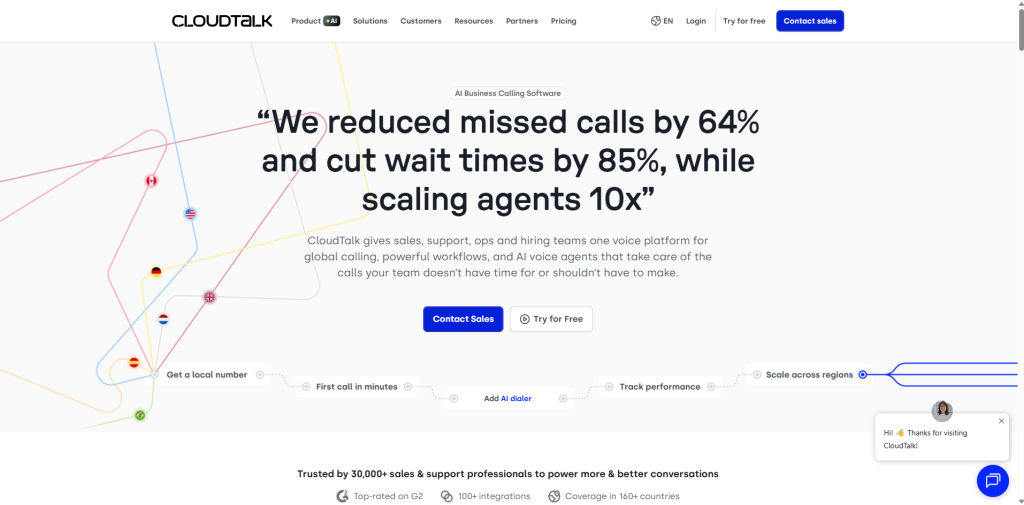
CloudTalk is a cloud-based business phone system designed to help growing teams manage their communications in one place. Its virtual receptionist handles inbound calls, answers FAQs, schedules meetings, and escalates complex issues to live agents without delays. It is a strong fit for SMBs and mid-market companies that need more than basic call routing. The platform stands out by combining autonomous call handling, deep native CRM integration, and conversation intelligence.
Key capabilities:
- Multilingual conversations: Handles full call flows across 35+ languages with genuine multi-turn dialogues instead of menu navigation.
- Smart call routing: Routes calls based on caller history, CRM data, agent availability, and detected intent.
- CRM integration: Native bidirectional sync with Zendesk, Intercom, Salesforce, and 100+ tools automatically pushes transcripts and tags to contact records.
- Workflow automation: Post-call actions like CRM updates, follow-up SMS, and ticket creation trigger automatically.
Best for: Businesses looking to scale their inbound call handling. It is a great choice for teams that want a reliable virtual receptionist deeply connected to their existing helpdesk or CRM platform.
Pricing: Base plans start at $25/user/month.
Integrations: Zendesk, Intercom, HubSpot, Salesforce, and 100+ more.
2. RingCentral: Best for a Proven, No-Code Setup
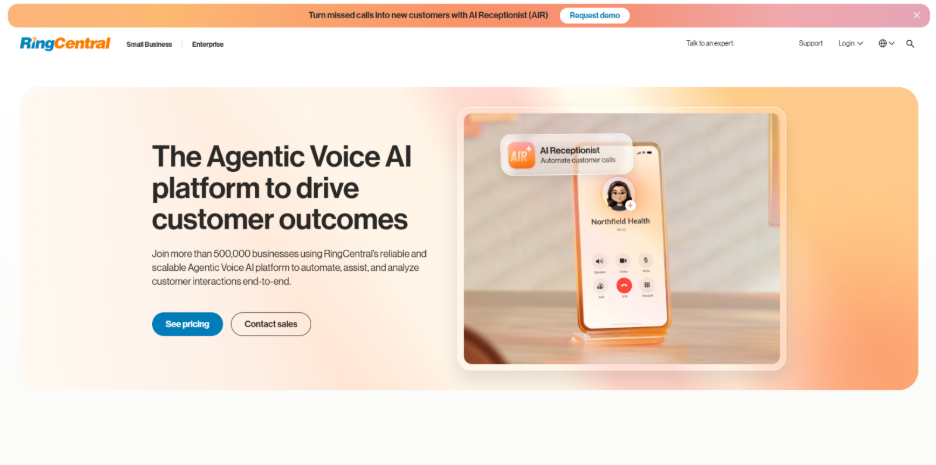
RingCentral is one of the most established UCaaS platforms globally. Its AI Receptionist (AIR) is a dedicated virtual receptionist tool that answers inbound calls in natural language, routes callers, books appointments, captures leads, and sends SMS follow-ups.
- Trains on your website and FAQs in minutes with no IT involvement needed.
- Answers calls in natural language, replacing rigid IVR menus.
- 99.999% uptime SLA, appropriate for mission-critical deployments.
- Calendar integration for booking appointments directly during the call.
Best for: Businesses already using RingCentral that want to add an AI receptionist without switching platforms, or companies seeking a fast, no-code setup backed by enterprise-grade reliability.
Pricing: Base plans start at $59/user/month.
Integrations: Salesforce, Microsoft Teams, ServiceNow, and 200+ more.
3. Smith.ai: Best for Small Businesses and Solo Operators
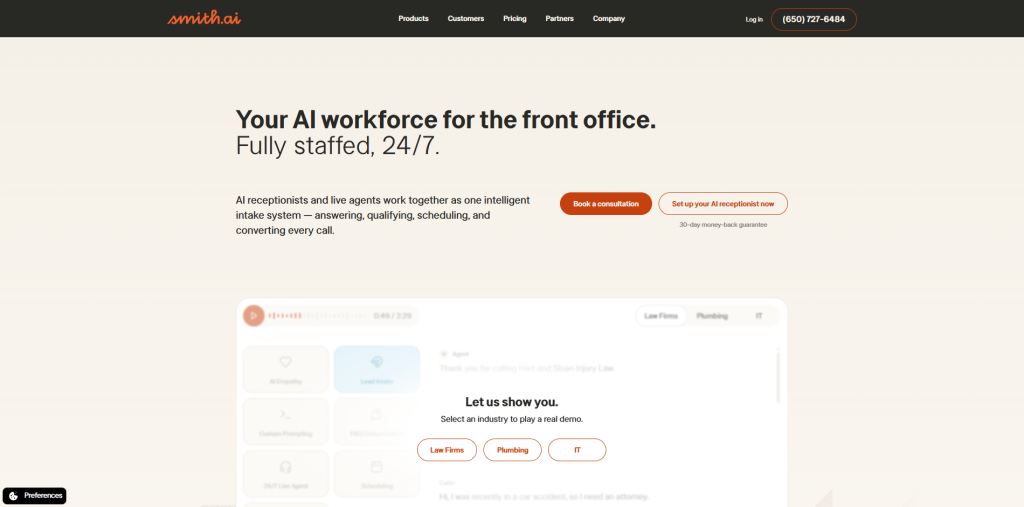
Smith.ai is a hybrid virtual receptionist service that combines live human agents with AI to handle inbound calls, live chat, and outbound follow-up. Unlike pure-software tools, Smith.ai always has human receptionists available as a fallback for calls the AI cannot resolve.
- 24/7 coverage combining AI and live human agents, ensuring no call goes to voicemail.
- Specializes in appointment booking, lead intake, and call screening.
- Charged per call, not per user or per seat.
Best for: Solo operators, law firms, medical practices, and small businesses that want full reception coverage without hiring staff. Particularly valuable for service businesses where every missed call is a direct revenue loss.
Pricing: Base plans start at $95/user/month.
Integrations: Clio, Salesforce, Zapier, and 30+ more.
4. Synthflow: Best for Agencies and No-Code Builders
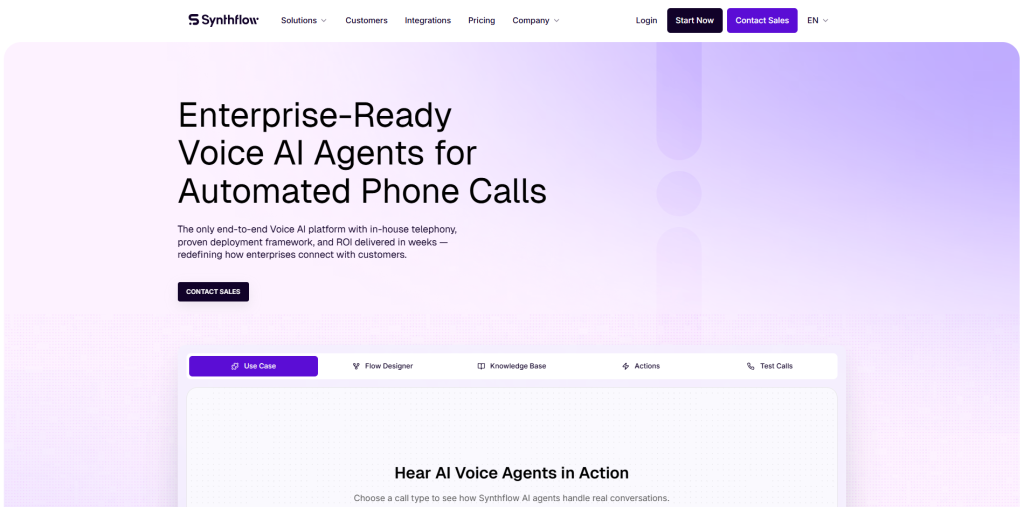
Synthflow is an AI-native voice agent platform designed for building and deploying virtual receptionists without writing code. It targets agencies, consultants, and businesses that want to create custom AI call flows through a visual interface and white-label the results.
- Visual no-code builder for designing full AI call flows and intake logic.
- White-label options let agencies deploy branded AI receptionists for clients.
- Connects to appointment tools, CRMs, and lead management systems.
- Supports 20+ languages with natural-sounding voice options.
Best for: Marketing agencies, consultants, and businesses that need a flexible AI receptionist builder with white-label capability.
Pricing: Custom pricing.
Integrations: HubSpot, GoHighLevel, Zapier, and 50+ more.
5. Bland AI: Best for Developers Needing High-Volume, Low-Cost Calls
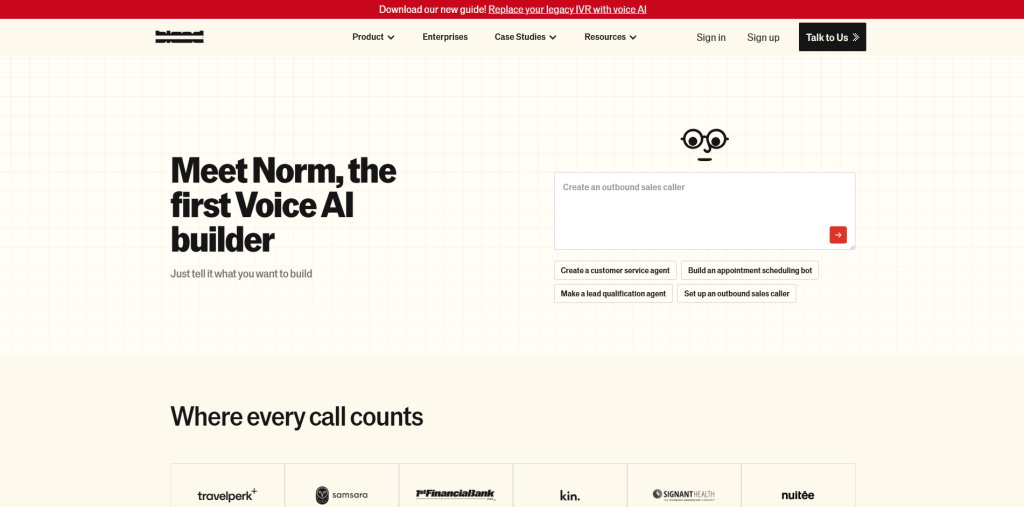
Bland AI is a developer-focused AI phone calling platform that enables businesses and engineers to build, deploy, and scale AI phone agents at incredibly low per-minute rates.
- Infrastructure-level AI phone platform built for high call volumes.
- Fully programmable via API, with support for custom logic and integrations.
- Among the lowest per-minute rates available for AI voice in 2026.
- Supports custom voice design, multilingual calls, and fine-tuned conversation flows.
Best for: Technical teams and developers building custom AI reception workflows at scale, or businesses with massive inbound call volumes needing cost-efficient automation.
Pricing: Custom, usage-based pricing.
Integrations: Custom via API and webhooks. Compatible with most CRMs through developer-built connections.
6. Dialpad: Best for Teams Already Using Google Workspace
Dialpad is a business phone platform that bundles AI features like real-time transcription and post-call summaries into its core product. It works well for teams that want a single vendor for calls and messaging and are already embedded in the Google ecosystem.
- Real-time transcription and post-call summaries reduce manual note-taking.
- Works natively with Google Workspace and Google Meet.
- Basic call routing and IVR configuration included.
Best for: Small teams already using Google Workspace that want a consolidated phone system with light AI assistance.
Pricing: Base plans start at $39/user/month.
Integrations: Salesforce, HubSpot, Google Workspace, and 70+ more.
7. Aircall: Best for Support Teams with Simple Routing Needs
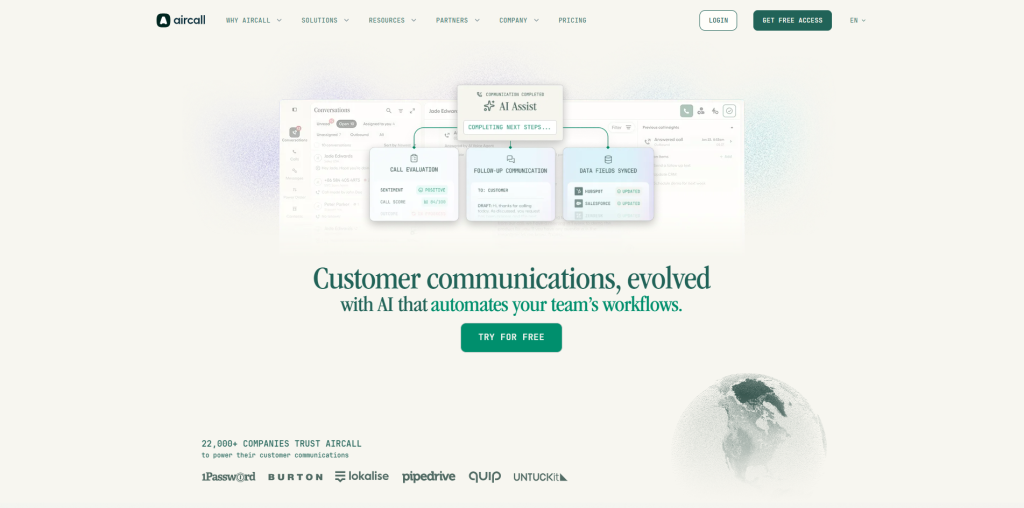
Aircall is a cloud phone system focused on customer support and inside sales. Its AI Voice Agent is an add-on that handles inbound calls, answers FAQs, and routes callers, though it is less autonomous than dedicated AI receptionist platforms.
- AI Voice Agent add-on handles inbound call answering and FAQ responses.
- Smart routing directs callers based on IVR selections and business hours rules.
- Clean, intuitive interface that is straightforward to onboard.
Best for: Customer support teams that want AI-assisted call management with a low-friction setup and do not need a fully autonomous, always-on AI receptionist.
Pricing: Base plans start at $30/user/month.
Integrations: HubSpot, Salesforce, Zendesk, and 100+ more.
Read Also: Best AI Voice Generator Trends That Will Shape
8. Vonage: Best for Developer-First Customization
Vonage offers a highly programmable communications platform. Its AI Virtual Assistant is built on Vonage AI Studio, a visual drag-and-drop builder that allows businesses to design custom voice AI call flows or build fully bespoke solutions via API.
- AI Studio enables custom virtual receptionist workflows beyond standard templates.
- Strong API and webhook capabilities for custom integrations.
- Standard business communications sit alongside the programmable layer.
Best for: Businesses with dedicated development resources that need highly tailored AI call handling beyond off-the-shelf templates.
Pricing: Custom, usage-based pricing.
Integrations: Salesforce, Microsoft Teams, Zapier, and 50+ more.
9. Google CCAI: Best for Large Enterprises on Google Cloud
Google Contact Center AI (CCAI) is an enterprise AI platform built on Google's Dialogflow, enabling sophisticated virtual agents capable of multi-turn dialogue, sentiment detection, and real-time agent guidance.
- Natural language understanding powered by Google's large language model infrastructure.
- Supports 30+ languages with high accuracy.
- Agent Assist provides real-time guidance to live agents during calls.
Best for: Large enterprises already running on Google Cloud that have the technical resources for a longer implementation and want access to best-in-class conversational AI infrastructure.
Pricing: Custom, usage-based pricing.
Integrations: Google Workspace, Salesforce, Zendesk, and enterprise-grade ticketing tools.
10. Numa: Best for Local and Multi-Location Businesses
Numa is an AI phone and messaging platform designed specifically for local businesses, including automotive dealerships, home services, and multi-location retail. It answers missed calls via SMS, books appointments automatically, and handles common customer questions.
- Automatically responds to missed calls via text, ensuring no lead goes cold.
- AI handles appointment booking and common FAQ responses.
- Multi-location management from a single dashboard.
Best for: Local service businesses, multi-location retailers, and automotive dealerships with high inbound call volumes and gaps in after-hours coverage.
Pricing: Custom, usage-based pricing.
Integrations: CDK, Reynolds and Reynolds, and major scheduling tools.
How We Evaluated the Top AI Virtual Receptionists
To narrow down a field of over 20 voice AI and communications platforms, we focused on practical business value rather than hype. Here is the exact criteria we used to select the tools on this list:
- Customer reviews and market presence: We analyzed verified customer feedback on major software review platforms like G2, Capterra, and Trustpilot to ensure these tools deliver reliable performance in real-world business environments.
- Conversational intelligence: We prioritized systems that use advanced natural language processing (NLP) to hold multi-turn, open-ended conversations, rather than legacy bots that force callers into rigid menus.
- Integration depth: A virtual receptionist is only useful if it talks to your existing software. We evaluated the quality of native integrations with major CRMs, helpdesks, and calendar applications.
- Time to value: We looked at the setup complexity. We included a mix of zero-code platforms that can be deployed in minutes and developer-focused tools that offer granular control, noting the technical requirements for each.
Why Are Businesses Adopting AI Virtual Receptionists in 2026?

Missed calls cost revenue. Research consistently shows that 62% of callers who reach voicemail do not leave a message. They simply hang up and call a competitor.
Businesses adopt AI virtual receptionists because they:
- Answer every inbound call instantly, regardless of time or call volume.
- Qualify leads before routing them to a human agent.
- Reduce the workload on front-desk and customer support staff.
- Lower operational costs relative to hiring additional reception staff.
- Deliver consistent, on-brand experiences at scale without training overhead.
For businesses with distributed teams, international customers, or high inbound call volumes, AI receptionists are no longer a luxury. They are a required operational tool.
What Should You Look for in an AI Virtual Receptionist?
Before committing to any platform, evaluate these key criteria:
- Natural language understanding (NLU): Can it handle open-ended questions, or is it restricted to structured menus?
- 24/7 availability: Does it operate reliably outside business hours and on weekends?
- CRM integration: Does call data sync automatically to your existing stack?
- Multilingual support: Can it serve customers in multiple languages natively?
- Escalation logic: Does it hand off to a live agent smoothly and contextually when needed?
- Analytics and reporting: Can you track call volumes, resolution rates, and performance?
- Setup complexity: Does the platform require developer resources, or can non-technical teams deploy it?
- Compliance: Does it meet GDPR, HIPAA, or other regulatory requirements relevant to your industry?
How to Choose the Right AI Virtual Receptionist
What is your business size?
- Small businesses (1 to 20 employees): Smith.ai or Numa offer reliable coverage with minimal setup and no IT involvement required.
- Mid-market (20 to 500 employees): CloudTalk or RingCentral provide the best balance of AI capability, CRM depth, and scalability.
- Enterprise (500+ employees): Google CCAI or RingCentral (at the enterprise tier) offer the compliance features, uptime guarantees, and customization large teams require.
What is your primary use case?
- Inbound lead qualification and CRM sync: CloudTalk handles lead capture, intent detection, and automatic CRM logging in one workflow.
- No-code setup on an existing phone system: RingCentral's AIR trains from your website and goes live in minutes.
- After-hours coverage for a small office: Smith.ai ensures every caller reaches someone, human or AI, around the clock.
- Agency or white-label deployment: Synthflow is built specifically for this model.
- High-volume developer-built flows: Bland AI offers the lowest per-minute pricing with full API control.
- Custom enterprise call flows: Google CCAI or Vonage are ideal for organizations with strict technical and compliance requirements.
Do you need multilingual support?
Language support varies significantly across tools. CloudTalk supports 35+ languages natively; Google CCAI supports 30+; Synthflow supports 20+. Most traditional VoIP platforms support 10 to 15 languages, while Smith.ai is English-only. If you serve international customers, this should be a primary selection criterion.
How important is CRM integration?
Integration depth varies more than buyers expect, especially when it comes to CRM integration. CloudTalk, RingCentral, and Smith.ai offer native CRM connections. Bland AI and Synthflow rely primarily on webhooks and Zapier, which require more setup. If you use HubSpot, Salesforce, or Pipedrive and want automated data syncs, verify that the CRM integration is native and bidirectional before buying.
Final Thoughts
The right AI virtual receptionist is the one that fits your workflow, not the one with the longest feature list.
For support teams in the SMB and mid-market space, CloudTalk and RingCentral are the strongest all-around choices. CloudTalk fits teams that want deep CRM automation and intelligence in a single platform, while RingCentral suits businesses wanting a fast, no-code setup with enterprise-grade reliability.
For small local businesses where every missed call is a lost appointment, Smith.ai or Numa deliver reliable coverage without the complexity. For agencies, Synthflow is the most flexible purpose-built option, and for developers needing low-cost infrastructure, Bland AI leads on price and programmability. Finally, for enterprises with deep technical resources, Google CCAI provides the most powerful underlying technology.
Match the AI capability to your actual call volume, language requirements, and integration stack, rather than defaulting to the most feature-rich platform your team will never fully use.
Frequently Asked Questions
Q1. What is an AI virtual receptionist?
An AI virtual receptionist is a voice AI system that answers business calls, responds to customer questions, routes callers to the appropriate team, and performs tasks like appointment booking or lead capture automatically, without human involvement.
Q2. Is an AI virtual receptionist better than a human receptionist?
An AI is better for handling high call volumes, providing 24/7 coverage, and automating repetitive tasks with consistent quality. Human receptionists remain better for complex, emotionally sensitive, or unusual interactions. Most businesses in 2026 use a hybrid model: AI for first-line call handling, and human agents for escalations.
Q3. How much does an AI virtual receptionist cost?
Costs range widely depending on the model:
- CloudTalk: Starts at $350/month per team (1,000 minutes).
- RingCentral: $59/month add-on (100 minutes).
- Smith.ai: Starts at $97.50/month (30 calls).
- Aircall: $0.99/minute add-on.
- Synthflow: Starts at $29/month.
- Bland AI: From $0.09/minute.
- Enterprise platforms (Google CCAI, Vonage): Custom pricing.
Q4. Can an AI virtual receptionist integrate with my CRM?
Yes, but integration depth varies. CloudTalk and RingCentral offer native, bidirectional sync with major CRMs like HubSpot and Salesforce. Synthflow and Bland AI connect via webhooks and Zapier, which offers flexibility but requires more setup. Always verify whether an integration is native or Zapier-dependent.
Q5. What languages do AI virtual receptionists support?
CloudTalk (35+), Google CCAI (30+), and Synthflow (20+) lead the pack. RingCentral and Dialpad support roughly 10 to 15 languages, while Smith.ai is English-only. Verify coverage for the specific languages your customers actually use.