






When companies implement a CRM system, they expect better team coordination and sales growth. Yet the mere presence of CRM does not guarantee results. Data accumulates daily. This includes not only contacts or call history, but also emails, deals, funnel stages, or reasons for rejection. Without systematic analysis, these records remain just a digital archive. When a corporation transitions from storing to analyzing information, it gains true value. CRM data analytics makes this transition possible by turning raw records into revenue-driving decisions. Converting data into useful insights is a realistic procedure. It also requires knowing how to transform numbers into specific decisions.
Modern CRM and the Role of Analytics in It
Modern approaches to CRM data analytics involve systematic work with historical and current data to predict results and optimize processes. Companies that invest in high-quality CRM analytics tools can see not only the status of deals, but also patterns:
- Which channels bring in the most solvent customers;
- Which managers consistently close deals faster;
- Which stages of the funnel create delays.
That is why integration and proper data export from a CRM are crucial. For example, if a team works with Pipedrive, it may need to automatically transfer data to Google Sheets, Microsoft Excel, or BI systems, particularly for deeper analysis. One example of this approach is using a Pipedrive connector, such as Coupler.io. It allows you to automatically import data from Pipedrive into other analytics tools. This approach enables regular data updates without manual exports. In turn, it reduces the risk of errors and opens up opportunities for systematic analysis. The tool supports configuring an automatic update schedule and selecting specific entities, allowing you to build detailed reports without additional technical development. In addition, the ability to filter and transform data during import helps prepare it for further visualization or integration with other sources within a unified analytical ecosystem.
What is Analytical CRM?
This question often arises among managers who want to move from operational to strategic use of the system. Analytical CRM is an approach in which customer data is used for:
- Segmentation,
- Behavior forecasting,
- Customer lifetime value assessment,
- Marketing and sales strategy optimization.
Analytical CRM differs from operational CRM in that it focuses on evaluating information rather than automating daily procedures. Its purpose is to extract actionable insights from data in order to make more informed judgments. Specifically, modifying sales scripts and changing price strategies. A strong CRM data analytics framework enables businesses to move from reactive decisions to proactive strategy.
Data in CRM that Really Matters
Take a look at the following list.
Sales Funnel
CRM records:
- How many deals move between stages;
- How much time is spent on each stage;
- Where the biggest losses occur.
These are some of the most common CRM analytics examples that demonstrate the practical value of the system.
By analyzing the conversion rate between stages, you can determine whether the problem lies in the lead quality or in the managers' work. If most deals get “stuck” at the presentation stage, this may signal a need to improve commercial offers or train the team.
Customer behavior data
- Communication history.
- Opening of letters.
- Responses to offers.
All of the above forms the basis for a deeper understanding of customers. If a company analyzes the actions that precede a successful deal closure, it can standardize these steps.
This is where the question of how to derive insights from data arises. It is necessary not just to look at reports, but to formulate hypotheses, test them, and verify them against real indicators.
Lead sources. Their quality
CRM allows you to link each deal to its source of attraction. This makes it possible to compare not only the number of leads, but also their profitability. Often, the cheapest channel does not bring the highest income. Only CRM data analytics helps to see the full picture:
- Average check,
- Sales cycle duration,
- Frequency of repeat purchases.
Such data helps to redistribute the marketing budget.
Tools for Turning Data into Solutions
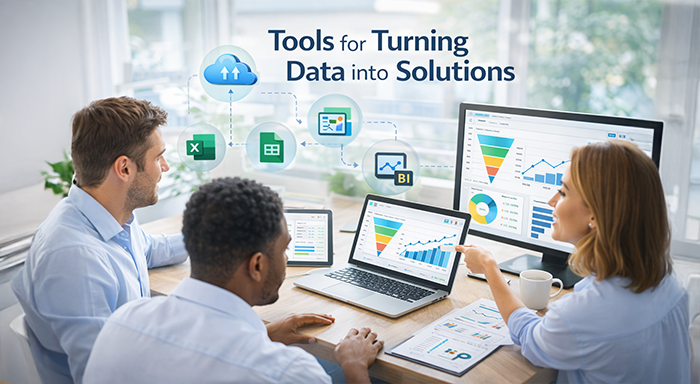
Most modern CRMs have built-in reporting dashboards. However, companies often use external CRM analytics tools for more complex analysis. These include BI platforms or specialized analytics solutions. They enable you to combine data from multiple sources, including CRMs, advertising accounts, and financial systems. It establishes a uniform platform for transforming data into useful insights. Looking ahead, technologies like quantum computing are beginning to reshape how CRM systems process large volumes of data, making real-time insights faster and more accurate than ever before. Analytics loses focus when key performance indicators are not clearly defined. The basic metrics that are worth tracking are:
- Average sales cycle;
- Conversion rate at each stage;
- Customer retention rate;
- Average revenue per customer;
- Projected revenue based on current deals.
Turn analytics into actionable steps
1. Identify bottlenecks.
If revenue is dropping, assess whether the cause is a decline in the quantity of leads, a drop in conversion, or an increase in the length of the sales cycle.
2. Customer segmentation.
You can adapt your communication to consumers by segmenting them based on industry, firm size, or behavior. CRM analytics examples demonstrate that personalized offers boost the likelihood of closing a deal since they address the customer's individual demands.
3. Forecasting. Planning.
If the system indicates that agreements of a given sort are often finished within 30 days, this enables for more precise cash flow planning. In this context, turning data into actionable insights entails making budget allocation decisions based on estimates and creating realistic team goals.
Conclusion
When a corporation analyzes data consistently and uses it to make clear management decisions, it achieves real outcomes. CRM data analytics solutions, including segmentation, funnel analysis, and forecasting, enable you to actively affect performance indicators. Transforming data into actionable insights requires dedication, critical thinking, and a willingness to adapt. When all decisions are based on verifiable data, the sales department obtains a strategic advantage. This is how CRM ceases to be a repository of information and becomes a tool for growth.