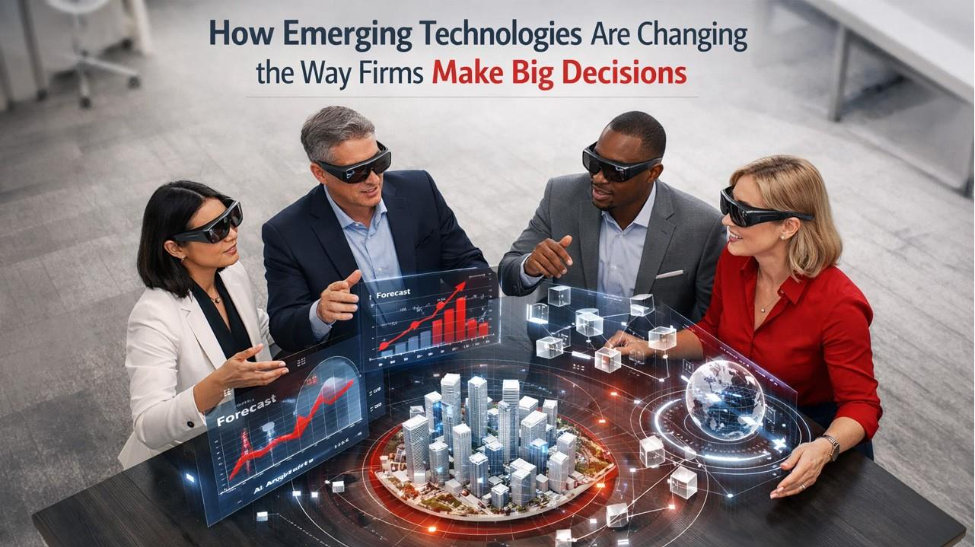






Big decisions used to rely heavily on experience, and static reports pulled together at the end of each quarter. Leadership teams gathered around spreadsheets, debated projections, and moved forward based on what they believed was most likely to work.
Emerging technologies are reshaping how firms think, plan, and act. Tools powered by AI, advanced analytics, automation, and real-time data systems now give decision-makers deeper visibility into performance, risk, and opportunity.
This article will dive deeper into learning more on how some small changes in organizations can define strategies, and how emerging technologies impact it.
Real-time intelligence over historical reports
For many decades, businesses strongly relied on historical reports to guide major decisions. Monthly sales summaries, quarterly financial statements, and annual performance reviews formed the backbone of strategic planning. These reports were useful, but they were always backward-looking.
Today, that model is changing. Emerging technologies allow firms to move from delayed reporting to real-time intelligence. Cloud-based dashboards, integrated data platforms, and advanced analytics tools pull information directly from operations as it happens.
This shift dramatically improves the quality of big decisions. Instead of reacting to problems after they escalate, firms can identify early warning signs and act immediately. Real-time intelligence also increases alignment across departments. This makes it easier for everyone to know what’s happening and find a solution every time there’s a problem.
AI and predictive decision-making
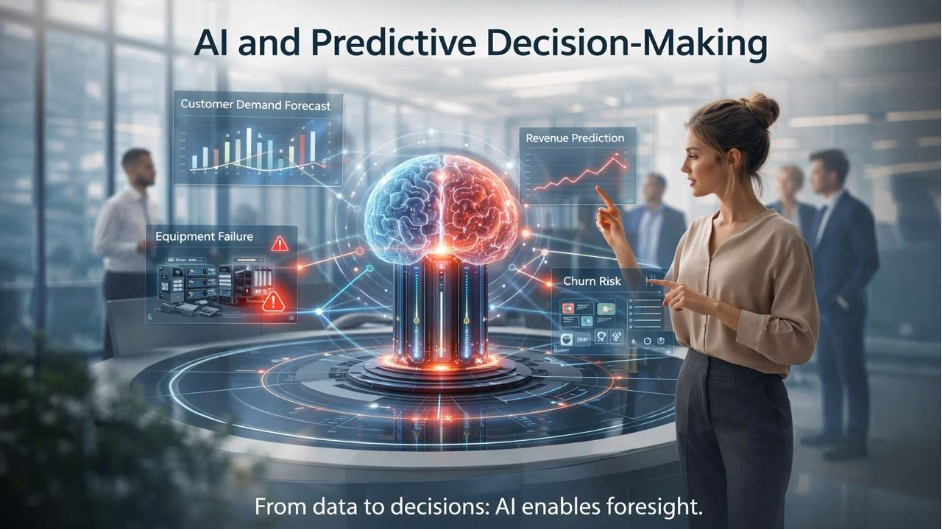
AI is changing decision-making from reactive analysis to a forward-looking strategy. Instead of simply explaining what happened, AI systems analyze large volumes of structured and unstructured data to identify patterns, detect anomalies, and forecast likely outcomes.
Overall, the global AI market size was around $371 billion. Predictive decision-making relies on machine learning (ML) models that continuously learn from new data. These systems can estimate customer demand, forecast revenue, anticipate equipment failures, or identify churn risks before they become bigger.
This transforms high-stakes decisions. It allows leaders to test scenarios before committing resources. For example, they can model how changes in pricing might affect demand, how disruptions in supply chains could impact margins, or how marketing investments might shift customer acquisition costs.
Big data and smarter risk management
Earlier, risk management relied heavily on periodic audits, limited datasets, and reviews that were carried out manually. Firms used historical performance and expert judgment to assess financial exposure and identify market threats.
However, large amounts of data are changing this dynamic. Today, organizations can gather tons of data from customer interactions, supply chains, and external market signals to analyze them for useful insights.
Let's understand with an example; abnormal or unusual patterns in transactions can signal potential financial fraud before it causes severe losses. Modifications in supplier performance data can highlight potential disruptions in the supply chain. Changes in the behaviors of customers can indicate merging reputational risks.
Big data also allows more precise risk modeling. Advanced analytics tools can simulate multiple scenarios, stress-test assumptions, and estimate the probability of different outcomes. Leaders can better understand not just what might go wrong, but how severe the consequences could be and which factors increase exposure.
Importantly, smarter risk management isn’t about eliminating risk entirely. Every major decision carry uncertainty. The goal is to make risks visible, measurable, and manageable across all domains of AI and analytics systems that firms rely on.
Blockchain, digital assets, and seamless cross-chain transfers to base
Blockchain technology is introducing a new layer of transparency and efficiency into how firms manage transactions, assets, and strategic partnerships. Unlike traditional systems that rely on centralized databases and intermediaries, blockchain networks use distributed ledgers that record transactions in a secure and tamper-resistant way.
Digital assets are a key part of this shift. These can include tokenized securities, stablecoins, digital contracts, and other blockchain-based representations of value. For firms, digital assets open new possibilities for raising capital, managing ownership, and settling payments through smart contracts.
As more businesses experiment with different blockchain ecosystems, moving assets smoothly between networks is no longer optional. It’s essential, and that’s why seamless cross-chain transfers to Base with DeBridge are becoming so important. They allow firms to transfer digital assets efficiently to Base, a scalable Layer 2 network built for lower fees and faster transaction speeds, without adding unnecessary friction or complexity to their operations.
This level of flexibility strengthens decision making. Leaders can evaluate transaction costs, performance metrics, and scalability requirements in real time, then shift assets accordingly. It reduces dependency risk and improves long-term planning because firms aren’t constrained by a single infrastructure choice.
As blockchain adoption continues to mature, cross-chain capabilities are becoming less of a tech upgrade and more of a competitive advantage. Businesses taking advantage of this into their strategy are going to be better positioned to operate more efficiently.
Data governance: running investment committees
As emerging technologies are changing the decision-making process, investment committees are now confronted with another challenge: how to make decisions with more data without losing clarity. Good data governance ensures that decisions made by the investment committees are not only well-informed but also consistent and transparent.
Running an effective investment committee today is much more than just reviewing financial projections. You need a structured approach to how your data is collected, validated, shared, and interpreted.
Meridian can show you how to run investment committees better, but here’s a short overview of what you need to know:
- Establish clear data standards: Every investment proposal should follow a standardized data framework. That includes consistent financial models, risk metrics, scenario assumptions, and performance benchmarks.
- Prioritize data quality and integrity: Data governance starts with trust. Investment committees should demand transparency about the source and creation of data. This is particularly important when investment proposals are based on predictive models or external market research.
- Separate data presentation from interpretation: One of the biggest mistakes in data governance is mixing raw data with persuasive stories. While context is important, investment committees should first look at raw data before looking at recommendations.
- Real-time dashboards for post-investment monitoring: Data governance doesn’t end when investment proposals are approved. Investment committees should also look at post-investment monitoring. Real-time dashboards can be particularly useful.
- Define roles and decision rights: Strong governance requires clarity around authority. Who validates the data? Who challenges assumptions? Who has final approval? Clearly defined roles prevent confusion and reduce political influence in high-stakes decisions.
Digital twins and scenario simulation
Digital Twins are transforming how firms plan, test, and optimize big decisions. A digital twin can be defined as an exact virtual replica of a physical system, process, or even an entire business operation. The physical system, process, or business operation is replicated virtually by using data from sensors, operational systems, and analytics platforms.
Scenario simulation is one of the strongest use cases for digital twins. Companies can avoid static forecasts and test various “what-if” scenarios in the virtual world. For instance, the company can use the same supply chain issues, demand fluctuations, or product rollouts to estimate the potential consequences in the virtual world.
Digital twins can also improve predictive decision-making processes. Companies can use real-time data inputs to track performance, detect anomalies, and forecast the results of various conditions.
Scenario simulation allows resource optimization, faster innovation, and more precise investment planning. Teams can test new product designs, operational changes, or pricing strategies in a low-risk environment. Much of this is made possible by cloud computing, which provides the scalable infrastructure needed to run these simulations continuously and at speed.
Automation and operational precision
Automation is redefining how firms execute tough operations and make strategic decisions. By eliminating repetitive and mundane processes through intelligent automation, organizations can decrease the likelihood of human error and increase productivity.
Sophisticated automation tools can be integrated into existing enterprise infrastructure to track processes, analyze data, and take actions programmatically. For instance, reconciliations, updates to inventory levels, or other processes can be performed in real-time without human intervention. This minimizes the chance for human error and ensures that decision-makers are making choices based on accurate and reliable information.
Automation also enables consistency. Standardized processes mean that important operations are executed the same way every time, regardless of team or location. When processes are predictable and reliable.
Moreover, operational precision improves accountability and transparency. Automated systems generate audit trails, log changes, and track performance metrics continuously. Leaders gain clear visibility into what actions were taken, when, and by whom; very important for regulatory compliance and risk management.
By combining automation with real-time data and predictive analytics, businesses can achieve a level of operational precision that supports smarter and faster decisions.
Emerging technologies are transforming decision-making from a process driven by intuition
Emerging technologies are strongly changing the way businesses make big decisions, moving the process from guesswork and hindsight to insight and foresight. AI, big data analytics, digital twins, automation, and blockchain, companies can see more clearly.
This shift isn’t just about technology, it’s about how businesses think and operate. Firms that embrace these tools can reduce risk, and make smarter investments. In today’s fast-moving world, emerging technologies aren’t just about being a nice-to-have, they’re important for making decisions that drive growth, and stay ahead of the competition.
Conclusion
Technologies in development are no longer relegated solely to the realm of the "innovation lab." They're fast becoming the foundation of the modern process of strategic decision-making. In an era of uncertainty, the ability to make better decisions is the ultimate competitive advantage for businesses that can leverage the power of real-time intelligence, AI-powered prediction, blockchain flexibility, and governance disciplines.