





Nowadays, business interactions are full of acronyms, and only a few of them lead to as much confusion as AI vs IA. When you first look at it, they look very similar. However, they, in fact, represent two diverse approaches to leveraging technology at work. One is related to machines working on their own. The other is related to machines helping people to act better. Getting this difference right is extremely important, specifically for teams assessing CRM platforms, software, or automation tools for their processes. In this blog, let us break down what AI vs IA is in simple terms, detail how each one operates, and showcase where businesses generally apply them.
What is AI vs IA?
Before comparing AI and IA, it is important to individually define them:
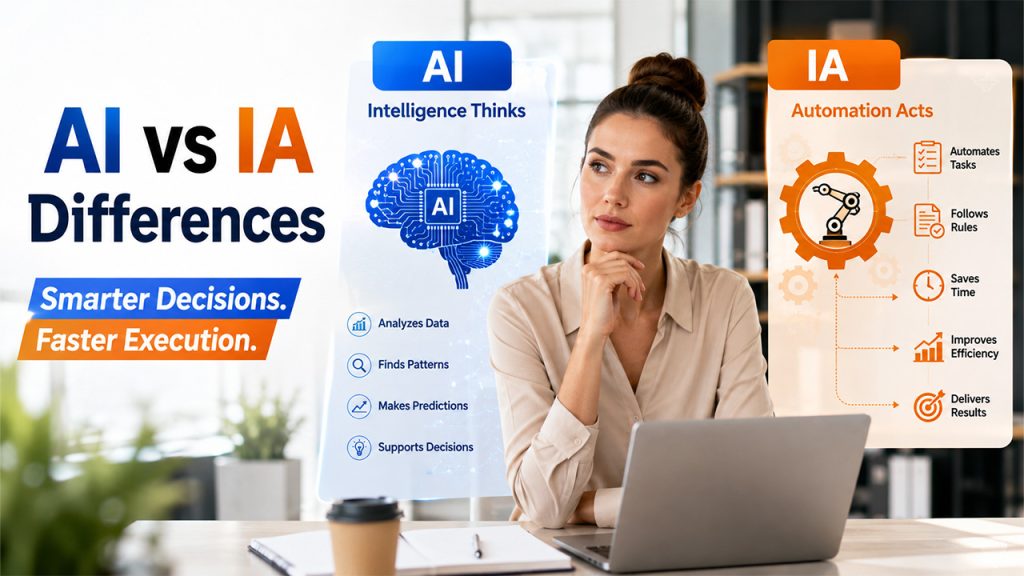
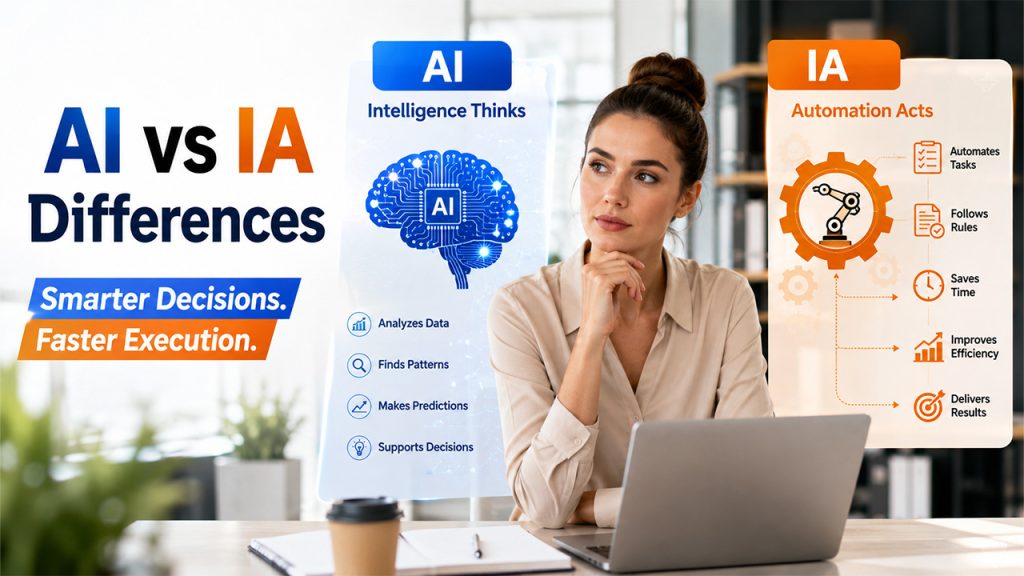
Artificial Intelligence (AI) is defined as systems created to perform tasks that would normally need human thought, like understanding language, recognizing patterns, and making predictions. AI platforms learn from information instead of following pre-written rules or fixed rules, which enables them to adjust as new data comes in.
On the other hand, Intelligent Automation (IA) integrates AI with automation technology to carry out routine business processes with little or no involvement of humans. Instead of just assessing data like what AI does, IA works on it, finishing tasks like updating records, routing tickets, or setting up workflows.
In short:
- AI is related to prediction and thinking.
- IA is about acting and executing.
Understanding AI vs IA at this fundamental level sets the stage for the rest of the comparison.
Read More: What Is Not Artificial Intelligence: Demystifying AI in 2026
AI vs IA: Main Differences
While AI and IA are relatable concepts, they are used for different purposes. Here is how they generally differ from one another:
- Focus – AI emulates human-like reasoning; IA simplifies and implements processes.
- Objective – AI focuses on making autonomous decisions; IA emphasizes enhanced efficiency.
- Human Involvement – AI can work with minimum oversight in specific tasks; IA is often created to minimize manual work while a human still keeps track of outcomes.
- Common Examples – AI comprises predictive analytics and natural language processing; IA entails automated lead routing and robotic process automation.
- Typical Goal – AI focuses on replacing specific manual judgement calls; IA focuses on improving overall productivity.
A straightforward way to remember the difference: AI gives you the intelligence, while IA applies this intelligence to routine work to ensure that it gets done quickly.
It is worth making note of the fact that a few sources leverage "IA" to mean Intelligence Augmentation instead of Intelligent Automation. This variation means leveraging technology to provide human decision-making instead of outright automating a task. Consider this a dashboard that reveals insights for a manager to work on, instead of a bot that finishes the action itself. Irrespective of whichever definition is utilized, the core idea remains consistent: IA extends or provides support to human effort, while AI mimics it.
AI and IA in CRM and Business Processes
Nowhere is the comparison of AI vs IA more practical than in CRM software. The majority of CRM platforms leverage both technologies together, even if the distinction is not always obvious to the end user.
Here is how the two generally show up in routine CRM use:
- AI assesses customer interactions with forecasts, which leads you to easily convert leads.
- IA then works on such predictions by assigning tasks automatically, sending follow-up emails, or updating pipeline stages.
- AI finds patterns in support tickets; IA directs them to the best team without manual sorting.
- AI creates content suggestions; IA deploys and schedules that content across different channels.
For instance, businesses that explore AI-driven tools such as ChatGPT integrated with CRM platforms are basically applying AI at the communication and content layer, while IA manages the operational side, such as automatically updating customer records and logging responses.
Similarly, when a business establishes CRM workflow automation, it is directly applying IA principles, since the objective is to remove manual steps such as task assignment, data entry, and reminder scheduling. AI generally feeds the intelligence that makes sure that these workflows are intelligent, such as understanding when a lead is ready for a sales call instead of following a fixed schedule.
Companies looking to integrate both technologies since their CRM must look at AI in CRM platforms created to automate feedback loops, since this indicates how AI-powered insights and IA-powered automation work side-by-side to enhance customer experience over time.
Selecting Between AI and IA for Your Organization
Instead of choosing one over the other, most of the organizations benefit from understanding where each technology aligns smoothly.
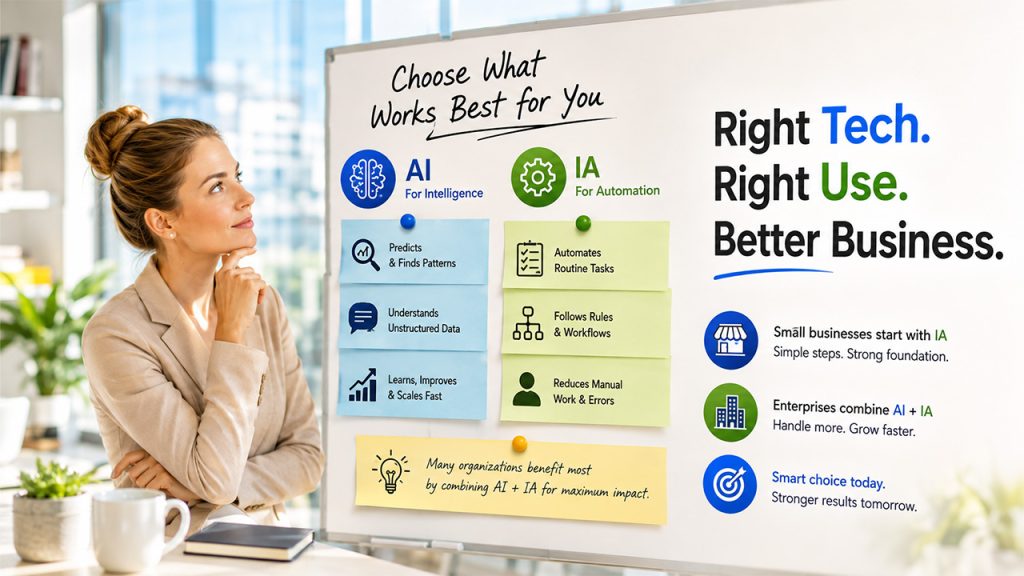
Leverage AI When:
- Tasks need prediction or pattern recognition.
- Decisions include unstructured data, such as customer messages or emails.
- Speed and scale are more important than manual oversight.
Leverage IA When:
- Processes are rule-driven and routine.
- The priority is minimizing administrative work and manual entry.
- Human oversight is still required for final decisions.
Smaller businesses generally begin with simple IA use cases, like task assignment or automated data entry, before layering in AI-powered features such as predictive scoring. Bigger businesses, specifically the ones handling support volumes or high sales, tend to include both from the outset. For businesses assessing an AI-driven CRM for small business use. The objective is often to look for a platform that already mixes such capabilities instead of separately adding them.
Conclusion
Comparing AI vs IA is not really about selecting a winner. Artificial Intelligence centralizes prediction and reasoning, while smarter automation puts this intelligence to work, executing tasks at scale. For the majority of businesses, specifically the ones on CRM platforms to handle customer relationships, the actual value comes from utilizing both technologies together. AI can be used to assess the data, and IA can be utilized to act on this data efficiently. As more and more platforms combine these technologies into one system, comprehending this distinction enables teams to select tools that genuinely fit how they work, instead of going for buzzwords
FAQs About AI vs IA
AI uses data to predict as well as reason. IA works on that intelligence to automate all the repetitive tasks.
A- Yes. AI extracts from customer data. IA automates actions such as follow-ups and lead routing.
A- No, it does not mean total automation. Essentially, IA means Intelligence Automation, where tech provides support to human decisions instead of replacing them.
A- Rule-based and routine processes call for IA first. Prediction via structured data needs AI first.