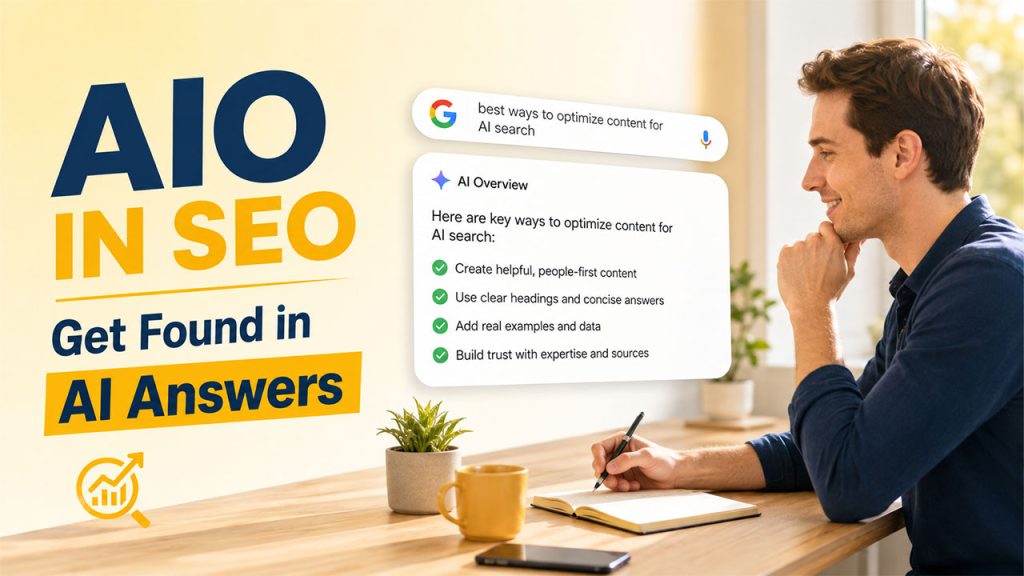






Someone types a question into Google. Within seconds, they get a detailed, well-written answer right there at the top of the results page. The answer is summarized in key points, and sources are cited, which prevents readers from scrolling down. They never click those blue links on result pages even though your article was probably one of the sources that the answer was built from.
It's becoming the default way search works and how people look things up on Google. And the reason is “AIO”. It has made its way firmly into SEO. Now you must be wondering what AIO in SEO actually means, and why it should influence the way you write content. Let's get into it.
What Is SEO?
SEO stands for Search Engine Optimization. At its core, it's the practice of improving a website so that search engines can crawl your website, understand it, and rank it on top when people search for related terms.
In a traditional sense, it means researching the right keywords, placing them naturally throughout your content, earning backlinks from trustworthy sites in your niche, and working on the technical SEO of your website, so that it loads fast and crawls easily. When you get these things right, you’ll climb the search engine results page (SERP) over time. For years, this technique worked well; however, that’s changing now.
If you're still fuzzy on how backlinks in SEO actually work, that's worth understanding before diving into how AI is reshaping search.
What Is AIO in SEO?
AIO stands for Artificial Intelligence Optimization. It refers to the practice of writing your content and shaping SEO strategy around how artificial intelligence (AI) now interprets search queries and generates responses, not just how it ranks links.
Let's understand this shift in simple terms: Earlier, search engines like Google used to match exact keywords. However, that is not the case anymore. Now, Google uses AI to actually understand the context of the query, what the person is really trying to find out, and then generates a direct, conversational answer instead of simply providing ten blue links. This is often delivered through what’s called an AI Overview.
This same shift is also driving a closely related practice called GEO (generative engine optimization), which focuses on getting content surfaced inside AI chat platforms.
Why AIO in SEO Matters for Modern Search

So, when people discuss “AIO in SEO”, they talk about two interconnected things: search engines generating AI-powered summaries of the web, and the optimization practice to make sure your content is good, clear, and trustworthy enough to appear in those summaries in the first place.
Let's think of it this way: If traditional SEO was about getting your restaurant listed in the phone book, AIO is about getting your dish recommended when someone asks a smart assistant where to eat.
The ground has already shifted, whether your strategy has caught up or not. A few things that are driving this change are:
- AI-Powered Search Engines Understand Content Better: AI doesn’t just match the exact keywords anymore; it now understands underlying meaning, context, and how ideas are connected to each other, much closer to how a person reads.
- Search Intent Now Matters More Than Keywords: Search results increasingly reflect what someone actually wants, based on context and behavior, rather than just the literal words they typed.
- AI Prioritizes High-Quality and Helpful Content: AI systems are evaluating things like readability, depth, expertise, and how genuinely useful a piece of content is, not just how many times a keyword shows up in the content.
To put it simply, AIO acts as a bridge between writing content that’s helpful to a human being and structuring it in a way a machine can easily find, summarize, and trust. If you miss one side of that bridge, you risk becoming invisible even if your content is excellent. Content that neither humans nor AI could find easily serves no purpose.
Key Benefits of AIO in SEO for Websites and Businesses
Let's look at the biggest advantages AIO brings to modern SEO and content optimization.
Improve Visibility in AI-Powered Search Results: If you align your content with the way AI systems interpret and summarize information, it’ll improve your odds of showing up in AI Overviews. This means your brand can appear in results even when users never click through to a traditional link. It is the visibility that you cannot achieve with traditional rankings alone.
Boost SEO Efficiency with AI Automation: AI-assisted tools handle time-consuming groundwork like keyword clustering, content audits, and competitor research. That frees up hours that would otherwise go into manual, repetitive analysis. You get time to plan your strategy and think of creative ways or ideas.
Build a Future-Proof SEO Strategy: Search is leaning further into AI with each update, not less. Building AIO into your content practices now means you're adapting ahead of the curve. It's far easier than struggling to catch up once the shift is already complete.
Deliver a Better User Experience with AIO: Content built with AIO in mind tends to answer real questions clearly and directly, without unnecessary, irrelevant details. That clarity is equally useful to both human readers and AI systems. It helps them scan for answers faster. Good AIO content and good user experience end up being the same thing.
AIO in SEO vs Traditional SEO: Key Differences Explained
The contrast becomes clearer when laid out side by side:
| Traditional SEO | AIO in SEO |
| Centers on keywords and backlinks | Centers on intent, context, and AI-driven insight |
| Mostly manual optimization | AI-assisted research and automation |
| One-size-fits-all content | Personalized, user-focused content |
| Reactive; adjusts after algorithm changes | Predictive; adapts ahead of how AI interprets content |
| Success measured mainly by click-through rate | Success also measured by visibility inside AI-generated answers |
Neither of them replaces the other, and it is worth mentioning because many people misinterpret this as “SEO is dead”. Well, it isn’t. Backlinks, technical performance, and quality content still hold up. AIO doesn’t tear down the foundation; rather, it adds a new layer to the top of it. This layer is built for an internet where AI reads your content first, and then it goes to humans.
How AIO in SEO Is Used to Optimize Content

Here are the practical ways businesses and marketers are already using AIO to improve SEO performance.
Structure Content for Better AI Extraction: First, structure your content by using clear headings, precise answers, and concise summaries, so AI systems can quickly extract key points instead of digging through dense paragraphs.
AI-Assisted Research and Topic Clustering: Tools like Surfer SEO, Clearscope, and MarketMuse use AI to group related keywords, identify gaps in content, and analyze competitor pages far faster than manual research ever could.
Semantic SEO Instead of Keyword Stuffing: Build your content around the full meaning and understanding of a topic rather than stuffing it with a keyword for ranking’s sake. This will be increasingly helpful since AI systems are designed to understand context, not just match words.
Strengthen E-E-A-T Signals for AI Trust: Author bios, cited sources, and real experience get woven into pages deliberately, because AI systems weigh trustworthiness and expertise heavily when deciding what to summarize or cite.
Track AI-Driven Search Visibility: Beyond tracking rankings, teams now check whether their content is actually appearing inside AI Overviews and generated answers, since that's becoming its own measure of success. Several AI SEO tools now built specifically for this purpose, tracking exactly how often a brand shows up in AI-generated answers.
These practices are not about chasing evolving algorithms. Rather, they are about making sure both people and AI can find your content, understand it, and trust it enough to recommend it to others.
The Future of AIO in SEO and AI-Powered Search
Nobody can predict the future, but there are a few things that feel pretty safe to expect soon. AI Overviews aren’t going away, and they’re only going to get better at answering questions directly. This means assuming ranking first alone is enough will be fading fast. What's coming next is not about chasing algorithms; rather, it is about building real trust that can’t be faked by AI and won’t be skipped over. Voice search, smarter assistants, and even more personalized results are all part of this same wave. The businesses that treat this as a long game, not a quick fix, are the ones who'll still be visible five years from now.
Conclusion
AIO was never the replacement for SEO, and it isn’t some passing trend either. It's what SEO naturally becomes once search engines stop simply indexing the web and start actually reading and understanding it in the same way a genuinely well-informed person would. The fundamentals that you already know like backlinks, quality content, real expertise, and a technically sound website, aren’t going anywhere. What's changed is who or what is reading them first. Businesses that treat AIO as an extension of good SEO, not a separate discipline, will be the ones still showing up when the answer is generated instead of just listed.
FAQs About AIO in SEO
AIO stands for Artificial Intelligence Optimization. It's the practice of shaping content and SEO strategy around how AI interprets, summarizes, and presents search results to users today.
No. AIO builds on traditional SEO rather than replacing it. Backlinks, technical performance, and content quality still matter; AIO just adds an AI-focused layer on top.
AIO can reduce click-through rates since AI Overviews often answer queries directly on the search page. Visibility inside those AI-generated summaries becomes increasingly important.
E-E-A-T stands for experience, expertise, authoritativeness, and trustworthiness. AI systems favor content showing these qualities when generating and sourcing summarized answers.
Focus on clear structure, genuine expertise, semantic depth, and diverse content formats. This makes content easier for AI systems to understand, trust, and feature.