





An AI-based SDR for lead generation should do more than add names to a list. The best ones find the right accounts, spot when a buyer is ready, qualify them and get a meeting on a rep's calendar without someone triaging every lead by hand.
This guide compares eight AI SDRs for lead generation and conversion in 2027: where their leads come from, how they qualify them, what they cost and where each one fits.
TL;DR
- Mid-market B2B teams with steady website traffic: Breakout, which identifies visitors, acts on 700+ buying signals and books meetings in-session.
- Outbound volume plus fast inbound callback: 11x.
- Outbound run by an AI BDR with built-in lead data: Artisan.
- Salesforce-centric teams converting inbound demand: Qualified.
- HubSpot-centric teams that want visitor identification: Warmly.
- Signal-based outbound with reps approving every send: Amplemarket.
- Small teams starting outbound on a budget: Apollo.io.
- Form-heavy inbound teams: Chili Piper.
Quick-pick summary
| Tool | Best for | Lead source | Starting price |
| Breakout | Mid-market B2B with steady website traffic | Inbound plus signal-based outbound | Signals $500/mo; Growth $2k/mo |
| 11x | Outbound volume plus fast inbound callback | Outbound and inbound | Alice from $3,750/mo, billed annually |
| Artisan | Outbound run by an AI BDR | Outbound, with inbound chat as an add-on | Custom |
| Qualified | Salesforce-centric teams | Inbound | Custom |
| Warmly | HubSpot-centric teams | Inbound | From $10,000/yr |
| Amplemarket | Signal-based outbound with rep approval | Outbound | Startup $600/mo |
| Apollo.io | Small teams starting outbound | Outbound | Free plan; paid plans per user |
| Chili Piper | Form-heavy inbound teams | Inbound | From $1,250/mo |
What is an AI-based SDR for lead generation?
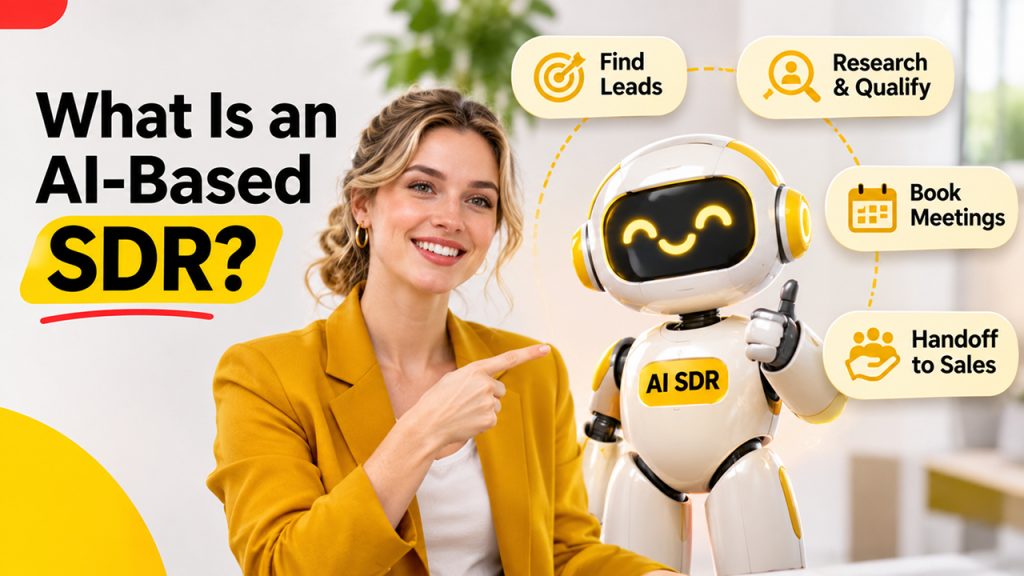
An AI-based SDR for lead generation is software that does the work of a sales development rep: it finds leads, researches them, starts conversations, qualifies them and hands the good ones to sales. It uses large language models to make the judgment calls a person used to make, and it reads from and writes to your CRM, calendar and enrichment tools.
The work breaks into six functions: engagement, research, qualification, routing, handoff and follow-up. Research, qualification and routing are what separate an AI SDR from a basic outreach tool, because those are the steps that decide which leads are worth a rep's time.
AI SDRs generate leads in two ways. Outbound AI SDRs find prospects who haven't engaged yet, using contact databases and buying signals. Inbound AI SDRs work the people already showing interest, such as website visitors, form fills and returning accounts, and convert them into meetings.
Top AI-based SDRs for lead generation compared in 2027
The quick-pick table above shows who each tool suits and what it costs. The comparison below goes a level deeper into how each one generates and converts leads: where its leads come from, how it qualifies them, which channels it works and how it hands leads to sales.
| Tool | Lead sources | How it qualifies | Channels | Handoff to sales |
| Breakout | Website visitors at person and account level, 700+ third-party signals, your CRM | In-session conversations, checked against CRM state | Web chat, email, LinkedIn | Books meetings with the right owner |
| 11x | A real-time company and lead database, signals, inbound calls and chats | Alice researches prospects; Julian qualifies inbound leads in real time | Email, social and rep calls; voice, chat, SMS and WhatsApp | Books meetings or transfers to a rep |
| Artisan | A 250M+ B2B contact database, intent signals, website visitors | A research agent checks each lead against your qualification criteria | Email and social; reps make the calls | Books meetings on reps' calendars |
| Qualified | Website visitors and your CRM data | Piper qualifies buyers in conversation | Web chat, voice, video, email | Piper Meetings books; routing sends leads to reps |
| Warmly | Website visitors at company and person level | ICP filtering; AI qualification on the top plan | Chat, email, retargeting via LinkedIn and ads | Alerts and routes leads to reps |
| Amplemarket | A 200M+ contact database and buying signals | Duo researches each signal and drafts outreach | Email, social, phone, voice notes, WhatsApp | Reps review, send and book |
| Apollo.io | A database of 240M+ contacts and 30M companies | The AI Assistant finds and qualifies prospects against your saved context | Email sequences and a built-in dialer | Reps run sequences and book |
| Chili Piper | Form fills and website chat | Concierge qualifies form submissions | Forms, chat, scheduling | Routes to the right rep and books the meeting |
1. Breakout — AI-based lead generation across inbound and outbound
Breakout finds leads in two places: the visitors already on your website and the accounts showing buying signals elsewhere. It identifies, enriches and qualifies both, then puts meetings on the right rep's calendar.
Best for: B2B teams with steady website traffic that want more qualified leads without adding SDRs.
Lead sources:
- Website visitors, identified at person and account level.
- 700+ third-party signals, such as hiring, funding, tech-stack changes and champion job moves.
- First-party signals, such as pricing-page visits and return visits.
How it qualifies:
- Every lead is matched against your CRM (open opp, closed-lost, customer, owner) and enriched through waterfall enrichment and buying-group identification.
- The Inbound Agent qualifies visitors in conversation while they're still on your site.
- The 1:1 Account Agent keeps a living dossier per account, refreshed with earnings calls, hiring, news and org changes.
Handoff to sales: The Inbound Agent routes qualified visitors and books meetings with the right owner, and the Outbound Agent follows up over email and LinkedIn. Spoc directs all three agents from one brief, and your team approves what ships.
Pricing: Signals starts at $500/mo with 5 seats and covers identification and enrichment. Growth starts at $2k/mo with 12 seats and adds the AI SDR, routing and scheduling. Enterprise is custom. Signals includes a free trial with no credit card required.
Limitations:
- Lead qualification and booking need the Growth plan.
- Outbound is driven by signals and site visits, so it isn't designed for high-volume list prospecting.
- Outreach runs on web chat, email and LinkedIn, with no phone or SMS channel.
Choose it when: you want your highest-intent leads, on your site and in the market, found and qualified automatically.
2. 11x
11x generates leads with Alice, an outbound agent, and captures them with Julian, an inbound agent for calls, chat, SMS and WhatsApp.
Best for: Teams that need a steady flow of net-new outbound leads and fast response to inbound ones.
Lead sources:
- A real-time company and lead database, with live web search and AI prospecting.
- Signal-based triggers, plus plays for nurture, reactivation, closed-lost deals and website visitor retargeting.
- Inbound calls, chats and contact-sales form submissions.
How it qualifies:
- Alice researches each prospect before writing personalized outreach.
- Julian qualifies inbound leads in real time across voice, chat, SMS and WhatsApp.
Handoff to sales: Alice books meetings from replies. Julian calls back form fills within a minute, then books a meeting or transfers to a rep.
Pricing: Alice starts at $3,750/mo billed annually and is priced per lead rather than per send. Julian starts at $2,417/mo for chat and $5,333/mo for voice.
Limitations:
- Contracts are annual, and buying starts with a demo.
- Outbound and inbound agents are priced separately.
Choose it when: your pipeline depends on outbound volume and you also want inbound leads called back fast.
3. Artisan
Artisan's AI BDR, Ava, builds lead lists from its own B2B database, works them through email and social, and books meetings.
Best for: Teams that want an AI BDR to own outbound lead generation end to end.
Lead sources:
- 250M+ verified B2B contacts, plus local-business data.
- Intent signals, such as funding, hiring and job changes.
- Website visitors, identified at person level in the US and company level globally.
How it qualifies:
- A research agent checks each lead against your qualification criteria.
- Waterfall email and phone enrichment fills in contact details.
Handoff to sales: Ava replies to prospects, handles objections and books meetings on reps' calendars. Reps take calls through the built-in dialer, with a brief before each call.
Pricing: Custom, scoped by lead volume: about 2,500 leads contacted per month on Team and about 6,000 on Scale.
Limitations:
- Prices aren't published.
- Ava doesn't place calls; reps do.
- Inbound website chat (Ava Inbound) costs extra.
Choose it when: you want one platform to source, enrich and work outbound leads with little manual effort.
4. Qualified
Qualified focuses on the conversion side of lead generation: its AI SDR, Piper, turns website visitors into qualified pipeline. Salesforce completed its acquisition of Qualified on April 1, 2026.
Best for: Salesforce-centric teams with strong website traffic.
Lead sources: Website visitors and inbound leads, enriched with your CRM data.
How it qualifies: Piper engages visitors by video, voice or live chat and qualifies them in conversation, while Agentic Nurture keeps working top-of-funnel leads.
Handoff to sales: Piper Meetings books meetings, Piper Email follows up in the inbox, and routing and alerts send conversations to reps.
Pricing: Custom, across Premier, Enterprise and Ultimate plans.
Limitations:
- Lead generation is inbound only.
- It's most at home in a Salesforce stack.
Choose it when: your leads arrive on your website and your team runs on Salesforce.
5. Warmly
Warmly turns anonymous website traffic into named leads, then alerts and routes them to your team. On June 30, 2026, HubSpot announced it has agreed to acquire Warmly.
Best for: HubSpot-centric teams that want to see who's on their site.
Lead sources: Website visitors at company and person level, with retargeting via email, LinkedIn and ads to bring them back.
How it qualifies: ICP filtering on every plan, with AI qualification and an Autopilot agent on the top plan.
Handoff to sales: Real-time and Slack alerts, lead routing and CRM sync, plus an AI chatbot and Warm Calling live chat on the Inbound Chat plan.
Pricing: AI Web-Deanonymization starts at $10,000/yr ($4,875/quarter), Inbound Chat at $20,000/yr and AI Inbound Autopilot at $30,000/yr.
Limitations:
- Person-level matches typically cover 5–20% of visitors, by Warmly's own figures.
- On the entry plan, leads arrive as alerts that a rep has to work.
Choose it when: you want named website visitors flowing into HubSpot with alerts and routing.
6. Amplemarket
Amplemarket finds leads through buying signals and drafts outreach for reps with its AI copilot, Duo.
Best for: Sales teams that want signal-led prospecting while reps stay in control of every send.
Lead sources: A database of 200M+ contacts, plus daily signals such as champion job changes, closed-lost prospects, competitor reviews, website and profile visits, funding and hiring. Custom signals can come from your CRM or API.
How it qualifies: Duo researches the context behind each signal and learns from reps' edits and dismissals.
Handoff to sales: Reps review Duo's drafts, then send sequences across email, social, phone, voice notes and WhatsApp.
Pricing: Startup is $600/mo for 2 users on an annual term; Growth and Elite are custom. Every plan has a free trial.
Limitations:
- A rep has to approve and send every message.
- Only the Startup plan has a published price.
Choose it when: you want an AI copilot surfacing the right leads each day, with reps making the final call.
7. Apollo.io
Apollo is a self-serve lead database with built-in outreach, plus an AI Assistant that runs prospecting workflows from a plain-language goal.
Best for: Small and growing teams building their first outbound lead engine.
Lead sources: A database of more than 240 million contacts and 30 million companies, plus inbound lead management.
How it qualifies: The AI Assistant finds and qualifies prospects against your saved company and product context, with users deciding when it runs.
Handoff to sales: Reps run email sequences, make calls from the built-in dialer and book meetings through Apollo's scheduler.
Pricing: Free plan; paid plans (Basic, Professional and Custom) are priced per user.
Limitations:
- Reps drive the outreach; the AI assists rather than holding conversations itself.
- Usage credits on paid plans add cost as prospecting grows.
Choose it when: you want lead data and outreach in one affordable tool you can start on your own.
8. Chili Piper
Chili Piper makes sure inbound leads don't stall between the form and the meeting: it qualifies, routes and schedules them, and adds an AI chat agent for website visitors.
Best for: Inbound teams with heavy form volume and many reps.
Lead sources: Form fills from your website, in-app and other sources, plus website chat.
How it qualifies: Concierge qualifies form submissions against your rules before routing them.
Handoff to sales: Leads go to the right rep and book instantly. Distro handles Salesforce record routing with SLAs, and Handoff automates SDR-to-AE handoffs.
Pricing: Routing & Scheduling starts from $1,250/mo.
Limitations:
- Visitor identification is company level only, and in beta for chat.
- It converts leads you already have rather than generating new ones.
Choose it when: your leads come through forms and speed-to-meeting is the bottleneck.
Lead generation vs lead conversion: where AI-based SDRs add the most value
Lead generation fills the top of the funnel; lead conversion turns that interest into meetings. AI-based SDRs help with both, but the value shows up differently.
Lead generation means finding people who haven't raised their hand yet. AI SDRs do this by searching contact databases, watching buying signals such as funding rounds, hiring and job changes, and sending personalized outreach at the right moment. The challenge is attention: generating a message is cheap now, but buyers' inboxes are crowded, so timing and relevance matter more than volume.
Lead conversion means acting on people who are already showing interest: a visitor on your pricing page, a form fill, a returning account. Here the buyer's attention is already yours, and the challenge is speed. A conversation that happens while the buyer is still on your site converts better than a follow-up email the next day.
That's why conversion is often the quicker place to start. The leads are already there, and the AI's job is to engage them before they leave. Signal-based outreach then extends the same approach to accounts that are researching but haven't visited yet.
How AI-based SDRs qualify leads before handoff to sales
Good qualification decides two things: which leads deserve a rep's time, and which ones don't. Most AI SDRs work through the same steps.
- Identify the lead. For a form fill, identity is given. For an anonymous website visitor, the AI resolves the company and, where possible, the person.
- Research the lead. It adds firmographics and signals such as company size, industry, funding, hiring and tech stack, then checks your CRM. A lead that's already an open opportunity, a closed-lost deal or a customer with an owner needs different handling from a brand-new one.
- Qualify in the conversation. In chat or by email, the AI asks the questions your reps would ask and checks the answers against your ideal customer profile.
- Decide what happens next. It books a meeting, keeps the conversation going, escalates to a person or closes the lead out.
- Hand off with context. The rep gets the conversation, the research and the reason the lead qualified, so they can pick up without starting over.
Disqualification matters as much as qualification. A wrongly escalated lead costs a rep a few minutes; a wrongly disqualified lead is lost without anyone noticing. Ask every vendor how its AI decides a lead isn't a fit, and how you can adjust that threshold.
How to evaluate an AI-based SDR for lead generation: data sources, qualification logic, setup time
Data sources. Ask where the leads come from. Some tools rely on large third-party contact databases, others on buying signals, and others on your own first-party data: website visits, CRM history and past conversations. Third-party data is available to every competitor using the same tool; your first-party data isn't. The strongest setups combine both, so outreach is timed by real intent rather than a static list.
Qualification logic. Ask what the AI does before it writes or replies: which sources it checks, how it scores fit and when it hands a lead to a person. Ask to see ten real conversations, not one polished demo, and check how it handles a pricing question, an objection or a request to talk to a human.
Setup time. Count the steps: connect your CRM and calendar, define what qualifies and what doesn't, set routing rules and go live. Ask whether onboarding is included and whether you can trial it first. Breakout and Amplemarket offer free trials and Apollo has a free plan; 11x, Artisan and Qualified sell through sales-led contracts.
Deliverability, for outbound. If the AI sends cold email, check how it manages domains, warmed inboxes and sending limits. Scaling by sending more from each inbox can damage your domain reputation.
The verdict
The right AI-based SDR depends on where your leads come from. If you need net-new leads from lists, 11x, Artisan, Amplemarket and Apollo.io are built for that. If your website already brings in demand, the bigger win is converting it, and Breakout does both: it identifies and qualifies visitors in-session, acts on 700+ buying signals and books meetings without manual triage.
If you want to test Breakout on your own traffic, its Signals plan comes with a free trial.
Pricing and features as of October 23, 2026, based on publicly available information. Confirm current pricing with each vendor.
Frequently asked questions (FAQs)
It's software that does the work of a sales development rep: finding leads, researching them, starting conversations and handing qualified ones to sales. It qualifies by combining research, such as firmographics, buying signals and your CRM history, with questions in the conversation, then checks the answers against your ideal customer profile before booking a meeting or routing the lead.
It depends on the lead. AI SDRs respond instantly at any hour and stay consistent across thousands of conversations, which helps most where speed matters, such as website visitors and new form fills. Human SDRs are still better at uncovering problems a buyer hasn't put into words, building rapport with senior buyers and handling unusual objections. Most teams get the best conversion by letting the AI handle first response and qualification, and routing high-intent, high-fit leads to reps.
Some can. Breakout covers both with separate Inbound and Outbound agents directed by one orchestrator. 11x pairs Alice for outbound with Julian for inbound calls and chat. Artisan's Ava runs outbound, with inbound chat available as a separately priced add-on. Tools such as Qualified and Chili Piper focus on inbound, while Apollo.io and Amplemarket focus on outbound.
Most combine three kinds of data: third-party contact databases (Apollo.io, Artisan and Amplemarket each include one of 200M+ contacts or more), buying signals such as funding, hiring and job changes, and first-party data such as website visits and CRM records. Enrichment tools fill in missing details, often by checking several providers in turn.
Often within weeks. Ketch went live on Breakout within days and generated 150+ leads in under three months, and Barti saw 19% additional pipeline influenced by Breakout in its first three months. Outbound tools need time to warm up sending domains, and 11x lists standard onboarding at two weeks.